
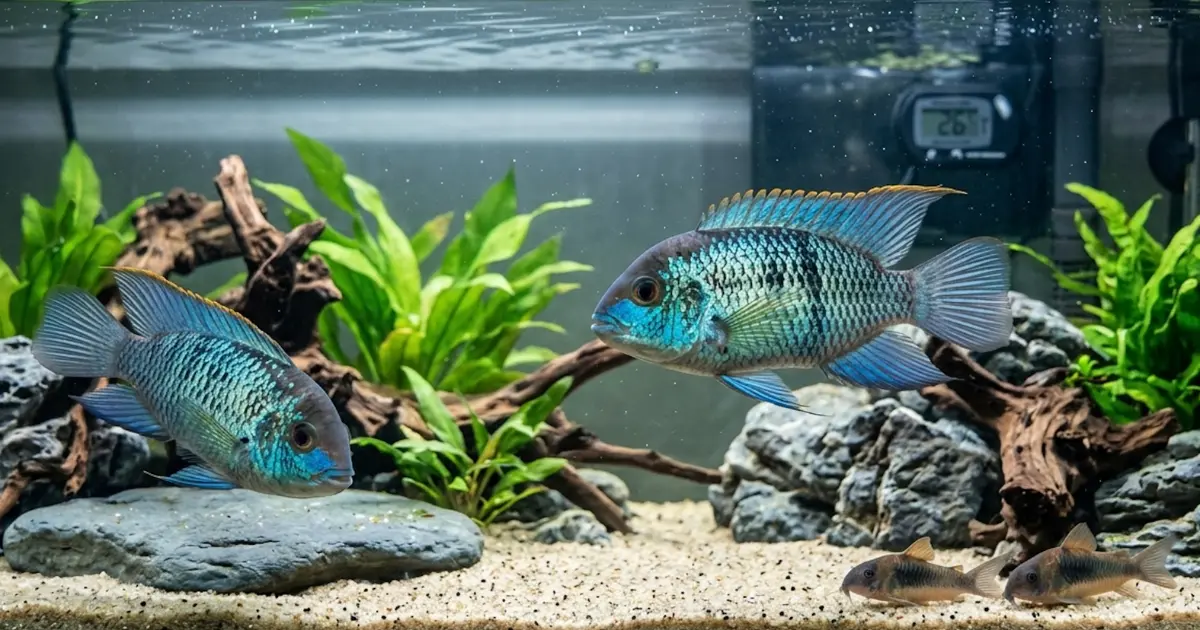
Blue Acara Fish (Andinoacara pulcher) belong to the massive Cichlidae family. They originate exclusively from the slow moving rivers of South America. Consequently, these fish demand stable tropical temperatures to thrive. Many casual hobbyists purchase them solely for their brilliant metallic coloration. These impulsive buyers frequently underestimate their spatial requirements. Therefore, this guide relies upon verifiable scientific evidence to help you learn how to maintain their environments safely.
Physical Features of Blue Acara Fish
Their oval shaped bodies and distinct iridescent scales define their anatomy. Specifically, Blue Acara Fish display a predominantly blue grey background covered in metallic spangles. They feature a highly distinct dark horizontal stripe running across their flanks. Males generally develop slightly longer, more pointed dorsal fins than females. Therefore, this subtle sexual dimorphism allows aquarists to identify mature breeding pairs. Their vibrant appearance creates a dynamic visual display.
Are They Suitable for Beginners?
Beginners often succeed when providing a properly sized, chemically stable aquatic environment. These fish possess incredibly hardy physical constitutions and adapt well. They will actively tolerate a wide range of standard water parameters. Inexperienced keepers frequently trigger stress by failing to provide adequate filtration systems. Therefore, managing their health demands a highly specialized, properly cycled aquarium setup. Dedicated novices must research their exact spatial requirements thoroughly.
Lifespan and Size of Blue Acara Fish
Understanding their biological growth prevents unexpected spatial crowding. Adult Blue Acara Fish generally reach approximately 15 to 20 centimeters in length. Furthermore, pristine water and proper nutrition accelerate their growth rate. Providing a highly stable environment maximizes their overall lifespan. Consequently, a perfectly maintained individual will easily live for up to ten years. You must commit to a multi year care plan.
Understanding Their Temperament
They exhibit peaceful but mildly territorial behaviors constantly. Dominant individuals will actively claim small areas around preferred driftwood. Sudden introductions of slow moving fish rarely result in intense aggression. Their mellow temperament dictates you can house them with similar sized tank mates. Therefore, they only display severe territorial violence during active breeding phases. Managing their environment requires constant behavioral observation and strategic planting.
Minimum Tank Size and Setup
Standard small tanks fail their spatial and biological needs. A single pair strictly requires a minimum 30 gallon aquarium. Furthermore, they function as capable diggers that demand soft, sandy substrates. You must absolutely secure heavy rock formations to prevent fatal accidents. Therefore, larger community tanks strictly demand an aquarium of 55 gallons. A larger water volume dilutes their heavy biological waste.
Ideal Water Parameters for Blue Acara Fish
Highly stable water chemistry prevents sudden physiological shock. You must maintain tropical water temperatures between 22 and 28°C. Blue Acara Fish strictly demand slightly acidic to neutral water. Their environment demands absolutely zero ammonia and absolutely zero nitrite. Therefore, you must maintain a pH of 6.5 to 7.5 for optimal function. Pristine, mineral rich water prevents deadly opportunistic bacterial infections.
Proper Diet for This Species
Optimizing their nutrition requires a highly varied, high quality menu. Their digestive tracts process both meaty foods and plant matter. Furthermore, they eagerly consume high quality sinking cichlid pellets and frozen foods. Feeding them exactly 4 grams of mixed matter twice daily works perfectly. Also, offering live earth worms occasionally boosts their complex immune systems. A strict, balanced diet absolutely prevents severe nutritional deficiencies.
Breeding Blue Acara Fish
These fish breed when provided with flat spawning surfaces. A bonded pair of Blue Acara Fish will thoroughly clean a smooth rock. Then, the female lays hundreds of eggs while the male aggressively guards. Both parents actively fan the eggs to prevent deadly fungal growth. Therefore, you must remove other tank mates to prevent massacres during this phase. Providing newly hatched fry with microworms ensures high survival rates.
Compatible Tankmates
Introducing other fish requires highly careful biological considerations. You must avoid any highly aggressive, massive cichlids. Furthermore, similarly sized, peaceful species like Severums offer highly successful tank compatibility. Large Corydoras catfish also share their planted environments quite peacefully. Consequently, avoid housing them with tiny Neon Tetras that easily become prey. Careful selection prevents highly stressful and unbalanced tank dynamics.
Sources
- Seriously Fish
https://www.seriouslyfish.com/species/andinoacara-pulcher/ - Aqua-Fish.Net
https://en.aqua-fish.net/fish/blue-acara - Aquarium Stocking Calculator
https://www.aquariumstockingcalculator.com/species/blue-acara - A-Z Animals
https://a-z-animals.com/animals/fish/fish-facts/ideal-tank-mates-to-pair-with-electric-blue-acara/


Leave a Reply
You must be logged in to post a comment.