

There is a special kind of chaotic, happy energy that only a school of Corydoras Catfish can bring to an aquarium. My tanks feel incomplete without them. I have a boisterous group of Panda Corys in my community tank, and they are in constant, wiggling motion, sifting through the sand with their tiny whiskers, their eyes blinking in that comically adorable way. In another tank, my quiet Peppered Corys share the substrate with a peaceful Betta and slinky Kuhli Loaches, creating a perfect community of bottom-dwelling characters. They are more than just a cleanup crew; they are the heart of the lower level of the tank, the perpetual motion machines, the little armored puppies of the fish world. They are a constant source of joy and activity.
The Corydoras genus, often called Corys, are some of the most popular and beloved bottom dwellers in the hobby. These peaceful, social catfish from South America are a must have for almost any community aquarium, but they have a few key needs that must be met for them to truly thrive.
What is the average lifespan of Corydoras Catfish?
A healthy Corydoras Catfish can live for ten to fifteen years with proper care. Specifically, the common 3 year estimate often results from poor water quality. Furthermore, stable parameters prevent the systemic stress that shortens their lives. In fact, some specimens reach twenty years in specialized setups. Therefore, I categorize them as a long-term commitment. As a result, you must plan for their longevity from the start.
How do you identify males and females?
Observing a school of Corydoras Catfish from a top down view is the most effective analytical method. Specifically, females are noticeably wider and rounder than the slender males. Furthermore, females often grow slightly larger in total body length. In fact, this robust shape is necessary for carrying large egg clutches. However, juveniles are notoriously difficult to sex accurately. Therefore, I recommend waiting for full maturity to identify breeding pairs. As a result, your observations will be much more precise.
What is the minimum tank size and proper setup for Corydoras Catfish?
A 20-gallon long tank serves as the analytical minimum for a school of six of Corydoras Catfish. Specifically, horizontal footprint matters much more than vertical height. Furthermore, sand is the only appropriate substrate for their health. In fact, sharp gravel will erode their delicate sensory barbels. Consequently, infections occur when these whiskers are damaged. Therefore, I prioritize fine sand to allow for natural sifting behavior. As a result, the fish maintain their sensory capabilities.
What are the ideal water parameters and maintenance?
Most Corydoras Catfish thrive in stable water between 22–26∘C (72–78∘F). Specifically, they require a pH range of 6.0 to 7.8. Furthermore, they are highly sensitive to accumulated nitrates on the substrate. In fact, being bottom-dwellers makes them the first to suffer from poor hygiene. Consequently, you must perform weekly water changes of at least 30%. Therefore, I prioritize pristine water with 0 ppm ammonia. As a result, you prevent bacterial barbel rot.
What should I feed my Corydoras Catfish?
Corydoras Catfish are industrious omnivores that require a dedicated and diverse food source. Specifically, they cannot survive solely on the leftovers from mid-water fish. Furthermore, you must provide high-quality sinking wafers and protein rich pellets. In fact, they relish supplemental feedings of live bloodwWorms: Choosing the Best Feeder Worms for Your Petorms and brine shrimp. However, they are not effective algae eaters. Consequently, they need a balance of plant and animal matter. Therefore, I recommend target feeding them after the main lights go out.
Why do Corydoras Catfish dart to the surface for air?
Quickly darting to the surface for air is a normal biological adaptation. Specifically, Corydoras Catfish are facultative air breathers that use their intestines for gas exchange. Furthermore, they gulp atmospheric air to supplement their oxygen intake. In fact, this allows them to survive in low oxygen environments in the wild. However, constant gasping at the surface may indicate a water quality emergency. Consequently, you should monitor the frequency of this behavior. Therefore, I recommend observing them daily for respiratory stress.
Which tank mates are compatible with Corydoras Catfish?
Corydoras Catfish are the perfect community fish due to their exceptionally peaceful nature. Specifically, they coexist perfectly with tetras, rasboras, and dwarf cichlids. Furthermore, they are completely safe with freshwater shrimp and snails. In fact, they occupy a different water level than most showpiece fish. However, you must avoid aggressive cichlids that view them as prey. Consequently, choosing calm residents ensures a stable social hierarchy. Therefore, I recommend schooling companions that share their temperature needs.
Why do Corydoras Catfish “zoom” around the tank?
Sudden hyperactivity is often triggered by a drop in barometric pressure. Specifically, these fish use a Weberian apparatus to sense atmospheric shifts. Furthermore, large water changes simulate the arrival of the rainy season. In fact, this behavior often precedes a spawning event in the aquarium. Consequently, it is a sign of environmental stimulation rather than stress. Therefore, I prioritize monitoring local storm fronts to predict this activity. As a result, you can witness Corydoras Catfish natural breeding cycles.
A Rainbow of Corys: Common Types in the Hobby
The Corydoras genus is massive, but here are some of the superstars you’re likely to encounter:
Bronze/Green Cory and Albino Cory (Corydoras aeneus)
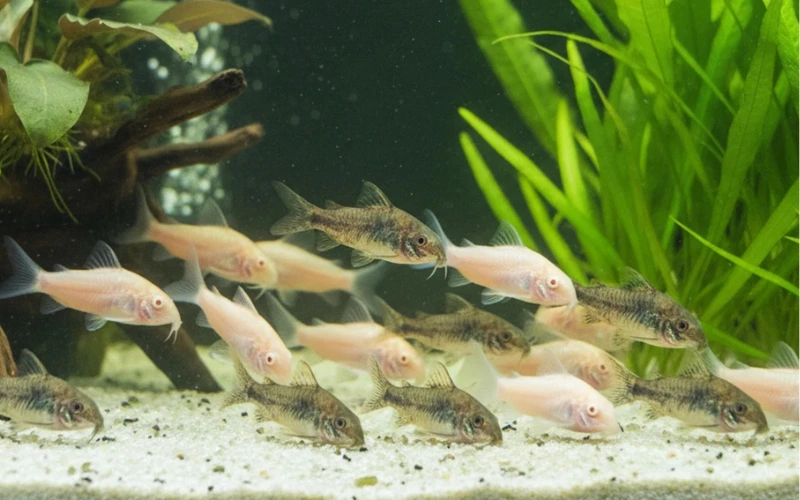
The classic, hardy, and ever-popular beginner Cory.
Peppered Cory (Corydoras paleatus)
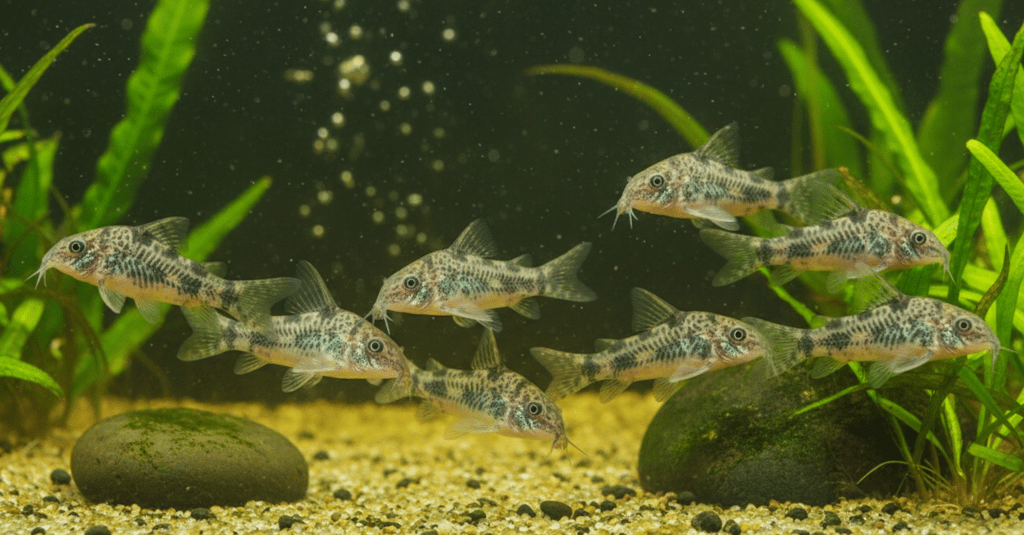
A beautiful spotted Cory that prefers slightly cooler water temperatures.

A beloved favorite, named for the black patches over its eyes and on its tail. They can be a bit more sensitive than the Bronze or Peppered.

A beautiful Cory with a fine, reticulated “scribble” pattern. Note: Most in the trade are actually the Three-Stripe Cory (Corydoras trilineatus), which has a similar but bolder pattern.
Sterba’s Cory (Corydoras sterbai)
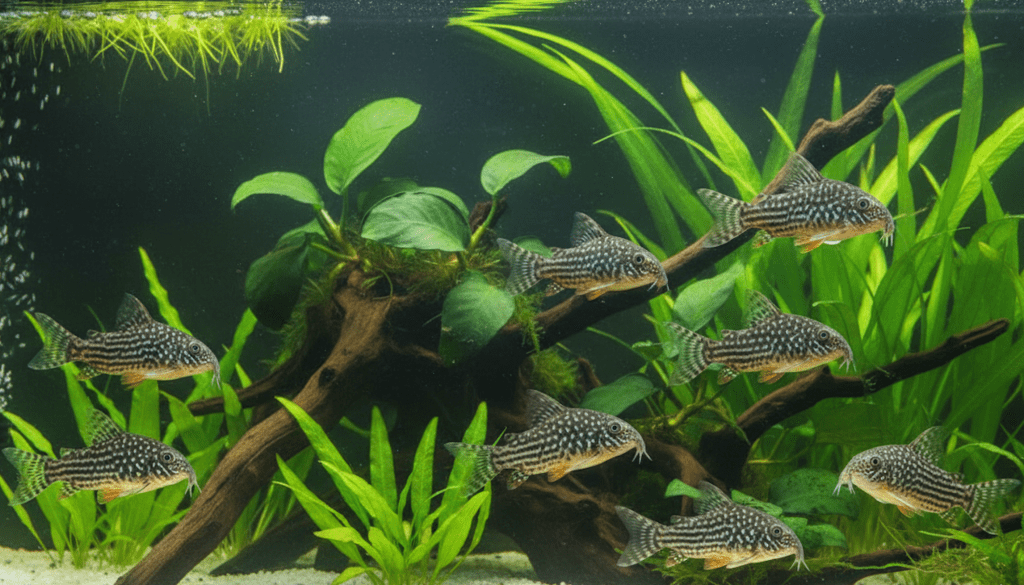
A showstopper with a dark body covered in bright white spots and brilliant orange pectoral fins. They prefer very warm water.
Pygmy Cory (Corydoras pygmaeus)

A true dwarf species (under 1 inch) that often swims in the mid-water, unlike its bottom-dwelling cousins. Must be kept in a gentle-flow tank.
Adolfo’s Cory (Corydoras adolfoi)
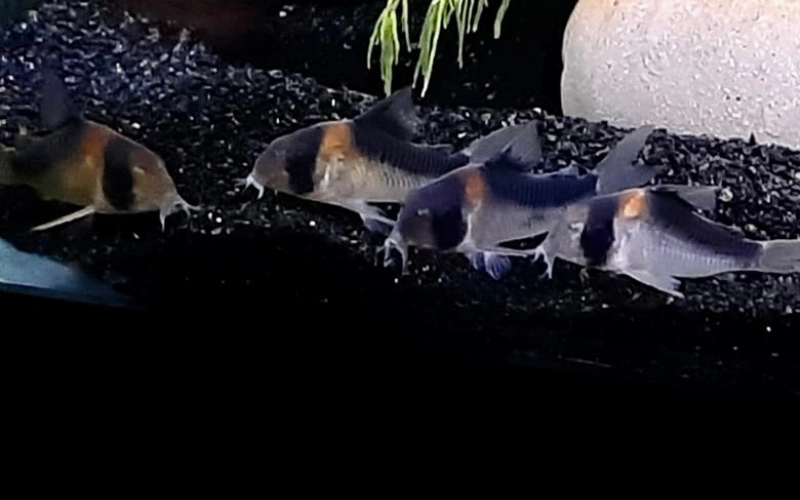
A beautiful white-bodied Cory with a black “mask” and a bright orange splash on its head.
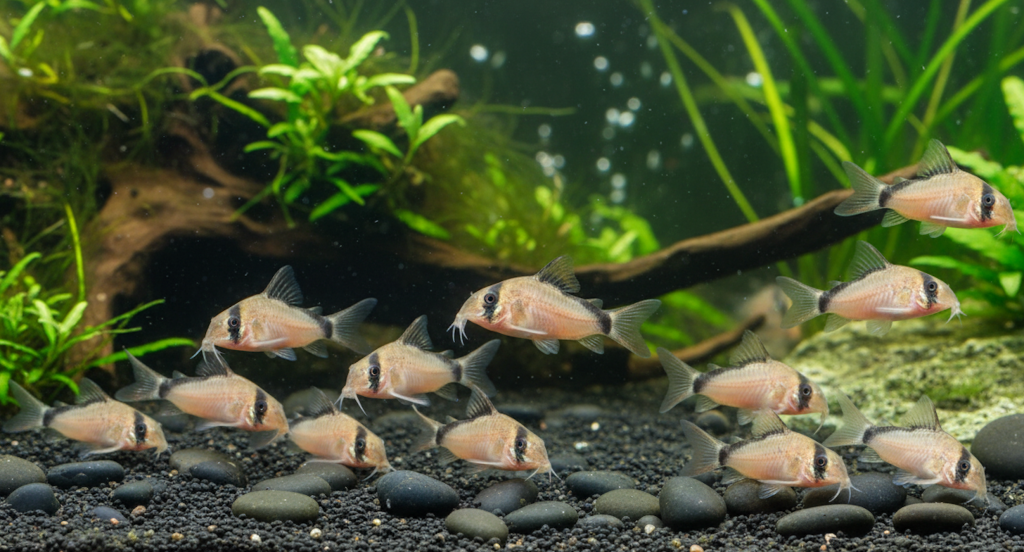
A striking Cory with a black “bandit mask” stripe running through its eye.
Skunk Cory (Corydoras arcuatus)
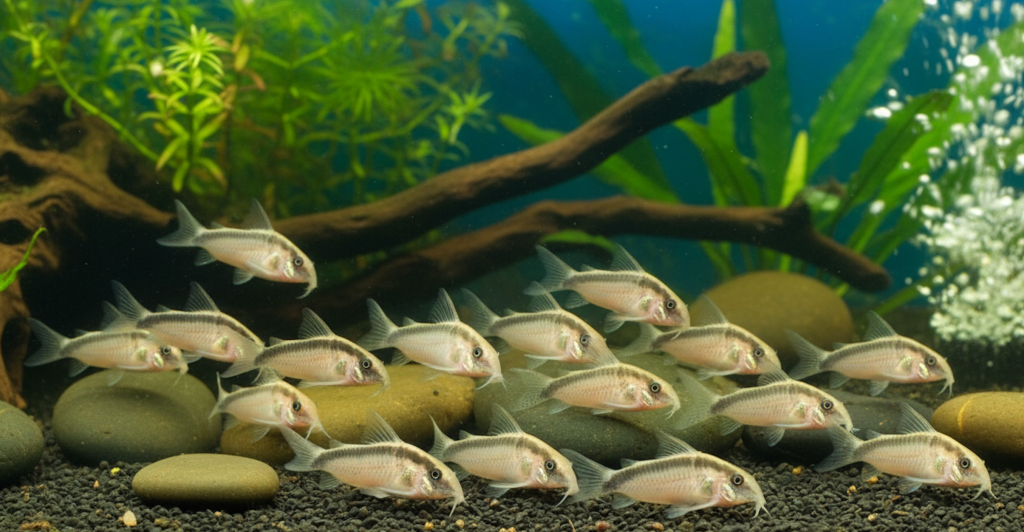
Named for the distinct black arching stripe that runs from its eye all the way to its tail.
Emerald Cory (Corydoras splendens)
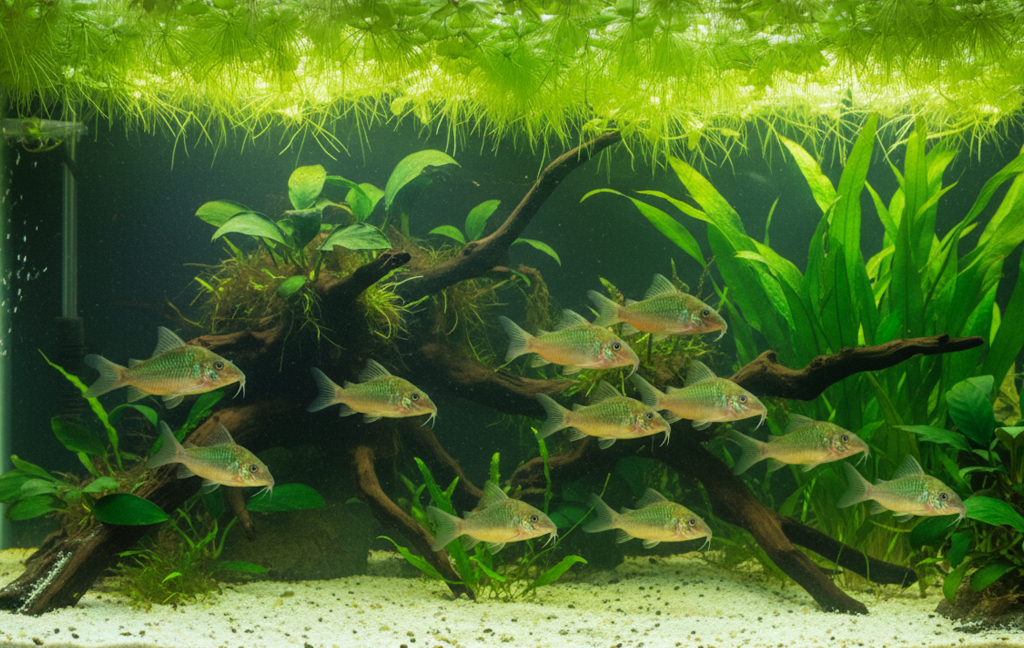
Often sold as a Cory, but it’s technically in a different genus (Brochis). They grow significantly larger than true Corys and are a beautiful, iridescent green.
Corydoras Catfish FAQ
Sand is the only appropriate substrate — gravel is harmful. Corydoras have delicate sensory barbels they use to sift for food, and sharp gravel erodes them over time. Damaged barbels develop bacterial infections that are often fatal. Fine sand is not a preference; it is a health requirement for this species.
This is a normal biological adaptation. Corydoras are facultative air breathers that use their intestines for gas exchange, gulping atmospheric air to supplement oxygen intake. However, constant or frantic gasping at the surface — rather than quick, occasional dashes — signals a water quality emergency and requires immediate parameter testing.
A minimum school of six is required in a 20-gallon long tank. Corydoras are highly social and rely on their group for psychological security. A lone or small group will be stressed, reclusive, and far more vulnerable to illness. They are not solitary bottom cleaners — they are schooling fish that happen to live at the bottom.
This “zooming” behaviour is triggered by drops in barometric pressure, which they detect through their Weberian apparatus. Large water changes can also trigger it by simulating the rainy season. It is a sign of environmental stimulation, not distress, and frequently precedes a spawning event. Consider it a good sign.
A healthy Corydoras can live 10–15 years, with some specimens reaching 20 years in specialist setups. The common estimate of 3 years typically reflects poor water quality, not the species’ actual lifespan. As bottom dwellers, they are the first fish to suffer from accumulated nitrates — pristine water is the single most important factor in their longevity.
Sources
- Aquarium Co-Op
https://www.aquariumcoop.com/blogs/aquarium/cory-catfish-care-guide - Aquarium Source
https://www.aquariumsource.com/cory-catfish-care/ - Britannica
https://www.britannica.com/animal/armored-catfish


Leave a Reply