
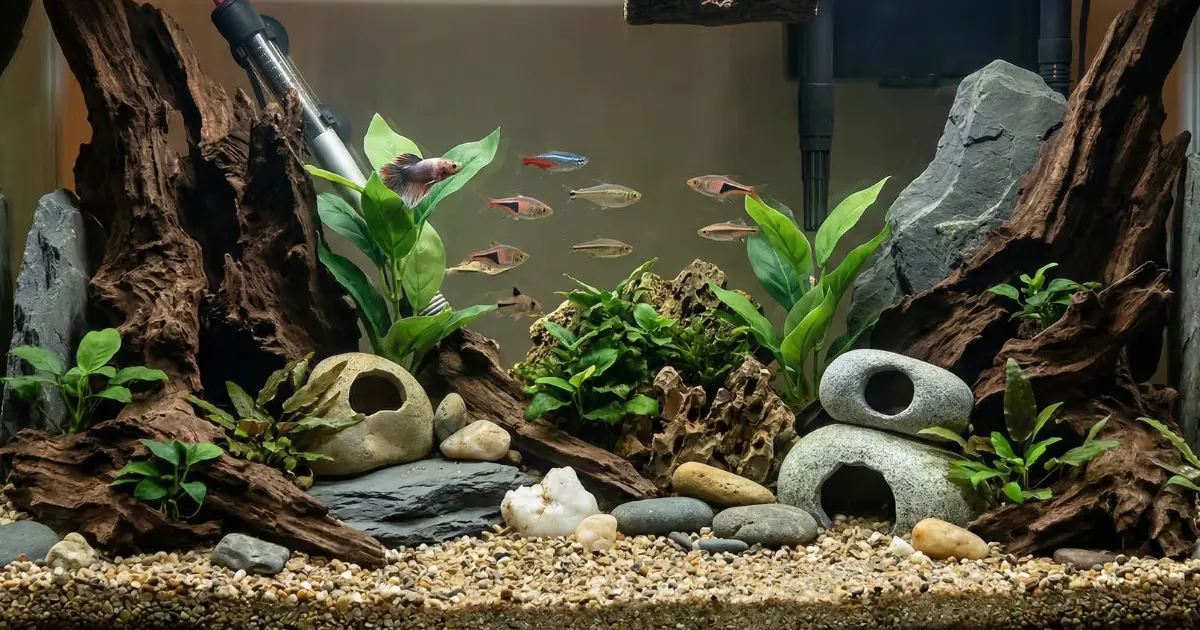
My first venture into the aquatic world was with two of the most beautiful fish I had ever seen: an Elephant Ear betta with fins like flowing silk, and a Double Half-moon with a stunning, vibrant tail. They were small, delicate creatures, and I thought a cozy little tank would be a perfect home. However, I was applying the “small fish, small tank” logic without understanding the invisible forces at play, such as the aquarium bioload.
I quickly learned a heartbreaking lesson. Their bioload, their invisible weight in waste, was immense in that tiny volume of water. The parameters crashed almost instantly. The very fragility that made their fins so beautiful also made them incredibly sensitive to the toxic soup their small home had become. They taught me that a larger tank isn’t just about giving a fish “more room to swim.” It’s about stability and a bigger buffer against the mistakes every beginner makes. It’s forgiveness. This guide is built on the memory of those two stunning fish, to help you look past the size of the pet and focus, instead, on the stability of their world.
What Does Aquarium Bioload Actually Mean?
Aquarium Bioload represents the total biological waste produced within a specific water volume. Precisely, it measures the combined urine, feces, and respiratory gases excreted daily. Every single living organism continuously adds to this highly toxic chemical burden. So, the beneficial bacteria inside your filtration system must process this waste. Thus, exceeding the processing capacity of these bacteria results in lethal ammonia spikes. Ultimately, managing this unseen chemical load dictates the fundamental survival of your aquatic pets.
How Do You Calculate the Aquarium Bioload?
You must evaluate several critical factors to determine your overall Aquarium Bioload accurately. Specifically, the total water volume acts as the primary diluting agent for toxins. The adult size and metabolic rate of your chosen species matter immensely. Massive predators naturally produce significantly more waste than tiny schooling tetras. Consequently, your specific feeding schedule directly influences the amount of raw organic material. You must analyze your mechanical and biological filtration capacities. As a result, calculating this metric requires an understanding of your entire ecosystem.
Mechanical Filtration and the Aquarium Bioload
Filtration systems physically remove solid detritus before it degrades into liquid ammonia. Specifically, large canister filters and custom sumps handle massive amounts of solid waste. Moreover, these powerful devices move high volumes of water through dense mechanical sponges. So, they physically trap the decaying organic matter for easy manual removal later. Therefore, powerful mechanical filtration directly supports environments struggling with a heavy Aquarium Bioload. Ultimately, upgrading your filter provides a significantly larger safety net against chemical crashes.
Why African Cichlids Require Heavy Aquarium Bioload Management
African Cichlid keepers frequently overstock their tanks to suppress deadly territorial aggression naturally. Specifically, crowding these highly aggressive fish prevents dominant individuals from claiming the tank. Furthermore, this extreme stocking density actively diffuses targeted bullying among the massive population. Consequently, this deliberate overcrowding generates an absolutely massive, highly dangerous Aquarium Bioload instantly. Therefore, these specialized keepers must use extremely powerful commercial sumps to process waste. Managing this specific setup requires advanced knowledge of intense biological filtration mechanics.
Managing Small Environments Without High Aquarium Bioload

Small aquariums lack the necessary water volume to dilute heavy waste accumulations. Specifically, a standard 40-liter tank reaches its maximum biological capacity incredibly quickly. Delicate species like Guppies strongly prefer slow, gentle water currents constantly. Consequently, attaching a massive, high flow canister filter would easily exhaust and kill them. Therefore, you must use gentle sponge filters that provide massive bacterial surface area. As a result, maintaining a low Aquarium Bioload remains the absolute safest strategy here.
The Truth About the Inch-Per-Gallon Rule
This outdated stocking rule serves only as a highly generalized guideline for beginners. Specifically, the rule falsely assumes a massive Oscar produces the same biological waste. Furthermore, it completely ignores the exponential mass increase as fish grow larger daily. Blindly following this rule frequently leads to a disastrously high Aquarium Bioload. Therefore, beginners should only use it as a highly conservative starting point. Ultimately, you must transition to advanced biological tracking as your husbandry skills improve.
How Diet Directly Impacts Aquarium Bioload
Every single pellet you drop into the water immediately contributes to the waste. Specifically, feeding exactly 2 grams of high quality protein creates a predictable metabolic output. Furthermore, overfeeding causes uneaten food to rot directly inside the warm aquatic environment. Consequently, this decaying organic matter releases massive amounts of lethal ammonia incredibly rapidly. Strict portion control actively minimizes the resulting Aquarium Bioload completely and safely. As a result, feeding your fish sparingly prevents catastrophic bacterial ecosystem crashes.
Aquatic Plants as Aquarium Bioload Processors
Live aquatic plants serve as incredibly powerful, natural chemical filters within captive ecosystems. Specifically, they actively absorb toxic ammonia and nitrates directly through their submerged leaves. Furthermore, a dense underwater jungle aggressively outcompetes unsightly algae for available suspended nutrients. Consequently, heavy planting significantly reduces the overall toxic Aquarium Bioload burden on filters. Replacing artificial plastic decorations with live flora improves water quality. Ultimately, cultivating a natural botanical environment provides unparalleled stability for delicate fish species.
Recognizing a Crashing Ecosystem
An overloaded biological system provides several highly obvious visual and chemical warning signs. Specifically, persistently cloudy or milky water indicates a massive, uncontrolled bacterial bloom. Furthermore, fish gasping heavily at the surface indicate severe chemical gill damage. Hence, a heavy Aquarium Bioload frequently causes these sudden lethal chemical spikes. Therefore, you must use liquid test kits weekly to monitor invisible nitrogenous compounds. Due to this, early detection allows emergency water changes before mass casualties occur.
Long-Term Stability Strategies
Achieving permanent environmental stability requires absolute consistency regarding your weekly mechanical maintenance schedule. Performing 30% weekly water changes actively dilutes accumulating invisible toxins. Furthermore, systematically vacuuming the substrate removes trapped, rotting organic detritus before it dissolves. Proactive physical cleaning drastically lowers the overall Aquarium Bioload. Therefore, you must never neglect these mechanical tasks if you keep large populations. Strict adherence to a cleaning routine guarantees a thriving, pristine aquatic display.
Chemical Filtration and Ecosystem Safety
Chemical filtration utilizes specific porous media to extract dissolved organic compounds rapidly. Specifically, activated carbon aggressively adsorbs the invisible toxins that contribute to overall waste. Furthermore, specialized synthetic resins can actively target and bind lethal ammonia molecules. Consequently, these chemical additions temporarily reduce the immediate impact of a massive Aquarium Bioload. Therefore, they serve as excellent emergency tools during sudden bacterial colony crashes. Ultimately, you must replace these chemical media regularly because they saturate incredibly quickly.
The Impact of Temperature on Aquarium Bioload
Warmer water temperatures actively accelerate the metabolic rates of cold blooded aquatic organisms. Specifically, a tropical tank generates waste much faster than a chilled cold water setup. Furthermore, warmer environments simultaneously decrease the total amount of available dissolved oxygen. Consequently, a high Aquarium Bioload becomes exceptionally dangerous during severe summer heat waves. Therefore, you must actively increase surface agitation to maximize essential oxygen gas exchange. Ultimately, balancing temperature controls prevents metabolic spikes from overwhelming your established biological filtration.
Aquarium Bioload FAQ
Aquarium bioload is the total biological waste—including urine, feces, and respiratory gases—produced within a specific water volume. If this waste exceeds the processing capacity of your filter’s beneficial bacteria, it will result in lethal ammonia spikes.
You must evaluate the total water volume, the adult size and metabolic rate of your fish, your feeding schedule, and your mechanical and biological filtration capacities. All of these factors combined determine how quickly waste accumulates in your ecosystem.
No, the inch-per-gallon rule is an outdated myth that falsely assumes all fish produce the same amount of waste. It ignores the exponential mass and metabolic rate of larger species, often leading to a disastrously high bioload if followed blindly.
Overfeeding causes uneaten food to rot directly inside the warm aquarium water, releasing massive amounts of lethal ammonia incredibly fast. Strict portion control is required to minimize raw organic waste and prevent catastrophic ecosystem crashes.
Sources
- PetMD (Guppy Care & Water Flow)
https://www.petmd.com/fish/guppy-fish-care-sheet - RateMyFishTank (African Cichlid Overstocking)
https://www.ratemyfishtank.com/blog/african-cichlid-aggression-how-to-reduce-aggression - Tropical Fish Hobbyist Magazine (Plants & Filtration)
https://www.tfhmagazine.com/articles/aquatic-plants/filtration-in-the-nature-aquarium - Fish Tank World (The 1-Inch Rule Myth)
https://www.fishtankworld.com/one-inch-of-fish-per-gallon-rule/


Leave a Reply
You must be logged in to post a comment.