
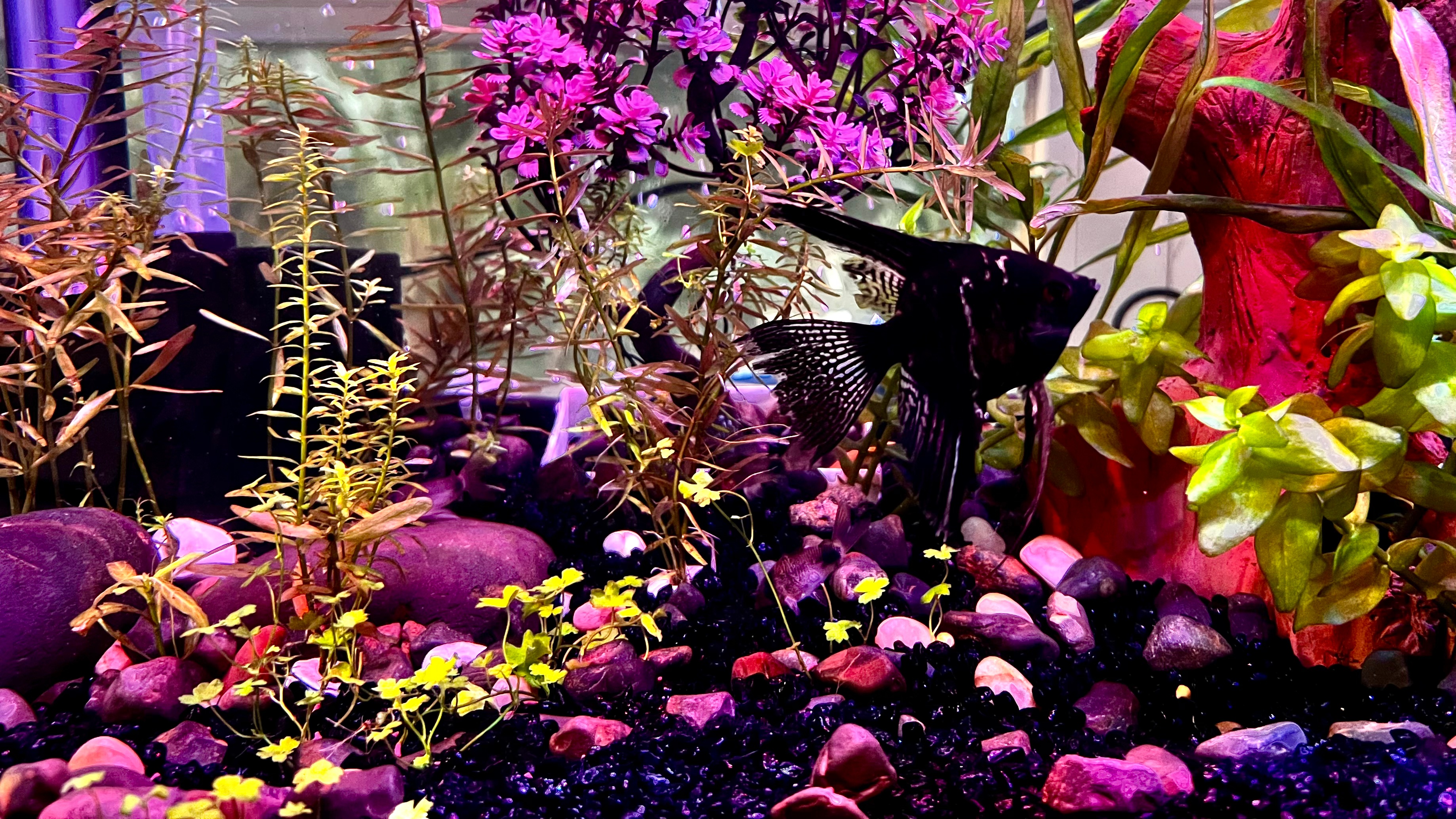
It’s the ultimate goal of every aquarist: a vibrant, bustling community tank where every inhabitant lives in harmony. Yet,it’s also the source of our greatest heartbreak, especially when a beautiful new addition turns out to be a relentless bully, terrorizing its tank mates. This raises the question: What makes one fish a peaceful citizen and another a tiny tyrant? The answer is a complex and fascinating mix of instinct, environment, and personality. Therefore, this guide will debunk the common myths about fish temperament and give you a framework for understanding the true nature of the fish you keep.
The Hooligans in a Fancy Suit
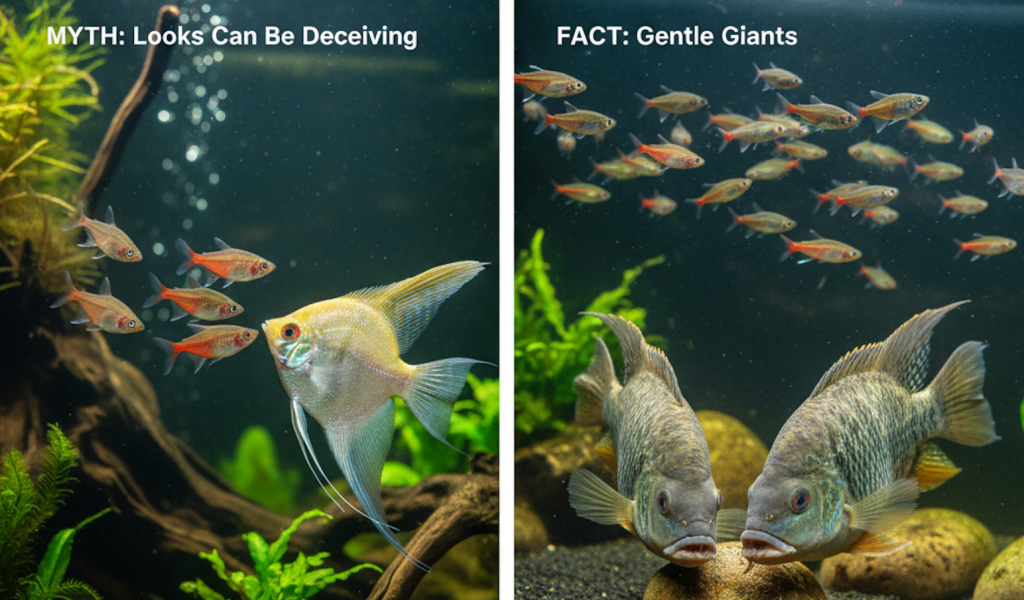
My South American cichlid tank was home to my beloved “gentle giants,” the Severums. They were large, intelligent, and carried themselves with the quiet confidence of a tenured professor. Indeed, they were, for all intents and purposes. In sharp contrast, in another tank, I had a school of beautiful, jewel-toned Serpae Tetras. They were tiny, elegant, and looked like the definition of a peaceful community fish. However, they were also absolute hooligans. They nipped at everyone, chased each other relentlessly, and generally treated the tank like their personal mosh pit.
This was a hilarious and profound lesson: you can never judge a fish’s temperament by its size, its family, or its looks. One of the biggest fish in my house was the most peaceful, while the tiniest jewels were the biggest troublemakers. This guide is for everyone who has been personally victimized by a tiny, beautiful hooligan.
Does a Fish’s Diet Determine Its Temperament? (The Carnivore Myth)
Let’s bust the biggest myth right now: a fish’s diet has almost nothing to do with its temperament. It’s true that it’s easy to assume that a meat-eater is an aggressive killer and a plant-eater is a gentle pacifist. However, this is completely wrong.
Example of an Aggressive Herbivore: The Mbuna cichlids from Lake Malawi are a perfect example. Their diet in the wild is almost entirely algae scraped from rocks. They are militant vegetarians. Yet, they are also some of the most territorial, aggressive, and downright murderous fish in the entire hobby. Their aggression isn’t about hunting; instead, it’s about fanatically guarding their personal rock (their food source and territory) from all intruders.
Example of a Peaceful Carnivore: Conversely, the Kuhli Loach is a shy, nocturnal noodle that is a micropredator, hunting for tiny worms and crustaceans in the sand. Despite their diet, they are one of the most peaceful and harmless fish you can own, spending their days hidden away and bothering absolutely no one.
What Really Determines Fish Temperament?
If it’s not diet, what is it? Aggression is driven by three main instincts.
- Breeding Instincts: Finally, when fish are ready to spawn, their hormones surge, and their aggression skyrockets. A bonded pair of Angelfish, normally peaceful, will turn into ferocious guardians, attacking any fish that comes near their eggs.
- Territoriality: This is, by far, the #1 driver of aggression. A fish claims a space—a cave, a rock, a corner of the tank—and will defend it from rivals in order to protect its resources and potential spawning sites. Cichlids are the masters of this.
- Predatory Instinct: In contrast, this isn’t about aggression; it’s purely about food. A large, predatory fish doesn’t “hate” the small tetra; it just sees it as a snack. This is the simple, unbreakable “mouth-size rule.”
A Roster of Fish Temperaments: From Pacifists to Tyrants
Who Are the Model Citizens? (Truly Peaceful Community Fish)
These fish lack strong territorial instincts and are safe for almost any peaceful community tank.
- Kuhli Loaches: Finally, as mentioned earlier, these nocturnal noodles are the definition of “keeping to themselves.”
- Corydoras Catfish: First, the ultimate pacifists. They are busy, armored bottom-dwellers who are entirely focused on sifting the sand for food and consequently could not care less about what’s happening above them.
- Rasboras (like Harlequin or Chili): Next, these small, shoaling fish are famously peaceful. They find safety in numbers and are, therefore, a perfect choice for adding a splash of calm, schooling action.
Who Are the Grumpy Neighbors? (Semi-Aggressive Fish)
These fish are generally peaceful but have a territorial streak that must be managed.
- Angelfish: They are graceful and peaceful for the most part, but they will establish a pecking order and can become very territorial, especially a breeding pair.
- Gouramis (like Pearl or Blue): These beautiful, intelligent fish are generally placid, but males can be aggressive toward each other.
- Most Barbs (like Cherry or Odessa): They are active and boisterous, which can be stressful for slow-moving fish. Some, like Tiger Barbs, are notorious fin nippers.
Who Are the Rulers of the Realm? (Aggressive and Predatory Fish)
These fish are best kept in a species-only tank or with other large, robust tank mates.
- Oscars: The famous “wet pets.” They are incredibly intelligent and personable, but they view their tank as their personal kingdom and will kill or eat almost any fish they can.
- Mbuna Cichlids: As discussed, their aggression is legendary. A properly set-up Mbuna tank is a carefully managed, beautiful warzone.
- Arowanas: Large, powerful apex predators that will eat any fish that can fit in their massive mouths.
How Can I Build a Peaceful Tank? A Checklist for Success
A harmonious tank is not an accident; it is the result of careful planning.
- Research the Fish Temperament, Not Just the Species: Don’t just research “Tetras”; research your specific type. A Neon Tetra is far more peaceful than a Serpae Tetra.
- Respect the Mouth-Size Rule: Always plan for the adult size of your fish.
- Provide Space: A larger tank is the best tool for diluting aggression.
- Aquascape for Peace: Use rocks, driftwood, and plants to break lines of sight and create distinct territories.
- Stock Your Tank Last with the “King”: Add your most aggressive or territorial fish to the tank last. This prevents it from claiming the entire empty tank as its territory before anyone else arrives.
Fish Temperament And Behavior FAQ
A fish’s diet has almost nothing to do with its level of aggression — this is one of the most persistent myths in the hobby. Mbuna cichlids eat algae almost exclusively yet are among the most aggressive fish in the trade. Territoriality, not diet, is the actual driver of fish temperament and aggression.
Territoriality is the primary driver of aggressive fish temperament. A fish claims a cave, rock, or corner of the tank and will defend it aggressively from rivals to protect its resources and potential spawning sites. Cichlids are the defining example, but territorial instincts exist to varying degrees across almost every fish family.
Yes, fish size and appearance have no reliable connection to fish temperament. Serpae Tetras, small jewel-like schooling fish, are notorious fin-nippers that aggressively harass tank mates, while large Severums are among the most peaceful fish in their size class. Temperament is driven by territorial instinct, not physical appearance.
The mouth-size rule states that any fish small enough to fit inside another fish’s mouth is a meal, not a tank mate. A large predatory fish does not show hostility toward small fish; it simply responds to a feeding instinct. Always research the adult size of every species before combining them in a community tank.
Corydoras catfish are among the most genuinely peaceful fish available, spending their entire lives searching the substrate for food and ignoring all tank activity above them. Kuhli Loaches are similarly non-aggressive, hiding during the day and bothering nothing. Rasboras, like Harlequin or Chili varieties, are small shoaling fish with no territorial instincts whatsoever.
Always add the most aggressive or territorial fish to the tank last, after all other inhabitants are already settled. Adding a territorial fish to an empty tank allows it to claim the entire space before others arrive, dramatically increasing its hostility. This single stocking-order rule prevents the majority of aggression problems in new community setups.
Sources
- Cichlid Forum (Aggression and Diet)
https://www.cichlid-forum.com/articles/aggression_diet.php - University of Florida (Fish Behavior)
https://edis.ifas.ufl.edu/publication/FA005 - Practical Fishkeeping (Community Tank Rules)
https://www.practicalfishkeeping.co.uk/features/how-to-set-up-a-community-tank/ - Seriously Fish (Serpae Tetra Profile)
https://www.seriouslyfish.com/species/hyphessobrycon-eques/ - The Spruce Pets (Reducing Aggression)
https://www.thesprucepets.com/reducing-cichlid-aggression-1380965


Leave a Reply
You must be logged in to post a comment.