
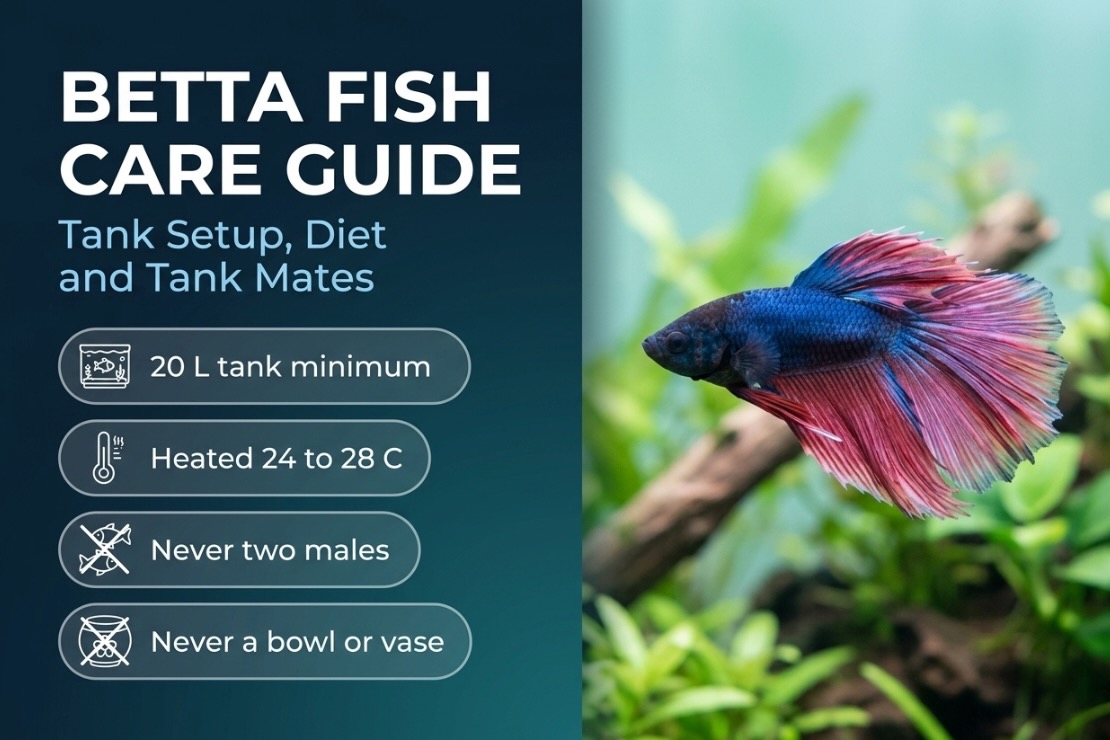
With their flowing fins, vibrant jewel tone colors, and feisty personalities, Betta fish (Betta splendens) are one of the most popular and iconic fish in the world. But their beauty is often overshadowed by a mountain of misinformation that consequently leads to improper care. Therefore, this guide will debunk the myths and answer all your questions, providing a complete roadmap to help your Betta not just survive, but truly thrive.
My entire journey as an aquarist began with two male Bettas, a stunning Elephant Ear and a vibrant Double Half-moon.I brought them home, placed them in their own separate 5-gallon tanks, and thought I had done everything right. Then came the hard part. Those two fish were my brutal, humbling introduction to the unforgiving science of the nitrogen cycle. They were the reason I learned what ammonia was, and they were the subjects of my first frantic, panicked water tests.
Later, I graduated to the complex social experiment of a female Betta sorority, a beautiful but chaotic world of Plakats, Crowntails, and Half-moons where I learned that Plakats often carry an extra dose of sass. But it all comes back to those first two. Ultimately, they were my first aquatic teachers, and this guide is dedicated to them.
Why Is It Called the Siamese Fighting Fish?
The Betta’s story begins in the rice paddies of Thailand (formerly Siam). Originally, wild Bettas featured drab, short fins; villagers collected them and watched them spar for entertainment. Subsequently, breeders spent generations selectively breeding them for aggression, thereby creating the “fighting fish” lineage. While we breed our ornamental Bettas for beauty, that fiery spirit persists.
Can You Keep a Betta Fish in a Vase or a Bowl?
No, absolutely not. This is, unequivocally, the most harmful myth in the entire hobby. Bettas are complex, intelligent fish that, therefore, require stable, heated, and filtered water to thrive. In contrast, a small, unfiltered bowl is a death sentence where the fish slowly succumbs to ammonia poisoning, stress, and disease.
What is the Ideal Tank Size and Setup for a Betta Fish?
- Tank Size: A 5-gallon (approx. 20 liters) tank is the minimum for a single Betta. Ideally, a 10-gallon (approx. 40 liters) is even better as it allows for more stable water parameters.
- Heater: Since Bettas are tropical fish, they require a heater to keep their water at a stable temperature between 76-82∘F (24-28∘C).
- Filtration: Therefore, a gentle, low-flow filter is essential. Sponge filters or hang-on-back filters with an adjustable flow are perfect.
- Lid: Finally, do Betta fish jump out of the tank? Yes! Because they are excellent jumpers, a tight-fitting lid is mandatory.
What Are the Different Types and Colors of Betta Fish?
Bettas have been bred into a stunning array of fin types and colors. Some popular varieties include:
- Veiltail: This is the most common type, with a long, flowing tail that droops downwards.
- Crowntail: In this variety, the rays of the fins extend beyond the webbing, thereby creating a spiky “crown” appearance.
- Halfmoon: This type is characterized by the tail fin forming a perfect 180 degree “D” shape when flared.
- Plakat: This is a short-finned variety that closely resembles the wild Betta. They are known for being very active and can be more aggressive.
- Elephant Ear (Dumbo): These Bettas have enormous pectoral fins that look like elephant ears.
- Double Tail: Finally, these Bettas have two distinct tail lobes separated at the base.

What is the Labyrinth Organ?
Bettas are “anabantoids,” meaning that they possess a special organ called a labyrinth organ. This organ allows them to breathe atmospheric air directly from the surface, which is an adaptation for living in low-oxygen rice paddies. Consequently, this is why they must always have access to the water’s surface.
What Does it Mean When My Betta Builds a Bubble Nest?
A bubble nest is a collection of saliva-coated bubbles that a male Betta builds at the surface. While a bubble nest can indicate good health (sick fish rarely build them), it is primarily a sign of sexual maturity and biological instinct. It is not a reliable gauge of “happiness” or water quality; even Bettas in poor conditions (like tiny cups) will build nests if the biological urge to breed is strong enough.
What is the Best Diet for a Betta Fish?
Bettas are carnivores. Therefore, their diet should be rich in protein.
- Staples: For their main diet, a high-quality Betta-specific pellet is the best staple food.
- Treats: In addition, supplement their diet with frozen or live foods like bloodworms, daphnia, and brine shrimp a few times a week.
What if it refuses food and spits it out? This is common. The reason is often that the pellet may be too large, or the Betta may be a picky eater. To remedy this, try breaking the pellet in half or switching to a different high-quality brand.
Can You Keep Several Bettas Together?
Males: Never keep two male Bettas in the same tank. They will fight to the death.
Females: It is possible to keep a group of 5 or more female Bettas (called a sorority) in a heavily planted tank of at least 20-30 gallons. This is an advanced setup, as you must manage their complex pecking order.
Male & Female: A male and female should only be kept together temporarily for the purpose of breeding, and only by experienced keepers.
What’s the Difference Between Male and Female Bettas?
Males: Generally have much longer, more elaborate fins and more vibrant colors.
Females: Have shorter fins, a rounder body shape, and are often less colorful (though some are quite beautiful). They also have a visible white “egg spot” on their underside.
Do Betta Fish Sleep? Do They Have Teeth?
Yes, Bettas do sleep! They often rest on leaves or lie at the bottom of the tank and can appear very still. And yes, they do have tiny white teeth used for grabbing their food.
How Big Do Bettas Grow and How Long Do They Live?
Most ornamental Bettas grow to about 3 inches (7.5 cm) in total length. With proper care in a heated, filtered aquarium, a Betta fish can live for 3 to 5 years and I have seen one that passed away at 7 years old.
Betta Fish Care FAQ
No — a bowl or vase without filtration and heating is a slow death sentence for a Betta fish. Ammonia accumulates rapidly in unfiltered water, causing organ damage, fin deterioration, and eventual death. A Betta requires a heated, filtered tank of at least 5 gallons to survive and genuinely thrive.
The labyrinth organ is a specialized respiratory structure that allows Betta fish to breathe atmospheric oxygen directly from the water’s surface. This adaptation evolved in the low-oxygen rice paddies of Southeast Asia. Bettas must always have unobstructed access to the surface — a blocked or sealed tank opening will cause suffocation.
Two male Betta fish cannot coexist in the same tank under any circumstances. They will fight immediately and relentlessly until one fish sustains fatal injuries. Even sustained visual contact through a shared glass panel causes chronic stress and immune suppression in both fish.
A bubble nest is a cluster of saliva-coated bubbles constructed at the water’s surface by a male Betta to signal reproductive readiness. It reflects sexual maturity and biological instinct, not overall happiness or ideal water quality. Bettas in poor conditions still build bubble nests, making it an unreliable welfare indicator.
A single Betta fish requires a minimum tank size of 5 gallons (approximately 20 liters), with 10 gallons being the preferred volume for stable water parameters. The tank must include a gentle low-flow filter, a heater maintaining 76–82°F (24–28°C), and a tight-fitting lid. Bettas are skilled jumpers capable of escaping any uncovered aquarium.
A Betta fish kept in a properly heated and filtered aquarium lives between 3 and 5 years, with exceptional individuals documented reaching 7 years. Lifespan is directly tied to water quality, diet quality, and available tank space. Fish kept in unheated, unfiltered bowls rarely survive beyond 12 to 18 months.
A Betta sorority is a group of five or more female Bettas kept together in a heavily planted tank of at least 20–30 gallons. Females establish a strict dominance hierarchy that reduces sustained aggression once the group stabilizes. Introducing fewer than five females dramatically increases bullying risk — this remains an advanced setup requiring consistent monitoring.
Sources
- Aquarium Co-Op (Complete Care Guide)
- FishLab (Betta Sorority Guide)
- Betta Fish (Types)
- NippyFish (BettaFish)
Leave a Reply
You must be logged in to post a comment.