
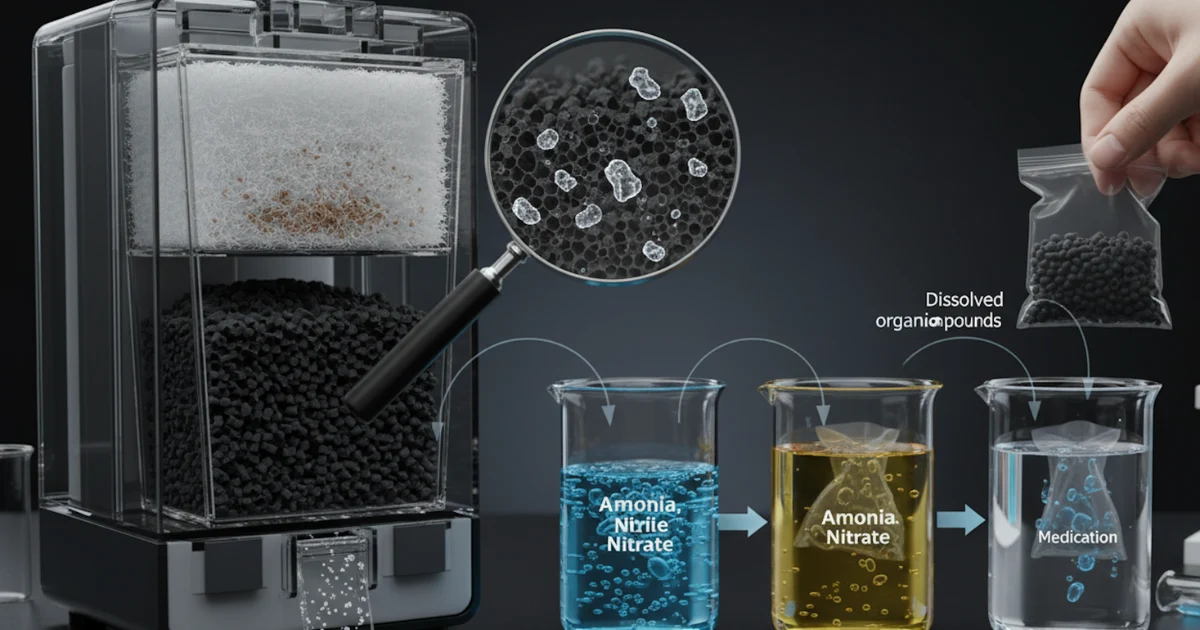
Activated Carbon functions as a highly powerful chemical filter within your setup. Manufacturers heat organic materials to create millions of microscopic pores. These tiny structures actively trap organic compounds. They use a complex chemical process called adsorption. Ultimately, it extracts invisible pollutants and severe odors. Thus, this process leaves the remaining aquatic environment significantly cleaner.
Does It Make the Water Clearer?
Indeed, it provides unmatched performance regarding visual water clarity. Decomposing organic matter frequently leaches dark tannins into the system. Naturally, these compounds turn the water slightly yellow over time. Conversely, Activated Carbon adsorbs these specific organic stains immediately. Accordingly, filtering your water through 50 grams of fresh media produces crystal clear results rapidly.
Does Activated Carbon Remove Ammonia or Nitrite?
You must understand its strict chemical limitations regarding the nitrogen cycle. Predictably, activated carbon fails to adsorb ammonia, nitrite, or nitrate molecules. Consequently, these specific inorganic compounds simply pass right through the microscopic pores. Moreover, you must rely entirely upon biological bacterial colonies for safety. They process these lethal nitrogenous wastes effectively without chemical intervention. Ultimately, this medium supplements biological filtration but never replaces it.
Does It Remove Chlorine?
It effectively removes chlorine from tap water through slow reactions. The carbon actively breaks down the chemical bonds within municipal additives. However, this specific reaction requires significant contact time for total neutralization. Meanwhile, the rapid water flow inside standard aquarium filters limits this efficiency. Therefore, you must always use a dedicated liquid water conditioner. This ensures instant, total chemical safety for your aquatic animals.
Does Activated Carbon Remove Medication?
It adsorbs nearly all pharmaceutical treatments from the water column instantly. Notably, activated carbon traps the active ingredients found in copper treatments effectively. Additionally, this aggressive removal completely neutralizes your applied antibacterial dyes. Consequently, you must absolutely remove all chemical media before administering any medication. Then, you should only reintroduce fresh media to extract residual medicine later.
Can It Help with Algae?
It provides only indirect assistance regarding severe nuisance algae outbreaks. Crucially, it actively removes dissolved organic compounds that fuel rapid algae reproduction. Regardless, it completely fails to remove primary algae fertilizers like nitrates directly. Thus, eliminating organic waste slightly starves the algae without eradicating it. Managing light duration and physical nutrient export remain your primary algae controls.
Where Should I Place Activated Carbon?
Precise placement dictates its overall chemical efficiency and physical lifespan completely. You must place your activated carbon directly after your mechanical filtration sponges. Passing the water through dense mechanical floss removes heavy physical debris first. Accordingly, this precise staging prevents solid fish waste from clogging microscopic pores.
How Often Should I Replace It?
It possesses a highly finite chemical capacity that expires relatively quickly. The microscopic pores completely fill with trapped organic compounds within four weeks. Once these pores reach maximum capacity, the medium ceases all chemical filtration. Hence, you must systematically discard the old media and introduce fresh batches. Neglecting this strict replacement schedule renders the chemical filtration completely useless.
Does Activated Carbon Leach Chemicals Back?
Extensive scientific testing proves this common hobbyist fear remains largely unfounded. The strong chemical bonds formed during adsorption prevent spontaneous toxin release. Furthermore, activated carbon requires extreme industrial heat or massive chemical shifts to decouple. Consequently, an exhausted bag simply sits inertly inside your filter. Leaving it inside too long simply wastes space rather than poisoning fish.
Should I Rinse It?
You must thoroughly rinse every new batch under cool tap water strictly. The manufacturing and shipping processes generate massive amounts of black carbon dust. Introducing unwashed media immediately blasts this dark dust directly into your display. Moreover, this floating particulate matter severely irritates delicate fish gills. Crucially, a brief rinse actively prevents this messy physical contamination.
Is Activated Carbon Safe for Planted Tanks?
Using this medium within heavily planted ecosystems requires highly careful consideration. Specifically, activated carbon indiscriminately removes necessary organic chelators that plants require. Continuous use actively strips the water column of vital, dissolved plant fertilizers. Accordingly, dedicated aquatic botanists strictly avoid using it to preserve optimal nutrition. You should only utilize it temporarily to clear water after major pruning.
Is It Necessary?
It remains entirely optional for the vast majority of stable, mature aquariums. Weekly water changes remove dissolved organic compounds much more effectively. Additionally, a perfectly balanced biological ecosystem naturally processes typical aquatic waste. Heavily planted tanks rarely require any supplemental chemical filtration for pristine clarity. Ultimately, you should view it as a specialized tool rather than a necessity.
Can Activated Carbon Be Reused?
You cannot simply wash or bake this specific medium in residential ovens. Industrial regeneration requires temperatures exceeding 800 degrees Celsius in oxygen free environments. Boiling activated carbon completely fails to break the strong adsorption bonds. Hence, you must accept that this media functions strictly as single use products. Attempting dangerous home regeneration methods wastes time and risks introducing severe toxins.
What is the Best Type?
Manufacturers produce this medium from several different raw carbon sources globally. Bituminous coal provides excellent macro porosity that traps large organic molecules incredibly efficiently. Meanwhile, coconut shell carbon offers massive micro-porosity for removing smaller, volatile compounds. Bituminous coal remains the absolute best, most versatile choice for standard filtration. Purchasing high grade, dust free bituminous media guarantees the highest possible chemical adsorption rates.
Drawbacks: The Cost of Activated Carbon
Strict monthly replacement schedules generate significant, recurring financial costs over time. Purchasing high quality, laboratory grade media requires a steady, continuous monetary investment constantly. Running multiple large canister filters amplifies this monthly financial burden significantly. Consequently, many hobbyists abandon continuous chemical filtration purely to reduce operating expenses. Relying on standard water changes provides a much cheaper alternative for maintenance.
Drawbacks: Removes Trace Elements
Its adsorption capabilities actively remove highly beneficial elements alongside dangerous toxins. It efficiently strips essential trace minerals like iodine and complex iron compounds. Coral reefs and delicate aquatic plants absolutely require these specific trace elements. Thus, continuous chemical filtration slowly starves these sensitive organisms of building blocks. Reef keepers and aquatic botanists must dose fertilizers to counter this.
Drawbacks: Limits Biological Capacity
Standard aquarium filters offer a highly restricted, finite amount of internal space. Packing a massive bag of chemical media removes valuable real estate. Biological filtration remains infinitely more critical for long-term survival than chemical polishing. Chemical filtration actively limits the beneficial bacteria your system supports. Maximizing biological media space always provides superior, significantly more stable ecosystem health.
Sources
- Aquariadise
https://www.aquariadise.com/activated-carbon/ - Zhulin Carbon
https://www.zhulincarbon.com/application/activated-carbon/activated-carbon-for-aquarium.html - Aquarium Science
https://aquariumscience.org/7-4-2-activated-carbon/ - Practical Fishkeeping – [https://www.practicalfishkeeping.co.uk/features/what-you-need-to-know-about-carbon/]
- Aquarium Source – [https://www.aquariumsource.com/activated-carbon-aquarium/]


Leave a Reply
You must be logged in to post a comment.