
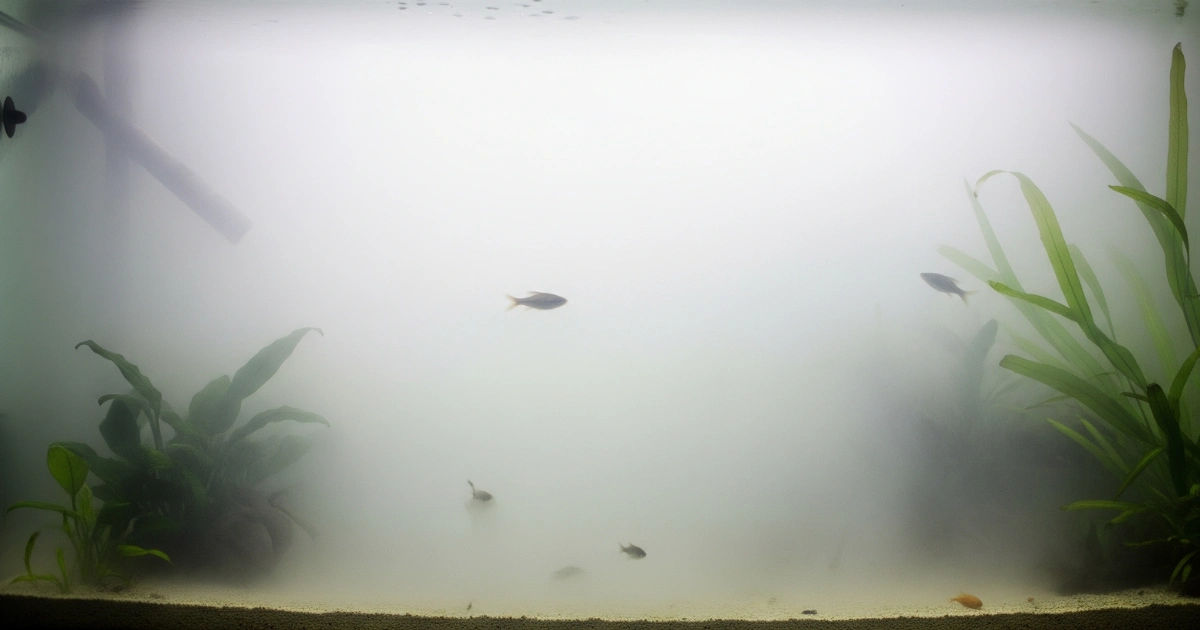
It’s a moment every new aquarium owner experiences: one day your tank is crystal clear, and the next it’s a hazy, cloudy mess. While this is easily the most common and frustrating problem in the hobby, don’t panic! In most cases, cloudy water is a temporary and fixable issue. Therefore, this guide will help you decode the different colors of cloudy water. You will understand the cause and it will provide clear, step-by-step solutions to bring back that crystal-clear view.
Why Is My New Aquarium Water Cloudy? (The White/Gray Cloud)
A Bacterial Bloom
That milky, grayish-white haze is almost always a “bacterial bloom.” This occurs when a new tank is set up and there’s often an excess of nutrients in the water (from waste, uneaten food, etc.). As a result, Heterotrophic bacteria produce ammonia as a byproduct of consuming the waste (mineralization). The danger is that they produce ammonia faster than your young filter can process it.
Is it Harmful? Generally, no. While unsightly, this type of bloom is a natural part of a new aquarium’s life cycle. However, the real danger is the ammonia that these bacteria are feeding on, which is harmful.
The Solution
Patience is key. Specifically, do not do a massive water change, as this can prolong the process. The best course of action is to wait it out. As your tank’s beneficial bacteria (the “good” bacteria in your filter) become established, they will outcompete the free-floating bacteria, and the water will clear on its own, usually within a few days to a week. Be sure to test your water parameters to ensure ammonia and nitrite levels are not dangerously high for any fish present. Massive water changes can sometimes prolong the bloom by removing the food source the beneficial bacteria need to establish, or by disrupting the balance further. “Waiting it out” is the standard accepted method.
Why Is My Aquarium Water Green?
Suspended Algae
Green water is caused by a massive bloom of microscopic, single-celled algae floating in the water column. This is almost always caused by an imbalance of two things:
- Too Much Light: For example, the aquarium is receiving too many hours of light per day (more than 8-10 hours) or is being hit by direct sunlight.
- Too Many Nutrients: Furthermore, there is an excess of nitrates and phosphates in the water, which algae use as fertilizer. This issue is typically caused by overfeeding or not performing regular water changes.
The Solution
- Reduce Lighting: First, cut your lighting period down to 6-8 hours a day and ensure the tank is not in direct sunlight.
- Perform a Blackout: For severe cases, a “blackout” can work wonders. Turn off the aquarium lights and cover the tank completely with a blanket for 3-4 days. A total blackout is the most effective chemical-free method for killing suspended algae. Your advice to cover the tank completely is accurate.
- Address the Nutrients: Finally, perform a large water change and reduce the amount you are feeding your fish.
Why did my tank get cloudy immediately after setup?
This is almost certainly dust from your substrate. For instance, even pre-washed sand and gravel can release fine particles into the water when first filled. However, this is harmless and will settle on its own or be removed by your filter within a day or two. Mechanical filtration removes this naturally.
Why is my established aquarium water cloudy?
A sudden white/gray cloud in a mature tank is a red flag. It is highly likely a mini-bacterial bloom caused by a disturbance to your ecosystem. The most common causes are:
- Over-cleaning your filter and killing off the beneficial bacteria.
- A sudden increase in bio-load (adding too many fish at once).
- An unnoticed dead fish decomposing in the tank.
- A large amount of overfeeding.
Solution: First, find and fix the cause immediately. Then, do a significant water change and test for ammonia and nitrite spikes.
Why is my water cloudy after a water change?
Stirring debris in the substrate can cause this cloudiness, but the water will clear quickly. However, a very large water change using water with a different chemistry can also trigger a minor bacterial bloom.
What causes yellow or brown water?
New driftwood usually causes this by leaching tannins. While the tannins change the water color, they are not harmful; instead, they create a “blackwater biotope” that benefits many species like Tetras and Bettas. Even so, the tint will lessen over time with water changes.
How Do I Prevent Cloudy Aquarium Water
Prevention is always the best cure. Thus, the key to crystal-clear water is good maintenance and balance.
- Control Your Lighting: Finally, use a timer to keep your aquarium lights on for a consistent 8-10 hours per day.
- Don’t Overfeed: To limit excess nutrients, feed your fish only what they can consume in about a minute, once per day.
- Don’t Overstock: Similarly, a lower fish population means a lower bio-load and fewer nutrients to fuel blooms.
- Perform Regular Maintenance: Always do consistent weekly or bi-weekly water changes.
- Clean Your Filter Properly: Remember, never wash your filter media in tap water. Instead, gently rinse it in the old tank water you removed during a water change to preserve the beneficial bacteria.
Aquarium Cloudy Water FAQ
White or gray cloudiness in a new aquarium is a bacterial bloom caused by free-floating heterotrophic bacteria feeding on excess nutrients. The bloom itself is not directly harmful, but the ammonia these bacteria generate can kill fish. Testing water parameters daily while allowing beneficial filter bacteria to establish naturally is the correct response.
Performing a massive water change to clear cloudy aquarium water from a bacterial bloom is counterproductive and extends the problem. Large changes strip nutrients that beneficial filter bacteria need to outcompete the free-floating bacteria causing the cloudiness. Small, targeted water changes to manage ammonia spikes are acceptable — patience and daily testing is the primary strategy.
Green aquarium water is caused by free-floating microscopic algae blooming in response to excessive lighting and elevated nitrates or phosphates. More than 8–10 daily light hours combined with overfeeding are the two primary drivers. Reducing lighting to 6–8 hours daily and performing a large water change resolves most outbreaks.
A total blackout is the most effective chemical-free method for eliminating green aquarium water rapidly. Cover the tank completely with a blanket for 3–4 days, cutting off all light to the suspended algae. After the blackout, reduce daily lighting to 6–8 hours and perform a large water change to prevent the bloom from returning.
Sudden cloudiness in a mature aquarium signals a mini-bacterial bloom triggered by ecosystem disruption. Common causes include over-cleaning the filter, a sudden bioload spike from adding too many fish at once, or an unnoticed decomposing dead fish. Testing for ammonia and performing a targeted water change are the required immediate steps.
Yellow or brown aquarium water is caused by tannins leaching from new driftwood or botanical materials like Indian almond leaves. Tannins are chemically harmless and create a beneficial blackwater environment favored by Tetras, Bettas, and Discus. The discoloration diminishes with regular water changes and poses no risk to fish or plant health.
Preventing cloudy aquarium water requires limiting daily lighting to 8–10 hours, feeding only what fish consume in one minute, and performing regular water changes. Filter media must be rinsed in old tank water, never tap water, to protect beneficial bacterial colonies. Avoiding overstocking keeps the bioload low enough to prevent bacterial blooms and algae outbreaks.
Sources
- Aquarium Science
https://aquariumscience.org/index.php/6-2-3-cloudy-water/ - Green Aqua
https://greenaqua.hu/en/blog/post/why-is-the-water-in-my-aquarium-cloudy - Swell UK
https://www.swelluk.com/help-guides/why-is-my-fish-tank-water-cloudy/ - Interpet
https://interpet.co.uk/support/we-can-help-you-with/your-aquarium/your-aquarium-health/understanding-cloudy-water-in-your-aquarium/ - Tannin Aquatics
https://tanninaquatics.com/blogs/the-tint-1/the-wood-part-of-the-natural-aquarium-equation - NT Labs
https://www.nt-labs.com/knowledge-hub/how-to-clean-an-aquarium-filter/
Leave a Reply
You must be logged in to post a comment.