
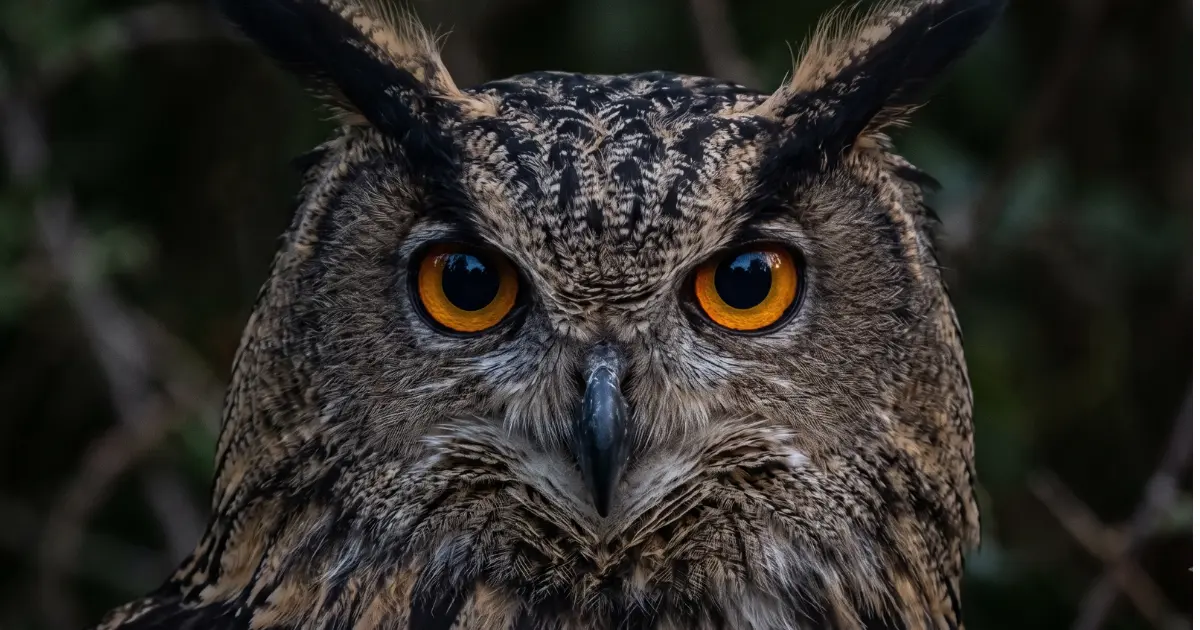
Ancient Athens sat at the peak of philosophy, democracy, and mathematics around 500 BCE. Yet the Athenians still handed their entire concept of wisdom to a small, fluffy bird with enormous eyes. The little owl became the companion of Athena, goddess of wisdom. Its image covered Athenian silver coins so thoroughly that “owls” became slang for money itself. An owl flying over troops before battle was read as a guarantee of victory. The Greeks were onto something. However, they were onto the wrong thing. They are not wise in any human sense. They are, instead, one of the most specialized killing machines evolution has ever produced. This guide breaks down the actual biology behind the myth, and it explains why almost nobody should ever try to keep one.
Why Did Ancient Greece Worship the Owl as a Symbol of Wisdom?

The Athenians likely mistook the owl’s forward-facing eyes for a thoughtful, human-like stare. Humans read forward-facing eyes as a sign of intelligence and attentiveness, since most primates share that same eye layout. They simply inherited the same trait for an entirely different reason. Binocular vision helps a predator judge distance to prey with precision. In fact, the Greeks were reading a hunting adaptation as a philosophical trait. The Rod of Asclepius did something similar with snakes, turning a practical animal behavior into cultural symbolism. Therefore, the owl’s reputation for wisdom says more about ancient pattern recognition than about actual owl cognition.
How Do They Achieve Nearly Silent Flight?
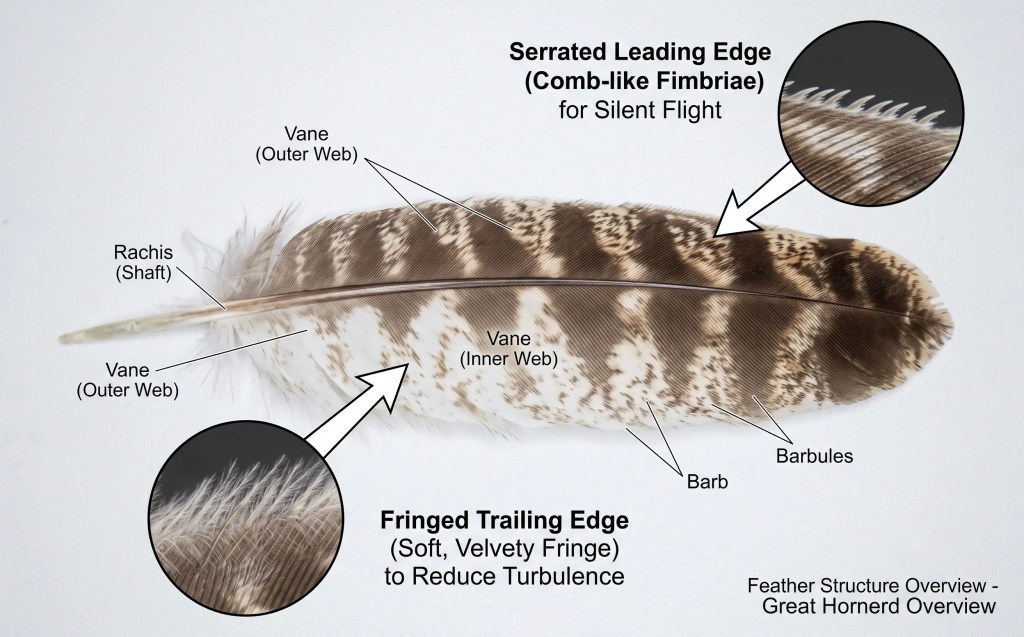
Owls fly almost silently because their feathers are engineered, not just shaped, for sound suppression. The leading edge of each wing feather carries a comb like row of stiff serrations that break up turbulent airflow before it becomes noise. Behind that, a soft, velvety surface texture on the feather absorbs remaining sound frequencies as air passes over it. The trailing edge finishes the job with a fringed, hair-like border that lets air bleed off gradually instead of shedding it in one noisy burst. A 2017 review in the Royal Society journal Interface Focus confirmed all three features work together. Alongside the owl’s large wing size and low wing loading, to allow slow, quiet flight. Specifically, low wing loading lets an owl glide at low speed without stalling, and slow flight itself produces less aerodynamic noise.
This system works so well that engineers have started stealing it outright. A 2024 University of California, Berkeley study published in Nature Communications combined owl feather serrations with cicada wing geometry to design quieter drone propellers. The resulting design cut sound pressure levels by up to 5.5 decibels and boosted propulsive efficiency by more than 20 percent compared to standard industry propellers. As a result, an adaptation that evolved purely to help it ambush a mouse is now shaping the future of drone engineering.
What Makes an Owl’s Eyes So Different From Ours?
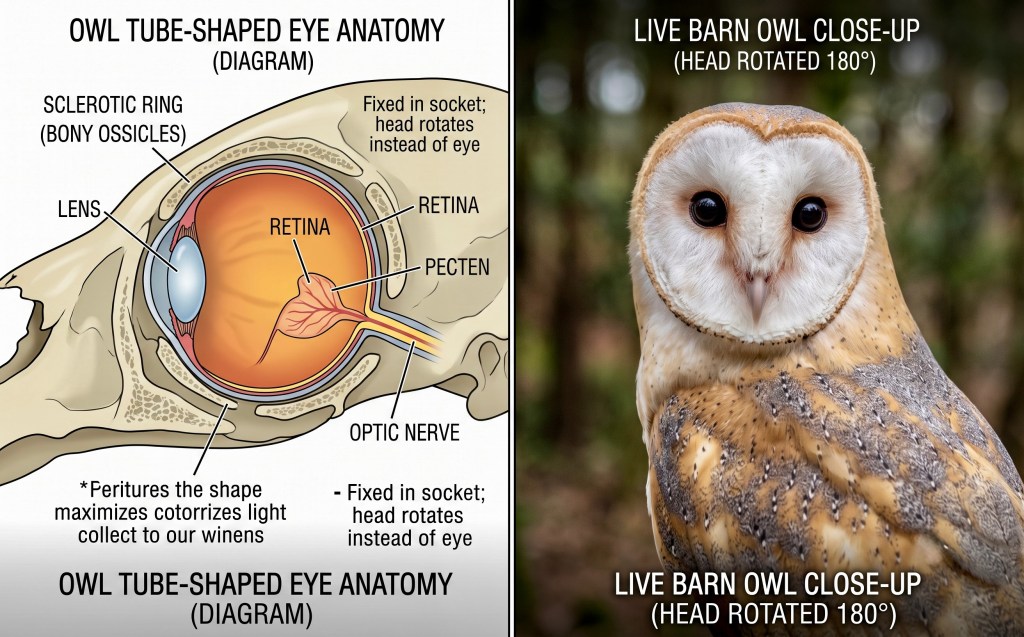
Owl eyes are not spherical like human eyes; they are tube-shaped and fixed permanently in the skull. Consequently, it cannot roll its eyes or shift them side to side the way a human or a cat can. To compensate, owls rotate their entire head instead, and they do it dramatically. Most species can turn their heads roughly 270 degrees in either direction, made possible by extra neck vertebrae and specialized blood vessels that keep circulation stable during the twist. It’s retinas are also packed with rod cells, the photoreceptors responsible for detecting light in low-light conditions.
Humans rely on a mix of rods and cones for color and daylight vision. They sacrifice most of that color sensitivity in exchange for extraordinary night vision. In fact, an owl’s eyes are so large relative to its skull that they leave comparatively little room for other structures, including brain tissue. That single anatomical trade-off explains a great deal about what owls are, and are not, capable of.
How Do They Hunt in Total Darkness?
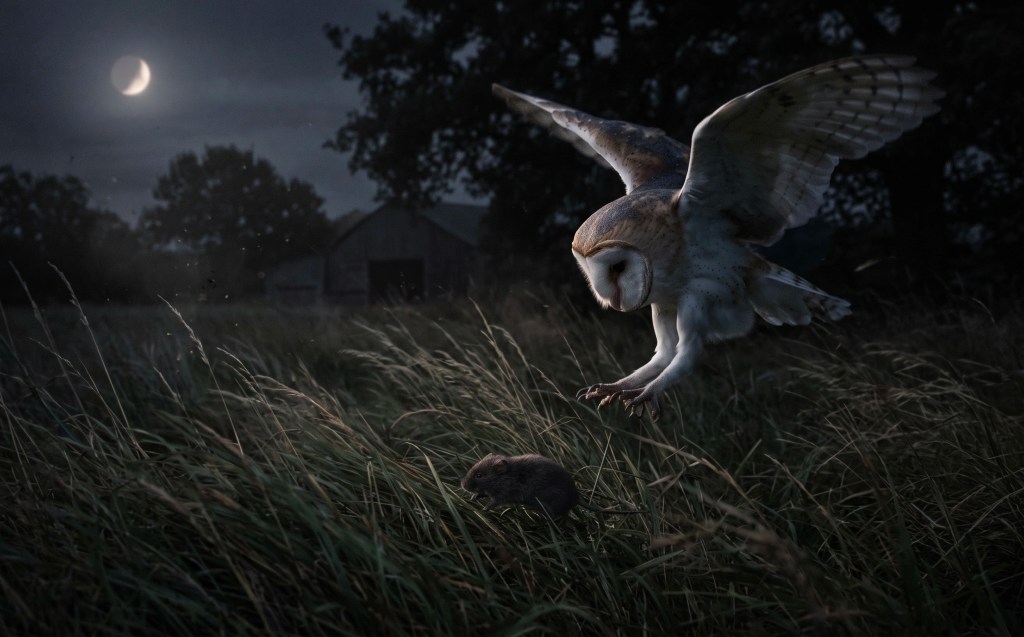
Owls do not rely on eyesight alone once darkness becomes near total; they hunt primarily by ear. Species like the barn owl have asymmetrically placed ear openings, with one ear set slightly higher on the skull than the other. This asymmetry lets it triangulate the exact vertical and horizontal position of a sound, effectively letting it “see” a rustling mouse through hearing alone. The flat, dish-shaped facial disc funnels sound toward those ears the same way a satellite dish gathers a signal. Specifically, an owl’s brain constantly updates its estimate of a sound’s location as new auditory information arrives, refining the strike point in real time. Combine that hearing system with silent flight, and the result is a predator that a mouse never hears coming. This is not folklore; it is a documented sensory system built entirely around ambush.
Are Owls Actually Intelligent?
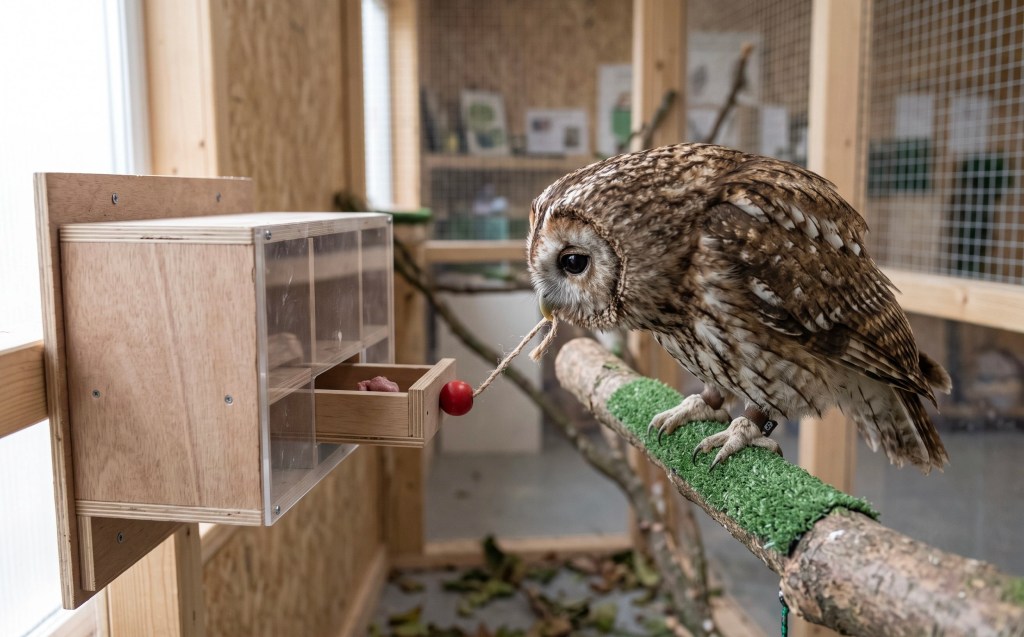
Owls do show real problem-solving behavior. Captive individuals have learned to pull strings to access food, and wild owls cache food for later use and occasionally bait prey into range. Some species have also demonstrated basic tool use and cooperative hunting. According to research summarized by Jennifer Ackerman in her 2023 book “What an Owl Knows.” However, they generally have fewer neurons than similarly sized mammals, and their brains are heavily optimized for vision and hearing rather than general reasoning.
A well-known cross-species study by Lefebvre and colleagues found that owls, as a family, show a moderate relationship between brain size and innovation, but nowhere near the level seen in corvids or parrots. They show little evidence of symbolic thought, self-awareness, or the flexible, generalized problem-solving seen in crows. Therefore, calling an owl “wise” is inaccurate. Calling it “narrowly brilliant at exactly one job” is far closer to the truth.
Can You Legally Own an Owl as a Pet?
In the United States, the answer is almost always no. Every native owl species is protected under the Migratory Bird Treaty Act of 1918, and possessing one without federal authorization is a criminal offense. No permit category exists for private pet ownership of any kind. The only legal paths involve becoming a licensed falconer, a wildlife rehabilitator, or working within a permitted educational program. Becoming a falconer alone requires progressing through apprentice, general, and master levels, a process that takes a minimum of seven years under federal regulation 50 CFR 21.82. Even then, the bird legally belongs to the sport of falconry, not to you as a companion animal.
Some people assume importing a non-native species like a Eurasian eagle-owl sidesteps this entirely. It does not, since the Wild Bird Conservation Act separately restricts most exotic bird imports. The United Kingdom takes a different approach, and captive breeding of certain owl species there is legal and commonly practiced. This legal gap between countries is precisely why online claims about “pet owls” are so often misleading, and why you should verify your own country’s specific wildlife law before assuming anything is allowed.
Which Owl Species Appear in the Pet Trade?

Where legal captive breeding exists, a small handful of species dominate the market. The Eurasian eagle-owl, the Bengal eagle-owl, and the spotted eagle-owl appear most frequently in UK falconry and educational contexts. Barn owls also appear, though usually through rehabilitation and education programs rather than private sale. In countries where enforcement is weak, the picture turns considerably darker. A peer-reviewed study published in Global Ecology and Conservation documented a genuine “Harry Potter effect” in Indonesian bird markets. Owls made up less than 0.06 percent of birds sold before 2002, but that figure rose to over 0.43 percent by 2008, and the vast majority were wild-caught and illegally trapped.
Interestingly, a separate peer-reviewed study in PLOS One tested the same theory in the UK and found no statistical link between Harry Potter’s popularity and increased trade or abandonment there. In other words, the popular “owls got dumped after the movies ended” narrative holds up in Indonesia’s data, but it does not hold up in the UK’s. That distinction matters, and repeating the flattened version of the story does a disservice to the actual research.
Why Are They Critical to Their Ecosystem?
Owls function as one of nature’s most efficient rodent control systems. A single barn owl family can consume more than 1,000 rodents in a single breeding season, and this predation pressure keeps agricultural pest populations in check without any chemical input. As a result, many farms now install barn owl nest boxes specifically to reduce dependence on rodenticides, which carry their own risks of secondary poisoning up the food chain. They also serve as an indicator species, since their presence and breeding success reflect the overall health of a local rodent population and habitat structure. Removing owls from an ecosystem does not just remove one predator; it removes a self-sustaining, chemical-free form of pest management that took millions of years to perfect.
What Are the Animal Welfare Concerns With Captive Owls?
Owls make consistently poor companion animals, and the welfare data backs this up directly. Unlike parrots, they show little evidence of forming genuine social bonds with humans; what people often interpret as affection tends to be food-driven association or simple habituation. Owls also require live or freshly killed whole prey to meet their nutritional needs, something most owners are neither prepared for nor comfortable providing long-term. Confinement in small cages restricts the wing-spreading and flight behavior owls need for muscle and bone health, and this frequently leads to feather damage and chronic stress.
J.K. Rowling herself publicly discouraged owl ownership after the “Harry Potter” films, stating she never intended to suggest an owl would be happy shut in a small cage inside a house. Consequently, most wildlife rehabilitation centers agree that an owl belongs in a large, secure aviary managed by an experienced falconer, never in a household as a casual pet.
My Experience
I do not keep an owl, and after researching this deeply, I have no intention of ever getting one. I built my exotic pet experience on species that genuinely adapt to captivity when their needs are met correctly, like my red-eared sliders Mike and Frida, and my chameleon Cosmo. Owls are a different category entirely. They are wild predators with a brain wired for one job, and no amount of enrichment replaces that.
Every serious falconer I have read about spent years training under strict legal oversight before ever handling a bird, and even then, the owl remains a working animal, not a companion. That distinction matters, and I think it gets lost in the aesthetic of owning something that looks wise and gentle in a photo. If you love owls, support a licensed rehabilitation center or a legitimate falconry program instead of chasing pet ownership. The bird, and the law, will both thank you.
Owls FAQ
Most owl species can rotate their heads roughly 270 degrees in either direction. Extra neck vertebrae and specialized blood vessels allow this range without cutting off circulation. Owls compensate this way because their tube-shaped eyes cannot move within the socket at all.
No, private pet ownership of any native owl species is illegal under the Migratory Bird Treaty Act. Only licensed falconers, wildlife rehabilitators, and permitted educational programs may legally possess one. Becoming a licensed falconer alone takes a minimum of seven years.
Owls show narrow, specialized intelligence built almost entirely around hunting. They demonstrate tool use, food caching, and problem-solving in captivity studies. However, they lack the generalized reasoning and self-awareness documented in corvids and parrots.
Serrated leading-edge feathers break up turbulent airflow before it becomes audible noise. A velvety feather surface and a fringed trailing edge absorb and release remaining sound gradually. Large wings and low wing loading also let owls fly slowly, which further reduces aerodynamic noise.
In Indonesia, confirmed market data shows owls rose from under 0.06% to over 0.43% of traded birds after the books released. Most of that trade was wild-caught and illegal. A separate UK study found no statistical link between the films and increased owl trade or abandonment there.
Yes, a single barn owl family can consume more than 1,000 rodents in one breeding season. Farms increasingly install owl nest boxes to reduce dependence on rodenticides. This lowers the risk of secondary poisoning moving up the food chain.
Sources
- Royal Society Interface Focus
Features of owl wings that promote silent flight - Nature Communications
Towards silent and efficient flight by combining bioinspired owl feather serrations with cicada wing geometry - Bioneers
What an Owl Knows: Rethinking Bird Brains & Intelligence - PMC (Cognitive Ornithology)
The evolution of avian intelligence - LegalClarity
Can You Legally Keep an Owl as a Pet: Laws & Permits - PLOS One
Investigating the impact of media on demand for wildlife: Harry Potter and the UK trade in owls - Smithsonian Magazine
Harry Potter Sparks Illegal Owl Trade in Indonesia


Leave a Reply