
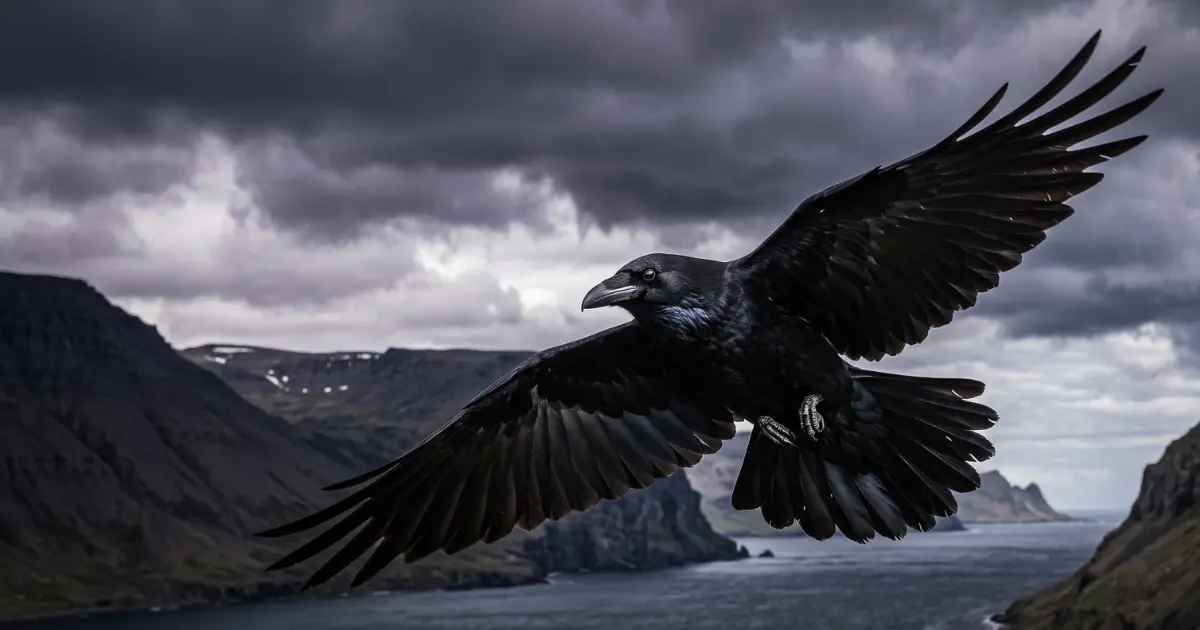
Ravens in Norse mythology rarely get treated as anything more than dark, atmospheric symbolism. That reading undersells them. Vikings built an entire information system around these birds, one that stretched from Odin’s throne in Asgard to actual open-ocean navigation. Consequently, ravens occupied a strange middle ground in Norse culture: half religious icon, half working tool. This article separates the two. It examines what the sagas actually document, what modern raven biology confirms, and where the myth simply outpaces the evidence.
What Made Ravens in Norse Mythology So Significant to the Vikings?

Ravens held a rare dual status in Viking society. They represented divine intelligence through Odin, and they served a practical, tested purpose at sea. Consequently, Norse culture never separated the sacred raven from the useful one. The bird on the god’s shoulder and the bird on the ship’s rail were, in the Viking mind, the same animal. This overlap is precisely why ravens in Norse mythology carry more weight than most animal symbols from the period. They were not abstract. Sailors without instruments trusted them with actual lives.
How Did Odin’s Ravens in Norse Mythology Gather Information?

Odin relied on two named ravens, Huginn and Muninn, whose names translate to Thought and Memory. According to the Poetic Edda and Snorri Sturluson’s Prose Edda, Odin sent them out at dawn to fly across the nine realms. By breakfast, they returned and whispered everything they had seen and heard into his ears. This routine made Odin function as an intelligence hub long before written record-keeping existed in Scandinavia. As a result, the sagas describe him fearing their failure to return more than almost anything else. Indeed, Snorri notes that Odin worried specifically about Muninn, since losing memory mattered more to him than losing thought. This detail is easy to miss. However, it reveals that the Vikings saw memory, not raw information, as the harder resource to protect.
Did Vikings Really Use Ravens to Find Land?

Yes, and this is not folklore dressed up as fact. The Landnámabók, Iceland’s medieval Book of Settlements, records a Norwegian explorer named Flóki Vilgerðarson doing exactly this. He carried three ravens on his voyage toward an unconfirmed western land. Flóki released them one at a time to read their flight paths. The first bird flew back toward the Faroe Islands, so land clearly sat behind him. The second circled the ship and returned, meaning nothing new had been found yet. The third raven, however, flew northwest and never came back. Flóki followed it and reached Iceland. The technique earned him the nickname Hrafna-Flóki, or Raven-Flóki, a name that outlived almost everything else about him.
Why Do Ravens in Norse Mythology Still Resonate Today?

The method behind Flóki’s ravens was not mystical at all. Land birds avoid open ocean whenever possible, so a raven released far from shore will fly toward the nearest coastline if one exists. Consequently, the “trick” was applied ornithology centuries before anyone used that term. This is also why ravens in Norse mythology hold up better than most ancient animal beliefs under modern scrutiny. The Vikings built a genuine navigation heuristic around an accurate observation of raven behavior. In fact, common ravens (Corvus corax) are known today for strong spatial memory and long-distance flight endurance, both of which support the saga’s account. Therefore, the myth and the method reinforce each other instead of contradicting one another.
Personal Note: How Exotastic Earth Verified This Story
Every article in this series gets checked against primary saga sources first, not secondary retellings. For ravens specifically, that meant separating the Poetic Edda‘s mythological framing from the Landnámabók‘s settlement record. These are different documents with different purposes, and conflating them is a common mistake online. I found no credible evidence that raven-navigation was a routine Viking practice beyond Flóki’s account. However, the underlying logic holds up biologically, which is why I kept it in the “confirmed technique” category rather than “unverified legend.” That distinction matters for an evidence-based platform. It is also, frankly, the entire point of this series.
Ravens in Norse Mythology FAQ
They appear as literal ravens within the mythology, not metaphors invented later. Snorri Sturluson describes them as physical birds that Odin gave the power of speech. Scholars debate whether they also represent extensions of Odin’s own mind. Both readings coexist in the source texts without one canceling out the other.
Huginn derives from Old Norse hugr, meaning thought or mind. Muninn comes from munr, translated as memory, though it can also imply mind or desire. Together, the names frame Odin as a god who actively processes and retains information, rather than one who simply knows everything by default.
The clearest documented case is Flóki Vilgerðarson’s voyage to Iceland in the Landnámabók. There is no strong evidence this was routine across the Viking Age. Treat it as a specific, recorded technique rather than a universal Viking navigation system.
Hrafna-Flóki Vilgerðarson was a ninth-century Norwegian explorer and one of the first Norsemen to deliberately sail toward Iceland. His raven-release method became so associated with him that it replaced his birth name in most historical records. He also named Iceland itself, after sighting a fjord full of drift ice.
Odin’s constant pairing with Huginn and Muninn in art and text earned him the title Hrafnaguð. This appears in the Prose Edda‘s Gylfaginning section. The name reflects how central the ravens were to his identity, not just his entourage.
Common ravens rank among the most cognitively capable birds studied, with strong memory and problem-solving skills. This does not confirm the mythology’s supernatural claims. It does explain why Norse culture, observing real raven behavior, would credit them with unusual intelligence.
Hashtags and Emojis for Social Media
#RavensInNorseMythology 🐦⬛ #VikingHistory ⚔️ #OdinsRavens #NorseMythology #AnimalsInHumanHistory 🌍
Sources
- Wikipedia
https://en.wikipedia.org/wiki/Huginn_and_Muninn - Norse Mythology for Smart People
https://norse-mythology.org/gods-and-creatures/others/hugin-and-munin/ - The Viking Herald
https://www.thevikingherald.com/article/who-was-hrafna-floki-vilgerdjarson-the-first-norsemen-to-intentionally-set-sail-for-iceland/171 - FunIceland
https://www.funiceland.is/facts/settlement-of-iceland/hrafna-floki-vilgerdarson/


Leave a Reply
You must be logged in to post a comment.