
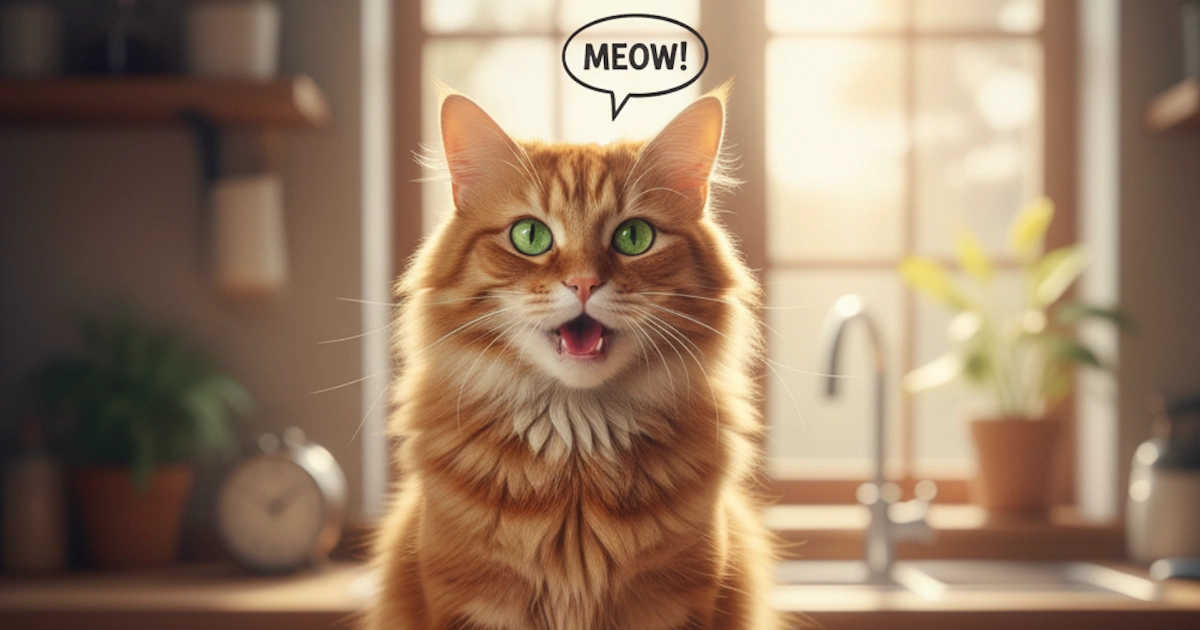
It is the constant soundtrack to a cat owner’s life: the sweet “mew” of a happy greeting, the sharp “meow!” of a dinner-time demand, and the long “mrrrroww” from the other side of a closed door. But,what are they actually trying to say? In other words, why does your cat provide a running commentary on your existence? Is it a sign of affection, or are you just being manipulated? Ultimately, this guide is your official translation dictionary for the complex and fascinating language of cat meowing.
A Formal Complaint to Management
I am a multilingual communicator in my own home. I understand the subtle color shifts of a grumpy chameleon, which is a language of pure, silent judgment. Furthermore, I can interpret the gentle sifting of my Kuhli Loaches, a quiet expression of “all is well.”
And then there are my cats. They do not communicate; instead, they narrate and hold press conferences. In fact, they deliver impassioned, Shakespearian monologues about the unforgivable tragedy of a food bowl that is only 98% full. They have me trained. For example, a short, sharp “mrrrp!” means “open this door immediately,” while a long, drawn-out “meeeeooooow?” is a formal inquiry as to why the petting has ceased. They are masters of vocal manipulation, and consequently, I am their well-trained, can-opening servant. This guide is my attempt to translate the demands of these tiny, furry CEOs.
What is the Big Secret Behind Cat Meowing?
First and foremost, here is the most fascinating fact: adult cats do not meow at each other. They use a complex language of hisses, purrs, and body language to communicate with other cats.
So, why do they meow at us? The answer is simple: they learned to. Kittens meow at their mothers to signal that they are cold or hungry. Then, as they grow up, they realize that we are completely oblivious to their sophisticated adult body language. Therefore, they revert to the one thing that always worked: they start meowing at us like we are their giant, clumsy, hairless mothers. The meow is a unique language that cats have developed specifically to communicate with humans, making the study of cat meowing so fascinating.
A Translation Guide: What is Your Cat Trying to Tell Me?
1. Is My Cat Just Saying Hello? (The Greeting Meow)
This is often a series of short, cheerful, chirpy meows you get when you come home. It is a genuine, happy-to-see-you greeting.
2. Is My Cat Demanding Something? (The “Command” Meow)
This is the most common reason for persistent cat meowing. Your cat wants something, and it knows you are the one who can provide it.
- The Food Meow: A loud, insistent meow, usually performed near the food bowl. It is a clear demand for service.
- The “Let Me In / Let Me Out” Meow: A long, mournful meow, typically delivered directly at a closed door.
- The “Pay Attention to Me” Meow: A persistent meow from a cat that is bored, lonely, or simply wants you to stop looking at that glowing rectangle.
3. Could My Cat Be Lonely or Bored? (The “I’m Bored” Meow)
Yes. A cat left alone for long periods without enough stimulation will often meow out of sheer boredom or loneliness.
4. When is Cat Meowing a Sign of Pain or Illness? (The Red Flag Meow)
This is the most critical distinction to learn. Specifically, you must pay attention to any sudden changes in your cat’s vocalizations.
- A Change in Tone or Volume: A cat that is normally quiet and suddenly starts meowing excessively may be in distress.
- Meowing at the Litter Box: This is a major red flag for a painful urinary tract infection.
- Meowing While Eating: This can signal a painful dental problem.
- Disoriented Howling: Older cats can develop feline dementia and may howl loudly at night out of confusion.
If you notice any of these signs, a trip to the veterinarian is essential.
How Can I Get My Cat to Stop Meowing So Much?
First, ensure all their basic needs are met. If the cat meowing is purely for attention, you can manage it.
Rule #1: Do NOT Reward the Demand Meow
This is the hardest part. If your cat is meowing at you for food, you must ignore it. Wait until they have been quiet for at least a few seconds, and then give them what they want. This teaches them that silence, not meowing, gets results.
Rule #2: Stick to a Schedule
Cats thrive on routine. Feed them at the same time every day to reduce “Is it dinner time yet?” meows.
Rule #3: Provide Enrichment for Boredom
A bored cat is a noisy cat. Therefore, provide plenty of toys and a scratching post. Most importantly,schedule active playtime with a feather wand every day to tire them out and reduce attention-seeking cat meowing.
Cats Meowing FAQ
Adult cats do not meow at each other — they communicate with hisses, purrs, and body language. Cats developed meowing specifically as a communication tool for humans, adapting the kitten-to-mother vocalization they learned worked early in life. The meow is a uniquely human-directed language that cats refined over generations of living alongside people.
Meowing inside or at the litter box signals a probable urinary tract infection requiring immediate veterinary attention. Meowing while eating indicates dental pain. Loud, disoriented howling at night in older cats is a primary sign of feline cognitive dysfunction. Any sudden, unexplained change in meowing frequency or tone warrants a veterinary evaluation.
The food-demand meow is a trained behavior that developed because it consistently produced results. Cats are precise cause-and-effect learners — once a vocalization reliably triggers a reward, it becomes a fixed strategy. Waiting until the cat falls completely silent before delivering food teaches it that silence, not meowing, earns the response.
Nighttime meowing most commonly occurs for three reasons: unsatisfied hunger or thirst, a demand for attention, or — particularly in senior cats — feline cognitive dysfunction causing disorientation and confusion. A cat that begins howling at night after years of silence should be evaluated by a veterinarian before behavioral management is attempted.
Responding to demand meowing — even once — reinforces the behavior, so the most important rule is to provide no response while the cat is actively vocalizing. Wait for a moment of silence, then deliver the attention or food. Consistent meal scheduling and daily interactive play sessions significantly reduce attention-seeking and boredom-driven meowing over time.
Sources
- Scientific American
https://www.scientificamerican.com/article/why-do-cats-meow-at-humans-but-not-at-each-other/ - VCA Animal Hospitals
https://vcahospitals.com/know-your-pet/how-do-i-know-if-my-cat-is-in-pain - Cornell Feline Health Center
https://www.vet.cornell.edu/departments-centers-and-institutes/cornell-feline-health-center/health-information/feline-health-topics/cognitive-dysfunction - The Spruce Pets
https://www.thesprucepets.com/stop-excessive-meowing-554060 - International Cat Care
https://icatcare.org/advice/why-does-my-cat-meow-so-much/


Leave a Reply