
You’ve perfected your reptile’s environment. Indeed, the temperatures are stable, the humidity is precise, and the diet is perfectly supplemented. Your pet is surviving. But is it thriving? The difference between those two states, in fact, often comes down to one crucial, and often overlooked, concept: reptile enrichment. Ultimately, providing a complex, stimulating world for your reptile is the final and most rewarding step in responsible husbandry. Therefore, this guide is your creative toolkit, designed to help you banish boredom and unlock the fascinating natural behaviors of your scaly companions.
Trying to Entertain a Tiny, Judgmental Dinosaur
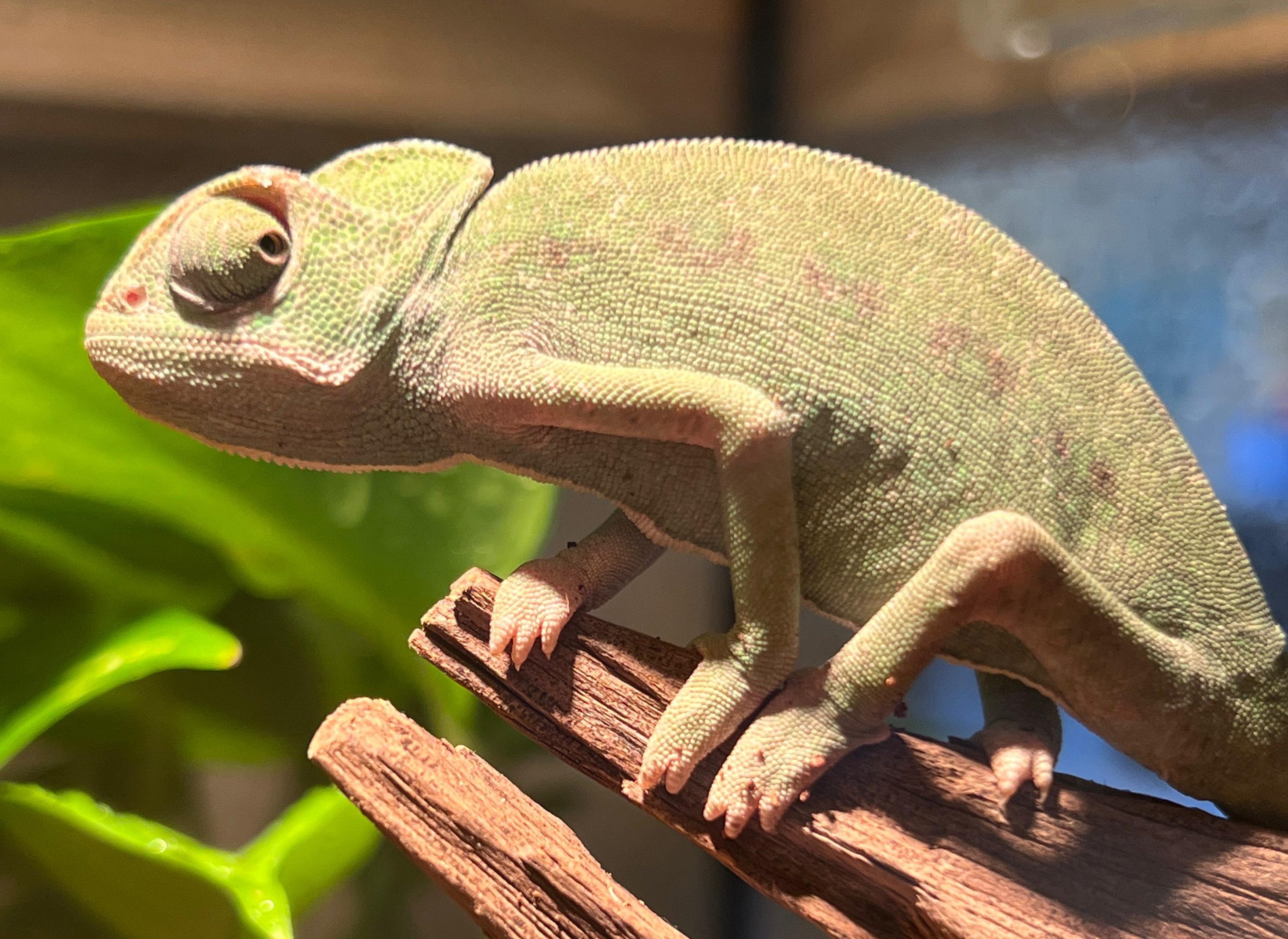
My chameleon, Cosmo. Enriching his life is a challenge on a whole other level. He’s a tiny, grumpy, prehistoric mastermind who is unimpressed by… well, everything. For instance, I’ll spend an hour meticulously rearranging the vines in his enclosure into a new, exciting jungle gym. In turn, he’ll reward me with a slow, judgmental side-eye that says, “I see what you’ve done here. It is adequate.” It’s a hilarious, humbling reminder that reptile enrichment isn’t about getting a thank you. It’s about providing the opportunity for natural behavior. Even if that behavior is just finding a new branch from which to silently judge you.
What is Reptile Enrichment, and Why Does It Matter?
First and foremost, environmental enrichment is the process of providing a stimulating, complex, and interactive environment. This allows an animal to engage in its natural, instinctual behaviors. It’s the critical difference between a reptile living in a sterile, functional box and one living in a tiny, captive world that challenges its brain. This environment challenges its body every single day. Conversely, a lack of enrichment leads directly to boredom, which, in the animal world, is a chronic and debilitating form of stress. This stress, in turn, leads to a lethargic, unhealthy, and unhappy animal.

The “Sterile Box” vs. The “Tiny World”
To illustrate, think about the classic, old-school reptile setup: a glass tank with paper towels, a single hide, and a water bowl. Does this provide for the animal’s basic survival? Yes. Does it provide for its psychological well-being? Of course not. This is the “sterile box.” The animal has nothing to do, nowhere to explore, no problems to solve, and no choices to make.
Now, imagine a “tiny world.” For a Leopard Gecko, this would mean an enclosure with a deep substrate to dig in. It should have multiple pieces of stacked slate to create tight crevices. There should be different textures like cork bark and smooth stones to explore. Additionally, its food should be scattered around the enclosure, not left in a bowl. In this world, the gecko isn’t just existing; instead, it’s actively engaging in the behaviors of a wild leopard gecko—it’s digging, climbing, exploring, and hunting. Consequently, its mind and body are active.
Why Does It Matter So Much?
The Core Benefits of Reptile Enrichment
Furthermore, providing enrichment is not just about making a “prettier” enclosure. It has profound and measurable benefits for your reptile’s health.
- It’s the Ultimate Stress-Buster: Boredom is a powerful stressor. aa stimulated reptile is a less stressed and more resilient reptile.
- It Promotes Physical Health: Enrichment encourages exercise. For example, for an arboreal Crested Gecko, a network of vines to climb builds muscle tone. Similarly, for a fossorial Sand Boa, a deep substrate to tunnel through is a full-body workout.
- It Prevents Behavioral Problems: Many of the “bad” behaviors we see in captive reptiles are a direct result of boredom. In fact, pacing, nose-rubbing, lethargy, and even aggression can often be traced back to an environment that is too small or simple.
- It’s Fascinating to Watch! An enriched reptile is an active reptile. Indeed, the greatest reward is that you get to witness a far wider range of your pet’s natural behaviors. You get to see the hunter, the burrower, and the climber.
How Do I Think Like a Reptile? (The Foundation)
The key to successful enrichment is to understand your specific reptile’s natural history. Therefore, before you add anything to their enclosure, ask yourself these questions:
Where is it from?
To begin with, this is the most foundational question. A reptile’s native habitat is the blueprint for its entire existence. For example, think about a Bearded Dragon from Australia. Its world is one of intense sun and dry air. Because of this, its instincts are to bask in powerful heat. Therefore, providing a single, monotonous temperature is failing the animal. The highest form of enrichment is a powerful heat lamp creating a basking spot of over 100°F on one side, and a cool, dark burrow on the other. In other words, you have given it a choice.
Now, consider a Crested Gecko from New Caledonia. Its world is one of dappled light and high humidity. For this animal, enrichment is a tall, vertical enclosure filled with a chaotic jungle of foliage.
How does it move?
An animal’s body is a roadmap to its enrichment needs. Specifically, for a fossorial species like a Kenyan Sand Boa, the substrate is the entire world. Thus, providing only a thin layer of aspen shavings is inadequate. The most crucial form of enrichment for a Sand Boa is a deep, 3-4 inch bed of substrate.
Similarly, for an arboreal snake like a Green Tree Python, a life on the ground is stressful. For this animal, enrichment is a series of secure, horizontal perches, allowing it to move securely.
How does it hunt or forage?
For most reptiles, finding food is the primary problem their brain evolved to solve. Thus, simply dropping food into a bowl is a recipe for a bored animal.
For instance, think of an active hunter like an Ackie Monitor. Its brain is a finely tuned machine. Scattering its insect feeders throughout a complex enclosure forces it to actively hunt.
Even a slow-moving ambush predator like a Ball Python benefits from this. For example, instead of dangling a thawed rodent in front of its face every time, try placing it in a different part of the enclosure after dark. This encourages the snake to actively “hunt” its meal.
How does it hide?
Additionally, this is the most critical element for a reptile’s psychological well-being. However, “hiding” means different things to different species. For example, for a crevice-dwelling species like a Leopard Gecko, their instinct is to wedge themselves into tight, dark spaces. Therefore, the best enrichment is to provide stacked pieces of slate that create tight, horizontal crevices.
Conversely, for a species that hides in leaf-litter like a Rough Green Snake, security means being visually obscured. Thus, a truly enriched enclosure is densely packed with foliage so the snake feels invisible.
In conclusion, by asking and answering these four fundamental questions, we move beyond just being a pet owner. Instead, we become amateur biologists. We learn to think like our reptile, and in doing so,we gain the ultimate reward: the ability to build a tiny, perfect world that allows our pets to truly thrive.
Reptile Environment Enrichment FAQ
Reptile enrichment is the deliberate design of a complex environment that allows captive reptiles to perform natural instinctual behaviors. It is the critical difference between an animal that merely survives and one that genuinely thrives. Chronic absence of enrichment causes measurable stress and immune suppression in captive animals.
Yes, reptiles experience boredom as a form of chronic, measurable stress. A barren enclosure with no choices, problems, or behaviors to perform actively harms the animal’s long-term health. Reptile enrichment is not an optional luxury; it is a core requirement for responsible captive husbandry.
Bearded Dragon reptile enrichment centers on thermal choice and active foraging opportunities. A powerful basking spot above 100°F paired with a cooler retreat gives the animal meaningful environmental control. Scattering food throughout the enclosure rather than bowl-feeding directly activates natural foraging behavior.
Effective chameleon reptile enrichment prioritizes vertical space, visual complexity, and periodic habitat novelty. A densely planted enclosure with varied vine textures and multiple perch heights supports natural arboreal movement patterns. Periodically rearranging climbing structures introduces spatial novelty that engages the chameleon’s environmental awareness and instincts.
Yes, reptile enrichment directly improves physical health by promoting natural movement and regular exercise. Arboreal species develop muscle tone through climbing, while fossorial species strengthen their bodies through burrowing. Reduced chronic stress from enrichment also directly supports immune function and lowers disease susceptibility.
A lack of reptile enrichment commonly causes pacing, repetitive nose-rubbing against glass, persistent lethargy, and increased aggression. These behaviors are frequently misattributed to illness or innate temperament problems. In most cases, they are direct responses to an environment too bare or too predictable for the animal’s instincts.
Foraging reptile enrichment involves scattering food throughout the enclosure instead of placing it in a static bowl. Active hunters like Ackie Monitors are forced to seek prey, engaging the problem-solving instincts their brains evolved for. Even ambush predators like Ball Pythons benefit when food placement varies unpredictably.
Sources
- MSD Veterinary Manual
https://www.msdvetmanual.com/exotic-and-laboratory-animals/reptiles/management-of-reptiles - Scientific American
https://www.scientificamerican.com/article/the-science-of-reptile-enrichment/ - ScienceDirect / Journal of Veterinary Behavior
https://www.sciencedirect.com/science/article/abs/pii/S155878781400057X - VCA Animal Hospitals
https://vcahospitals.com/know-your-pet/reptile-care-and-enrichment - The Spruce Pets
https://www.thesprucepets.com/enrichment-for-snakes-and-other-reptiles-554123
Leave a Reply
You must be logged in to post a comment.