
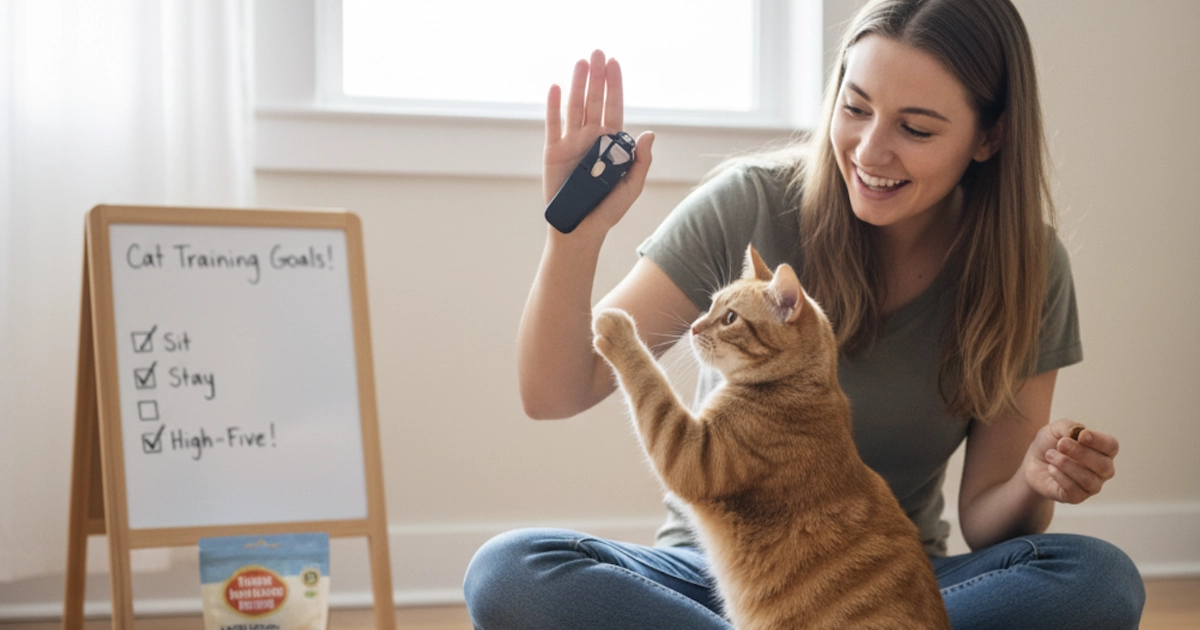
It is a statement uttered as fact in households across the world: “You can’t train a cat.” Consequently, we see them as stubborn, independent, and completely uninterested in our human rules. We believe that dogs are trainable, and conversely, cats simply… are. But what if that’s completely wrong? What if, in reality, the creature currently napping on your keyboard is a tiny, furry genius just waiting for the right motivation? The truth is, cats are not only trainable, but also brilliant learners. You just have to learn to speak their language. This guide, therefore, is your complete handbook for unlocking your cat’s hidden potential and finally proving to your friends that, yes, you can teach a cat to high-five.
The Illusion of Control
In my house, I am the highly trained servant to a board of eight feline CEOs. Indeed, I have been expertly conditioned by them over many years. I know that a specific, short “mrrp!” is a direct order to open the bedroom door. Furthermore, I have also learned that a prolonged, soulful stare from across the room is a performance review indicating my lap-providing services are currently subpar. Consequently, they have me wrapped around their little paws.
Training them? This, however, is a different matter altogether. Rather, it is a complex, ongoing negotiation with a team of tiny, furry lawyers who are paid in tuna. This guide, therefore, is the collection of negotiation tactics that have actually worked.
Can You Really Train a Cat?
Yes, absolutely! In fact, the myth that cats are untrainable comes from a fundamental misunderstanding of their motivation.
A Dog’s Motivation: A dog is a pack animal, genetically wired to please its pack leader. Therefore, their primary question is, “What do you want me to do?”
A Cat’s Motivation: A cat is a solitary hunter. Consequently, their primary question is, “What’s in it for me?”. As a result,you cannot train a cat using dominance or a simple desire for praise. Instead, you must train them like you would a dolphin or a zoo animal: with clear signals and high-value, immediate rewards.
What is the Best Method for Training a Cat?
The only method that works is Positive Reinforcement, powered by a technique called Clicker Training. This method focuses on using a distinct sound (a “click” from a small plastic clicker) to mark the exact moment your cat does the right thing, which is then followed immediately by a delicious treat.
Consequently, the cat learns to associate the “click” sound with the reward. Ultimately, the click becomes a powerful “YES!” signal that tells them, “What you just did at this exact second is what earned you this treat.” This makes your communication with them incredibly clear and precise.
How Do I Start a Training Session?
- “Charge” the Clicker: The first step is to teach your cat what the click means. Simply sit with your cat, click the clicker, and immediately give them a tiny, high-value treat. Repeat this 10-15 times. Do this for a few short sessions. Your cat will very quickly learn that click = snack.
- Keep Sessions Short and Sweet: A cat’s attention span is short. Keep your training sessions to just 2-5 minutes long, once or twice a day. Always end on a positive, successful note.
- Choose the Right Time: The best time to train is when your cat is a little hungry and receptive, not right after a big meal or a long nap.
- Use High-Value Treats: Their normal kibble won’t cut it. You need something special and smelly, like tiny pieces of plain cooked chicken, freeze-dried shrimp, or a lickable puree treat.
What Are the First Commands I Should Teach My Cat?
How do I teach my cat to “Sit”?
This is the easiest one to start with. To begin, hold a treat in front of your cat’s nose, after which you slowly move it up and back over their head. As soon as their head follows the treat, their bottom will naturally lower into a sit. At that precise moment their rear touches the ground, click and give them the treat.
How do I teach my cat to “Come”?
This can be a life-saving command, so start training in a quiet room. First, say your cat’s name and the word “Come!” in a happy, excited voice. The moment they start walking towards you, click and then reward them generously when they reach you. Crucially, however, never use this command to call them for something they hate, such as a trip to the vet, as this will destroy their trust in the command.
How do I teach my cat to “High-Five”?
Since your cat is already comfortable with the “touch” behavior, this next step follows quite easily. First, hold your hand up and wait patiently for them to investigate it with their paw. As soon as their paw makes contact with your hand, clickand offer the treat. This immediate pairing reinforces the idea that touching your hand with their paw is the behavior that earns the reward.
How Do I Train My Cat to Stop a Bad Behavior?
The key to correcting unwanted behavior is redirection, not punishment. This is because scolding a cat is not only ineffective but also only creates fear and mistrust between you. Therefore, you must focus your efforts on a two-part solution: first, make the “bad” behavior unattractive (perhaps by using a deterrent); and second, you must simultaneously provide a better, more attractive alternative to satisfy your cat’s natural instincts.
For Scratching the Couch:
- Make the couch corner unappealing by covering it with double-sided tape.
- Place a tall, sturdy sisal scratching post right next to it.
- Make the post a paradise by rubbing it with catnip.
- The moment you see them use the post, shower them with praise and a treat.
For Jumping on the Counter:
- Make the counter unpleasant. A few strips of double-sided tape or even upside-down plastic carpet runners can work.
- Never, ever feed them from the counter.
- Provide an attractive “yes” nearby, like a tall, sturdy cat tree where they are allowed to be.
Can I Really Teach My Cat to Walk on a Leash?
Yes! This is a fantastic way to provide safe outdoor enrichment.
- Get a Comfortable Harness: Never attach a leash to a cat’s collar. Use a well-fitting, secure harness.
- Harness Acclimation: Let your cat get used to wearing the harness indoors for short periods, associating it with treats and praise.
- Leash Practice: Once they are comfortable, attach the leash and let them drag it around inside. Then, pick it up and simply follow them.
- The First Steps Outside: Start with a quiet, safe, backyard area. Let them lead the exploration.
Cat Training FAQ
Cats are trainable, and the belief that they cannot be is a fundamental misconception about their motivation. Unlike dogs, cats do not work for approval or praise — they work for immediate, high-value rewards. Applying the same reward-based methods used with dolphins and zoo animals produces reliable, consistent results with cats.
Clicker training uses a small device that produces a distinct sound to mark the exact moment a cat performs a desired behavior. The click is immediately followed by a high-value treat, teaching the cat that the sound signals “that action just earned a reward.” This precision makes communication significantly clearer than verbal praise alone.
Cat training sessions should run no longer than two to five minutes, conducted once or twice daily. A cat’s attention span is short, and sessions that run too long produce diminishing returns rather than progress. Every session must end on a positive, successful action to leave a rewarding final association.
Punishing a cat for unwanted behavior creates fear and distrust without communicating what the correct behavior is. A cat cannot connect a delayed correction to the triggering act, producing anxiety rather than compliance. Redirection — making the unwanted behavior unattractive while providing a rewarding alternative — is the only method that produces lasting change.
Leash training is achievable for most cats and provides valuable safe outdoor enrichment. A well-fitting harness is required — a leash must never attach to a collar, as cats can injure their neck or slip free. Harness introduction should begin indoors with short wearing sessions paired with treats before any outdoor exposure.
Regular kibble is insufficiently motivating for cat training because it lacks the novelty needed to hold focus. Small pieces of plain cooked chicken, freeze-dried shrimp, or lickable puree treats provide the sensory intensity required to sustain motivation. Each treat must be tiny — just enough to taste — so the cat remains hungry and engaged.
Sources
- Scientific American
https://www.scientificamerican.com/article/can-you-train-a-cat/ - International Cat Care
https://icatcare.org/advice/clicker-training-your-cat/ - The Spruce Pets
https://www.thesprucepets.com/train-your-cat-to-sit-554063 - VCA Animal Hospitals
https://vcahospitals.com/know-your-pet/training-cats-positive-reinforcement - MSD Veterinary Manual
https://www.msdvetmanual.com/cat-owners/behavior-of-cats/training-and-behavior-of-cats


Leave a Reply
You must be logged in to post a comment.