

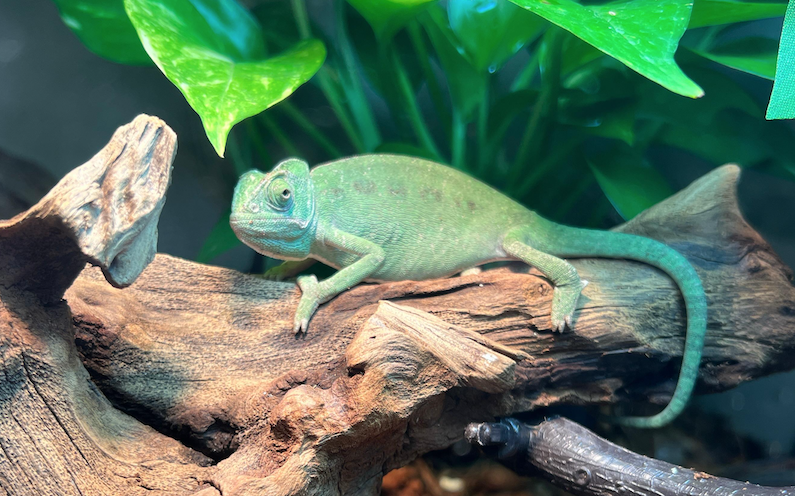
This article isn’t just a care guide for an African chameleon; it’s a chronicle of everything I’ve learned from my own grumpy roommate, Cosmo. When he came into my life, I thought I understood “love” from my cats and dogs. However, I was not prepared for the complex, love-hate relationship with a creature that communicates mostly through sighs and side-eyes.
Cosmo has taught me that animal companionship isn’t always about cuddles. Sometimes, it’s about earning the quiet trust of an animal that prefers to be left alone. It’s also the hilarious moment when he hisses at my hand, only to willingly climb onto my head two minutes later to demand a better view. Ultimately, he is a constant, grumpy reminder that the most rewarding relationships in this hobby aren’t always the easiest. Therefore, this guide is dedicated to him, and to helping you understand the beautiful, challenging reality of caring for these magnificent creatures.
How long have Chameleons been on earth?
The earliest known chameleon fossils date back to the Middle Eocene period, around 40 million years ago. recent molecular clock studies suggest that chameleons diverged from other lizards around 65 million years ago (the K-Pg boundary). The “out-of-Africa” hypothesis for the colonization of Madagascar via oceanic dispersal is the leading scientific theory. Subsequently, Madagascar experienced colonization by chameleons from Africa in two separate waves. The first wave occurred around 65 million years ago, and the second wave happened around 47 million years ago. African chameleonsare primarily found in Africa, with Madagascar having the most diversity. They inhabit a wide range of environments, from rain forests to deserts. Furthermore, some species have adapted to life in Europe and Asia. The Common Chameleon, for example, is found in parts of Greece and the Middle East.
What does the African Chameleon look like?
Chamaeleo Africanus looks very similar to Chamaeleo Chameleon (African desert chameleon). However, it does not have flaps on the back of its head, and it is larger in size. In fact, it can grow to be 45 to 50 cm. These chameleonschange color based on light, temperature, and stress levels. The colors range from yellow or bright green to dark green with black spots. Generally, they’re darker when basking or stressed and brighter when excited or calm. Finally, males have a tarsal spur on the back feet, which looks like an extra toe, and they have a large casque on their head.
Habitat: What type of enclosure is best for an african chameleon?
African chameleons are arboreal; that is, they live in trees. Therefore, they need a large, vertical enclosure screened on 2 or 3 sides with vinyl-coated wire or poly mesh. Since chameleons do not like to be on the ground, the enclosure should have tall plants with a lot of branches and vines filling most of the space.
As for the bottom of the enclosure, many hobbyists prefer a bare bottom. This is done to avoid using sand, gravel, bark, or moss, so that the chameleon does not eat it by accident while catching prey. However, if you do not wish to have a bare-bottom enclosure, coco husk is a good choice to be used as substrate because it’s large enough that the chameleon can’t swallow it.
Furthermore, they need a heating lamp and a 15W UVB 5.0 lamp positioned in a way that helps provide several basking areas with different temperatures. Finally, African chameleons drink water from droplets on the leaves; consequently, they will not drink from a bowl or a dish. Misting or dripping systems give this natural effect and also keep humidity levels up. Always keep the watering location consistent, but note that they do not like being splashed with water.
What do Chameleons Eat?
Variety is key to provide the chameleon with all the nutrition it needs. It eats crickets, meal worms, wax moths, red runner roaches, dubia roaches and other types of roaches.
- 0 to 3 months old, feed it as much as it wants.
- 3 to 9 months old, feed it 10 to 15 bugs a day.
- 9 to 12 months old, feed it 4 to 5 a day
- 1 year and above, feed it 4 bugs 3 times per week
Feeding the roaches:
Collard greens
apples
Oranges
Kale
Mango
Potatoes
Can Chameleons Suffer Health Problems?
They can suffer from Vitamin A and calcium deficiency, which is usually due to a poor diet. They are also susceptible to Stomatitis or mouth rot, with symptoms that include drooling, excess saliva, or redness around the mouth. Furthermore, they can also suffer from metabolic bone disease (MBD).
MBD is usually due to an inadequate care level, meaning poor lighting, poor nutrition, and a lack of UVB light, which leads to calcium and Vitamin D3 deficiency. Basically, no chameleon should suffer from MBD; it indicates that you have failed to provide it with what it needs, and it is the result of a long time of neglect.
Behavior and Mating for African Chameleons:
African chameleons reach maturity at one year of age. Consequently, mating can last for several days. A female chameleon will be basking more and have an increased appetite. Eventually, she will go to the bottom to lay her eggs. She can lay a clutch up to 70 eggs. You can then take the eggs and place them in a container. Finally, bury the bottom half of the eggs in vermiculite and keep it moist with water.
Examples of plants for the enclosure:
- Umbrella Tree (schefflera Spp.)
- Weeping Fig (Ficus Benjamina)
- Rubber Tree (Ficus Elastica)
- Ficus Audrey
- Golden Pothos (Epipremium aureum)
- Monsteras
- Atrakinas
How to I hydrate my African Chameleon’s Enclosure?
Out there in nature, chameleons get water from food, dew and rain. Natural humidity cycle is high during the night and lower during the day. Constantly wet surfaces will cause fungal, bacterial and mold growth. Daily hydration using a misting system is what most hobbyists favor.
Misting: Anything from a hand mister to an expensive misting system for terrariums. It gives both dew on the plants. Some are sold as automated systems. You can set them to work for an afternoon rain. Another setting at night allows a layer of dew in the morning. An ideal schedule would be to turn on the mister from 1 am to 3 am. Then, from 5 am to 7 am. Finally, from 8 pm to 10 pm.
Fogger: Mostly used for areas with natural lower humidity. Foggy mornings are important for hydration. You can set it to work once a day from 2 am to 7 am.
Drippers: If you will use this method then you need a drainage collection tray. Do not let it pool up to avoid health hazards for our chameleon. You can buy a dripping system. Alternatively, make a simple one by poking a pin into a party cup. Let it drip naturally. You can set it to work once a day from 3 pm to 5 pm
How to know if my chameleon is well hydrated?
A thirsty chameleon will go over to the dripper or when you hand mist and drink. A hydrated chameleon will ignore it or will play with it by shooting its tongue at it. Another thing that is a good indicator is the chameleon’s stool. It should be moist with white urates attached to it. If the white part is orange it means the body is retaining the water before it exits the body.
Disclaimer: This article is for informational purposes only. The information provided should not be considered a substitute for professional veterinary advice. If your pet is displaying concerning behavior, it’s crucial to consult with a qualified veterinarian.
African Chameleon Care FAQ
African chameleons rank as intermediate to advanced reptile pets due to their precise environmental needs. They require specialized lighting, misting systems, tall vertical enclosures with live plants, and minimal handling. Beginners often fail to recognize early signs of dehydration or calcium deficiency.
African chameleons need misting two to three times daily to mimic natural humidity cycles. An ideal schedule runs from 1 AM to 3 AM, 5 AM to 7 AM, and 8 PM to 10 PM. Constant wet surfaces cause fungal and bacterial growth.
African chameleons instinctively drink water droplets from leaves rather than standing water. Their visual system registers movement, not still surfaces, so misting or dripping systems provide the rainfall effect they recognize. Water bowls go ignored and often become breeding grounds for bacteria.
Adult African chameleons grow up to 50 cm and require large, tall, vertical enclosures. Screened mesh on two or three sides ensures airflow, while tall plants and branches fill the vertical space. Ground-level enclosures cause severe stress and chronic anxiety.
African chameleons tolerate minimal handling and view it as a stress event. Frequent contact causes color darkening, hissing, and immune suppression, while brief voluntary interactions during cage maintenance work best. They are observation pets first, not companion reptiles like bearded dragons.
Metabolic bone disease in African chameleons results from chronic UVB deficiency, poor diet, and inadequate calcium supplementation. Soft jaw, bent limbs, and tremors signal advanced cases of prolonged keeper neglect. Proper UVB 5.0 lighting, gut-loaded insects, and reptile calcium powder prevent MBD entirely.
Adult African chameleons over one year need four insects three times per week, while younger chameleons require daily feeding. Variety matters more than volume. Crickets, dubia roaches, and silkworms gut-loaded with greens deliver complete nutrition without causing obesity or gout.
Sources
- Nature
https://www.nature.com/articles/ncomms3477 - Chameleon Academy
https://chameleonacademy.com/chamaeleo-africanus-african-chameleon/ - MSD Veterinary Manual
https://www.msdvetmanual.com/exotic-and-laboratory-animals/reptiles/management-of-chameleons - Reptiles Magazine
https://reptilesmagazine.com/chameleon-nutritional-habits/ - LafeberVet
https://lafeber.com/vet/metabolic-bone-disease-in-reptiles/


Leave a Reply