
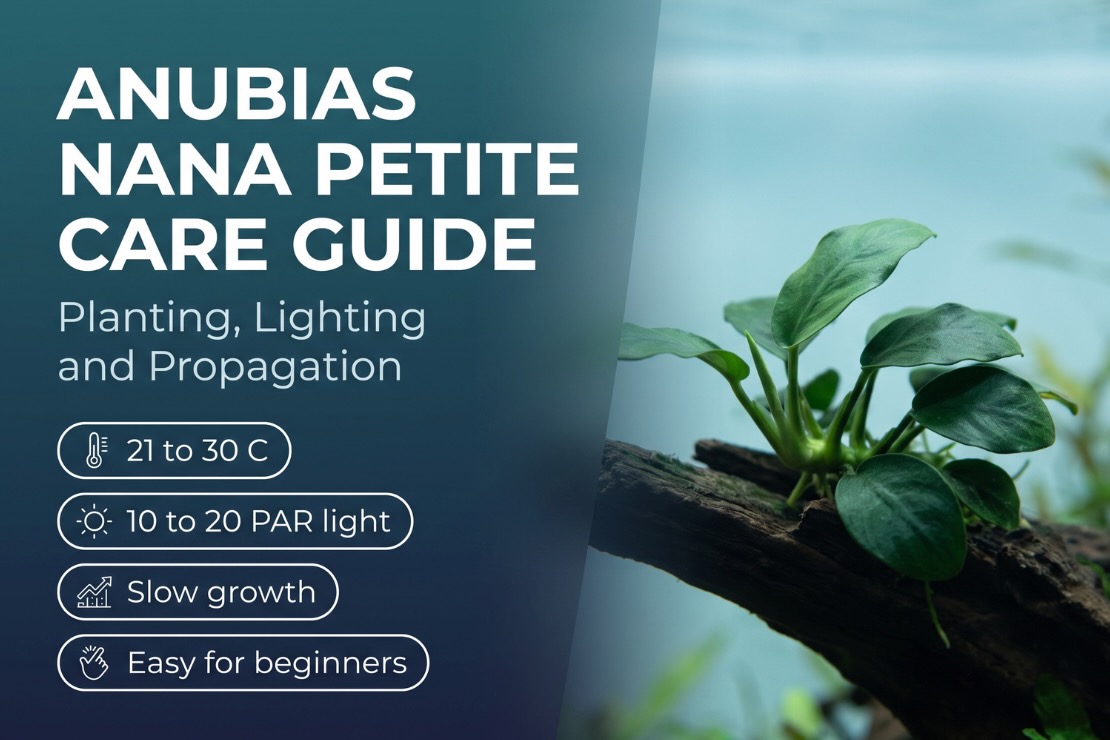
Anubias Nana Petite (Anubias barteri var. nana ‘Petite’) belongs to the Araceae family and represents a laboratory cultivated miniature variation. Its parent species originates from the shaded river banks of West Africa. This guide uses verifiable botanical evidence to ensure your aquatic gardening meets professional standards. Therefore, you must recognize that its unique physiology demands specific attachment rather than traditional substrate planting.
Physical Features of Anubias Nana Petite

Anubias Nana Petite is a compact aquatic plant with a distinct anatomy. Its small, thick, tear drop shaped leaves sit on short stalks called petioles. The leaves look deep green and leathery, and they feel firm to the touch. The plant rarely exceeds around 5 centimeters in total height. Furthermore, its leaf blades stay small compared with the standard Anubias barteri var. nana, so it scales well in small tanks.

All growth starts from the rhizome. This thick, horizontal stem creeps along a surface and produces leaves above and roots below. In fact, the rhizome stores the plant’s energy, which helps explain the slow growth. Therefore, damaging or burying the rhizome harms the whole plant.
The roots are thin and wiry. They grow from the underside of the rhizome and grip rock or wood. Consequently, the plant anchors itself to hardscape instead of rooting in the substrate. Its dense, low profile suits foreground accents, nano tanks, and detailed hardscape. However, new leaves appear slowly, so patience matters more than fertilizer.
Quick Care Sheet for Anubias Nana Petite

Providing the correct parameters prevents physiological stress and encourages steady, slow, growth cycles. Furthermore, adhering to these ranges ensures the structural integrity of the plant remains intact. You must monitor your water temperature to stay within the biological thresholds strictly.
| Feature | Requirement |
| Skill Level | Easy (Beginner Friendly) |
| Lighting | Low to Medium (10-20 PAR) |
| CO2 | Not required (Beneficial) |
| Placement | Foreground / Attached to Hardscape |
| Temperature | 69–86°F (21–30°C) |
| Growth Rate | Slow |
How Do I Plant Anubias Nana Petite?

Burying the rhizome prevents essential gas exchange and leads to immediate, fatal tissue rot. Furthermore, you should use Cyanoacrylate based plant glue or cotton thread to attach it to driftwood. The roots will eventually grow around the hardscape and anchor the plant permanently. Therefore, keeping the rhizome exposed to the water column is the only way to ensure survival. As a result, proper mounting actively prevents plant loss.
Lighting and CO2 Requirements
Anubias Nana Petite grows well under low to moderate light, roughly 10 to 20 PAR. This range reflects its origin on the shaded banks of West African rivers. Strong light does not speed up its growth much. Instead, it feeds algae on the slow growing leaves, which stay in place for a long time.

Keep the photoperiod at 6 to 8 hours daily. A simple timer removes the guesswork. Furthermore, a consistent schedule keeps conditions stable for the plant. Place it in a shaded spot, such as under taller plants, beside driftwood, or below floating plants. As a result, the leaves avoid scorching and algae stays under control.
The leaves work as your light meter. Clean, dark green leaves signal a balanced setup. Green spots or dark tufts on the leaf surface signal too much light.
CO2 injection is not required. However, it can raise the growth rate slightly. The gain is small compared with the cost of a CO2 system. Therefore, most tanks do fine with moderate light and no CO2.
Fertilization and Nutritional Needs

As an epiphytic plant, it primarily absorbs nutrients directly from the water column through its leaves and roots. Specifically, you should use a high quality liquid supplement like Aquarium Co-Op Easy Green or Seachem Flourish. Furthermore, maintaining adequate levels of potassium and iron prevents the onset of chlorosis and leaf yellowing. Root tabs are largely ineffective because the plant is not anchored in the soil. Therefore, regular weekly dosing ensures all essential micronutrients remain available.
Why Is My Anubias Nana Petite Melting or Turning Brown?

“Melting” often occurs when the plant is transitioning from emersed (out of water) to submersed (underwater) growth. Specifically, the plant sheds its terrestrial leaves to grow new, specialized aquatic foliage better suited for the tank. Brown spots can indicate severe potassium deficiency or physical damage from aggressive tank mates. You must remove decaying leaves immediately to prevent organic waste buildup. Therefore, maintaining stable water parameters during this transition period is critical for survival. As a result, patience is required as the plant adapts to its new environment.
Propagation is achieved simply by dividing the healthy rhizome into smaller distinct sections. Specifically, you must ensure that each new section contains at least three or four healthy leaves and attached roots. Utilize a sterilized pair of aquarium aquascaping scissors to make a clean, quick cut through the rhizome. Consequently, each segment will begin to grow as an independent individual once secured to a new surface. Therefore, you can easily expand your collection through this methodical division process. One plant can eventually cover an entire piece of driftwood.

Is It Safe for Goldfish or Cichlids?
Anubias Nana Petite remains one of the few plants that can survive in tanks with goldfish or large cichlids. Specifically, its thick, leathery leaves are highly unpalatable and physically tough enough to withstand occasional nibbling. Furthermore, because it is attached to heavy hardscape, these “earth moving” fish cannot uproot it during their digging behaviors. It provides much needed greenery to tanks that are otherwise devoid of live vegetation. Therefore, it acts as a durable biological decoration for the most destructive aquatic residents. It bridges the gap between aquascaping and aggressive fish keeping.
Managing Algae and Maintenance

Because this plant grows so slowly, it is highly susceptible to Black Brush Algae (BBA) and Green Spot Algae. Specifically, you can perform a brief “bleach dip” or use a soft toothbrush to gently scrub the leaves during water changes. Reducing the light duration or increasing the water flow often prevents algae spores from settling. Consequently, maintaining a healthy population of algae eating shrimp or snails provides natural maintenance. Therefore, keeping the leaves clean ensures the plant can perform photosynthesis effectively.
Emersed Growth Capabilities

Anubias Nana Petite is amphibious and thrives in high humidity environments out of the water. Specifically, it is frequently grown emersed in commercial nurseries to maximize growth speed and prevent algae. Furthermore, you must ensure the rhizome and roots remain constantly damp to prevent fatal dehydration. Consequently, it is a premier choice for the “water line” area of a paludarium where it can grow between rocks. Therefore, providing a humid atmosphere allows the plant to transition between aquatic and terrestrial states. It offers incredible versatility for various hobbyist setups.
Common Troubleshooting and Solutions
Early detection is the best way to save the plant. Check the leaves and the rhizome every week during water changes. Specifically, match the symptom to the likely cause below.

- Yellowing leaves. Yellow leaves usually point to a shortage of nitrogen, potassium, or iron. Old leaves also yellow naturally with age. Therefore, trim the oldest leaves first, then adjust your liquid fertilizer if new leaves also turn pale.
- Brown spots. Brown spots can indicate potassium deficiency. They can also come from physical damage, such as nibbling or rough tank mates. Consequently, check your dosing and watch which fish touch the plant.
- Soft or mushy rhizome. This condition indicates rhizome rot, which usually follows burial in the substrate. Cut away the rotting tissue with sterilized scissors. Then attach the healthy section to hardscape with the rhizome fully exposed.
- Melting leaves after purchase. Many plants arrive grown out of water. The plant sheds these leaves and grows new aquatic ones. In fact, this transition is normal. Remove decaying leaves quickly and keep water parameters stable.
- Algae on the leaves. Black brush algae and green spot algae settle on slow growing leaves. Reduce the light duration and improve water flow. Furthermore, algae eating shrimp or snails help with routine cleaning.
- Plant drifts off its mount. Thread dissolves and glue sometimes loosens over time. Reattach the plant until the roots grip the surface. As a result, the plant anchors itself permanently.
- Growth seems stalled. Slow growth is a normal trait of this plant. Confirm that light, nutrients, and temperature sit in range before changing anything. Then wait.
Sources
- Tropica Aquarium Plants
https://tropica.com/en/plants/plantdetails/Anubiasbarterivar.nan - Aquarium Co-Op
https://www.aquariumcoop.com/blogs/aquarium/anubias-care-guide - Aqua-Fish.Net
https://en.aqua-fish.net/plants/anubias-barteri-var-nana-petite - Buce Plant
https://buceplant.com/products/anubias-nana-petite - Flowgrow
https://www.flowgrow.de/db/aquaticplants/anubias-barteri-var-nana-petite
Leave a Reply
You must be logged in to post a comment.