
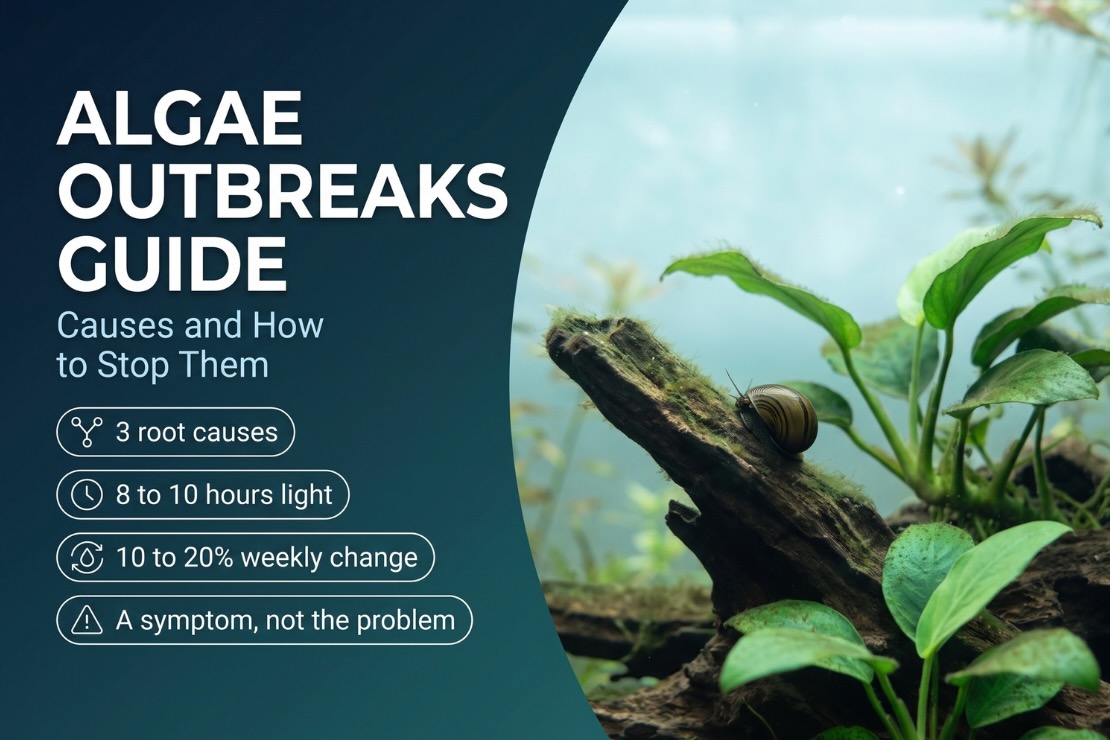
Algae outbreaks in aquariums are a common problem that can be unsightly and even harmful to your fish. I remember my first “real” planted aquarium well. I placed the driftwood with precision, and then I planted the new greenery with the focus of a surgeon. When I finally filled it with crystal-clear water, I thought I had created a masterpiece. It was pristine. It was perfect. For about a week.
Then, the Algae Outbreaks arrived. It wasn’t just a few spots; instead, it was an uninvited guest. It decided to redecorate my entire masterpiece in shades of slimy green and fuzzy brown. As a result, the beautiful driftwood suddenly looked like it was wearing a bad, brown toupee. I scrubbed, yet the algae just smirked and came back stronger.
It was during that frustrating, slimy battle that I learned the single most important lesson in fishkeeping: algae isn’t the problem; rather, it’s a symptom. It’s your tank’s messy, annoying way of screaming that something is out of balance. This guide, therefore, is my battle plan, born from that first war with the green slime. It’s here to help you read the signs and win the war before it even begins.
What is the Reason for Algae Outbreaks?
Before we delve into prevention methods, it’s important to understand the factors that contribute to its growth: First, excess nutrients. Algae thrive on nutrients like nitrates and phosphates, which can accumulate from uneaten food, fish waste, and even tap water. Second, excessive light. Algae require light to photosynthesize and grow. Overexposure to light, whether from natural sunlight or artificial lighting, can fuel it’s growth. And finally, poor water quality. Dirty water with high levels of organic matter provides an ideal breeding ground for algae. Algae outbreaks rarely come from a single cause. Instead, the three factors above work together, and each one amplifies the others.

Nutrients deserve the first look. Fish waste and uneaten food break down into ammonia. Beneficial bacteria then convert ammonia into nitrite and, finally, into nitrate. Most home tanks do not remove nitrate on their own. Consequently, it builds up until a water change or fast-growing plants take it out. Phosphate follows a similar path, entering through fish food, decaying plant matter, and some tap water. A nitrate and phosphate test kit shows which nutrient is running high.
Light works differently. Plants and algae both use it, so extra light helps both. However, plants need nutrients and carbon dioxide to make use of that light. When light exceeds what plants can handle, algae collect the leftover nutrients. A timer set to a fixed photoperiod removes the guesswork. Furthermore, a tank near a window receives uncontrolled sunlight, which can undo any timer.
Water quality ties everything together. Detritus in the substrate, clogged filter media, and dead spots with weak flow all release nutrients slowly. In addition, these areas often become the first places where algae appear. Gravel vacuuming and rinsing filter media in old tank water address this hidden source.
Finally, the type of algae gives useful clues. Brown diatoms often appear in new tanks while the nitrogen cycle settles. Green spots on the glass usually point to strong light. Cyanobacteria, a bacterium that looks like slimy green sheets, often points to poor flow and excess organic waste.
How to Prevent Algae Outbreaks?
Here are some practical steps you can take to prevent it from taking over your aquarium:
- Regular Water Changes: Performing regular water changes is essential to remove excess nutrients, maintain water quality and manage algae outbreaks. Aim for a 10-20% water change weekly.
- Proper Filtration: A high-quality filter is crucial for removing waste products and maintaining water clarity. Ensure your filter is adequately sized for your tank and that you regularly clean or replace filter media.
- Control Lighting: Limit the duration of your aquarium’s lighting to 8-10 hours per day. Avoid placing your tank in direct sunlight, as this can significantly increase growth.
- Feed Sparingly: Overfeeding your fish can lead to excess nutrients in the water. Feed only as much as your fish can consume within a few minutes and remove any uneaten food promptly.
- Maintain a Balanced Ecosystem: Introducing live plants to your aquarium can help consume excess nutrients and compete with algae for resources. This will prevent algae outbreaks. However, ensure you choose plants that are compatible with your fish and lighting conditions.
- Regular Cleaning: Regularly clean the inside of your aquarium’s glass to prevent it from attaching and spreading.
How can I keep Algae Growth Under Control?

Use an Algae Scrubber, which, is a device that attaches to the inside of your aquarium and helps remove it from the glass. Also, consider UV sterilizers. UV sterilizers can help kill algae spores and control algae outbreaks. It will be a good idea to introduce algae eating creatures: Some fish and invertebrates, such as Siamese algae eaters and shrimp, can help control algae populations. By following these guidelines and being proactive about maintaining your aquarium, you can effectively prevent growth and create a thriving environment for your fish. Remember, prevention is key when it comes to algae control in aquariums. By taking the necessary steps and maintaining a balanced ecosystem, you can enjoy a beautiful and healthy aquarium for years to come.
Aquarium Algae Outbreaks FAQ
Algae outbreaks in aquariums result from three root causes: excess nutrients, excessive light duration, and insufficient biological filtration. Nitrates and phosphates from fish waste and uneaten food provide the nutrient base algae need to dominate a tank. Algae growth is a symptom of imbalance — identifying which cause applies determines the correct prevention or correction approach.
Excess nutrients — primarily nitrates and phosphates — accumulate when uneaten food decays, fish waste builds up, and water changes are infrequent. Algae absorb these dissolved compounds and use them to fuel rapid reproduction, spreading across glass, substrate, and plant surfaces. Reducing feeding amounts and performing regular water changes directly cuts the nutrient supply algae depend on.
Algae outbreaks do not typically harm fish directly, but they signal water chemistry problems that do. Excessive algae growth competes with plants for nutrients, can clog filters, and indicates nitrate levels that stress fish over time. Extreme algae bloom events — particularly cyanobacteria outbreaks — can deplete oxygen levels overnight and cause mass fish death.
Limiting aquarium lighting to 8–10 hours per day is the standard recommendation for preventing algae outbreaks in both planted and fish-only tanks. Sunlight hitting the tank directly amplifies algae growth far beyond artificial lighting and should be avoided entirely. A plug-in timer that automates the photoperiod eliminates the human inconsistency that causes recurring algae problems.
Siamese algae eaters, Otocinclus catfish, and amano shrimp are among the most effective algae-controlling species for freshwater aquariums. Nerite snails are excellent for glass and hardscape algae and do not reproduce in freshwater, preventing overpopulation. No algae-eating species should replace water changes or lighting control — they are supplemental tools, not root-cause solutions.
Algae is not always a problem — a stable thin layer on the back glass is natural and harmless in any established tank. The issue begins when algae spreads aggressively across all surfaces, suffocates plants, and discolors the water. Visible algae that expands daily is the signal that nutrients, light, or filtration are out of balance.
Live plants compete directly with algae for the dissolved nitrates, phosphates, and carbon dioxide that algae need to reproduce. A well-planted tank consumes excess nutrients faster than algae can exploit them, keeping algae suppressed without chemical intervention. Faster-growing stems like water wisteria or hornwort are especially effective, absorbing nutrients at higher rates than slow-growing species.
Sources
- Aqueon: The Fight Against Algae – Prevention and Control of Nuisance Algae
- Green Aqua (The Ultimate Algae Guide)
- Buce Plant (Algae Causes & Solutions)
- Aquarium Co-Op (Siamese Algae Eater Care)
- Aquarium Science (UV Sterilizers)
- Aqueon (Algae Prevention)
Leave a Reply
You must be logged in to post a comment.