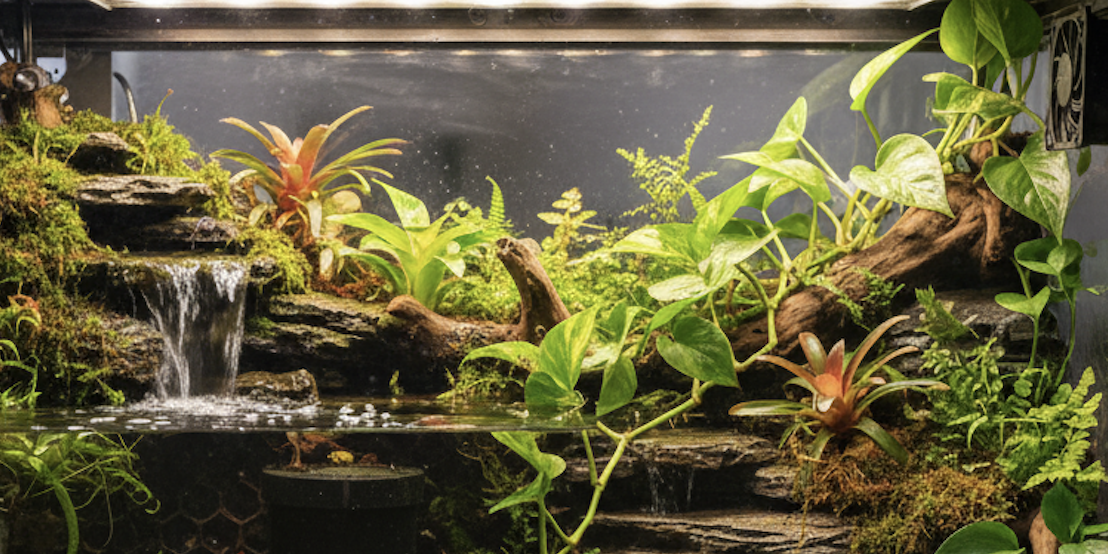
It is the ultimate dream for many keepers. They envision a single glass box that contains a complete, living world. It includes a misty, plant-choked shoreline and a crystal-clear pool teeming with life. There is also the gentle sound of a trickling waterfall. This is the paludarium, a breathtaking fusion of an aquarium and a terrarium. It is, consequently, a challenging, ambitious, and deeply rewarding project that represents a pinnacle of the hobby. Therefore, this guide is your complete blueprint for building your very own self-contained swamp.
The Glorious, High-Maintenance Swamp
My life is a constant, carefully managed battle between “wet” and “dry.” For my turtle and fish tanks, I’m a plumber, ensuring water stays in. Meanwhile, for my chameleon, I’m a meteorologist, creating the perfect balance of humidity and airflow on land. Typically, the two worlds are separate. And then there’s the paludarium—the glorious, high-maintenance swamp that throws all those rules into a blender. It is the ultimate project for the hobbyist who has looked at their aquarium and their terrarium and thought, “Why not both?”
Furthermore, it’s a project that requires you to be a plumber, a landscape architect, a gardener, and a zookeeper. You must take on all these roles simultaneously. I am both terrified and completely obsessed with the idea of it. Therefore, this guide is my obsessive research; it serves as our map to building the perfect indoor jungle. I hope to build one myself soon and share the journey with you all.
What Exactly is a Paludarium?
The word paludarium comes from the Latin word palus, meaning “swamp” or “marsh.” It is a type of vivarium becauseit incorporates both aquatic and terrestrial elements. This combination creates a shoreline or swamp-like habitat. Furthermore, this unique setup allows you to keep a diverse range of semi-aquatic animals and plants that wouldn’t thrive in a standard aquarium or terrarium.
How Do I Build the Paludarium Structure?
Creating a stable division between land and water is the most critical construction step.
What is the Best Way to Separate Land and Water?
The False Bottom Method is the most popular and versatile for hobbyists.
- Create the Support: An “egg crate” light diffuser panel, cut to the shape of your desired landmass, is supported on legs made of PVC pipe.
- Add the Drainage Layer: The area above the egg crate is filled with a lightweight drainage material like LECA (Lightweight Expanded Clay Aggregate) or lava rock.
- The Result: This creates a lightweight landmass with a large, open cavity underneath. This hidden space not only dramatically increases the total water volume of your tank, but it also provides a perfect, hidden place for your water pump, filter intakes, and heater.
How Do I Set Up the Water Section?
What kind of filtration do I need?
A canister filter is the ideal choice. First, the intake can be hidden in the false bottom, and then the output can be routed to the top of your landmass to create a beautiful, naturalistic waterfall, which also aerates the water. Alternatively, a small, submersible pump can also be used just for the waterfall effect.
Do I need a heater?
Yes, a submersible aquarium heater, also hidden in the water section under the false bottom, is essential to maintain a stable tropical temperature.
What about the substrate?
The aquatic section can have a fine sand or gravel substrate, just like a standard aquarium.
How Do I Build the Land Section?
This is where you build your terrestrial ecosystem, often using the same principles as a bioactive terrarium.
- The Substrate Barrier: Place a mesh screen over your drainage layer to prevent your soil from falling into the water below.
- The Substrate: Use a moisture-retaining substrate mix like an “ABG mix” (a mix of peat, sphagnum, charcoal, and coco fiber) over the barrier.
- Humidity and Ventilation: Paludariums are naturally high-humidity environments. A tight-fitting glass lid is essential to trap this moisture. However, you also need some ventilation (like a screened strip or a small computer fan) to prevent the air from becoming stagnant, which can cause mold and respiratory issues.
What Plants Can I Use in a Paludarium?
You have three distinct zones to plant, which, is part of the fun!
Aquatic Plants (Fully Submerged)
These aquatic live plants are entirely in the water section. Consequently, great choices include Anubias, Java Fern, and Cryptocoryne.
Marginal Plants (Roots in Water, Leaves in Air)
These plants are perfect for the shoreline. They thrive with their roots in the wet substrate or even directly in the water. Therefore, Peace Lilies, Pothos, and many mosses are excellent choices.
Terrestrial Plants (On Land)
Finally, these plants need high humidity but do not want their roots constantly waterlogged. As a result, Bromeliads, small ferns, and various vining plants are perfect for the land portion.
What Animals Can Live in a Paludarium?
This is the ultimate habitat for a huge range of semi-aquatic creatures. Always research the specific needs of your chosen inhabitant.
Amphibians: Dart Frogs are a classic choice. Newts and salamanders also thrive.
Reptiles: Chinese Water Dragons (require a very large setup), Anoles, and some species of water snakes.
Invertebrates: Vampire Crabs and other semi-terrestrial crab species are perfect, creating a fascinating micro-community.
Fish: You can add a small school of peaceful, hardy nano fish like Neon Tetras or Guppies to the aquatic section.
What Are the Biggest Challenges of a Paludarium?
Let’s be perfectly and honestly clear: building a successful paludarium is one of the most rewarding and beautiful projects in the entire reptile hobby. However, it is also one of the most complex. A paludarium is not just a bigger tank; rather, it is the ambitious act of merging two distinct hobbies—aquarium keeping and terrarium keeping—into a single, functioning ecosystem. Consequently, this fusion creates a unique set of challenges that can be a source of immense frustration for the unprepared. Therefore, understanding these hurdles is the first and most important step toward overcoming them.
You Are Building, Not Just Buying
A standard aquarium is a single, complete system. A terrarium is another. However, a paludarium is both, smashed together, and you are the engineer tasked with making them work in harmony within the same small box. This, in turn,creates a cascade of complexity and cost.
The Skill Set: You can’t just be a fish keeper or a reptile keeper; you have to be both. Specifically, you must understand the nitrogen cycle for your water section, while simultaneously managing the soil composition, drainage, and lighting needs of your land section. Therefore, it’s a demanding fusion of biology, chemistry, and even a bit of geology.
The Construction: The land area doesn’t just appear. Instead, you have to build it. This involves creating a stable and secure structure out of heavy materials like rock and driftwood, and then constructing a waterproof barrier to keep your terrestrial substrate from turning into a muddy swamp. Consequently, this construction phase requires planning, patience, and often, a lot of trial and error.
The Cost of “Both”: The financial investment is significantly higher than for a standard setup. You are essentially buying equipment for two separate habitats. So, you need an aquarium filter and a misting system and you might need a submersible water heater and an overhead heat lamp for a basking spot. You need to buy aquatic plants and terrestrial plants. You need pounds of rock and wood for the hardscape. The initial investment to build a proper, functional paludarium can easily be two or three times the cost of setting up a standard aquarium or terrarium of the same size.
The Humidity vs. Ventilation Battle: A Constant Balancing Act
This is the great, unending war of paludarium keeping. It is a delicate and often frustrating balancing act between two opposing, but equally vital, needs.
The Need for a Jungle: Your tropical land plants and many amphibians require consistently high humidity to thrive. To achieve this, you need to trap moisture within the enclosure.
The Danger of a Swamp: If you trap that moisture too well and have no airflow, you create stagnant air. Stagnant, humid air is the perfect breeding ground for mold, fungus, and harmful bacteria. For many reptiles, this can lead to deadly respiratory infections. Your beautiful jungle quickly becomes a smelly, dangerous swamp.
Achieving this balance is the art of paludarium science. Success requires creating gentle but constant air exchange. This is often done by having a partially screen-covered top, or by installing small, low-voltage computer fans on timers to create a gentle breeze for a few hours a day. Automated misting systems are also a game-changer, providing bursts of high humidity that are then allowed to partially dry out, mimicking a natural rainforest cycle rather than creating a perpetually soggy environment.
The Maintenance Maze: The Ship in a Bottle Problem
A standard aquarium is easy to clean; you have clear access from the top. A front-opening terrarium is easy to access from the side. A paludarium is a complex, three-dimensional landscape locked inside a glass box, and maintaining it can feel like trying to build a ship in a bottle.
Water Changes Become an Obstacle Course: Performing a gravel vacuum or siphoning water from the aquatic section requires navigating your siphon around a maze of rocks, wood, and plant roots. It’s no longer a simple, five-minute task.
The Two-Sided Glass Cleaning: The underwater portion of your glass will grow algae. The aerial portion of your glass will be covered in hard water spots from your misting system. You will often find yourself needing to scrub one part of the glass and polish the other, a uniquely frustrating maintenance chore.
Difficult Gardening: Trimming a plant at the back of a dense, humid, and heavily decorated paludarium is a true test of patience and requires specialized, long-handled aquascaping tools.
The Inevitable “Mudline”: No matter how well you build your barrier, some of your land substrate will inevitably wash into your water section over time. Keeping that dividing line clean and crisp is an ongoing battle.
While these challenges are significant, they are not meant to discourage you. They are a realistic preview of the commitment. The reward for overcoming them—the creation of a stunning, multi-level, living ecosystem that hums with life in both its water and its land—is one of the most profound and satisfying achievements in the entire hobby.
Sources
- The Bio Dude
https://www.thebiodude.com/blogs/bio-activity-with-alex-tietz/paludarium-construction-and-the-false-bottom - MSD Veterinary Manual
https://www.msdvetmanual.com/exotic-and-laboratory-animals/reptiles/management-of-reptiles - VCA Animal Hospitals
https://vcahospitals.com/know-your-pet/respiratory-tract-disease-in-reptiles - University of Florida IFAS
https://plants.ifas.ufl.edu/manage/why-manage-plants/aquatic-and-wetland-plant-biology/ - Aquarium Breeder
https://aquariumbreeder.com/vampire-crab-detailed-guide-care-diet-and-breeding/

Leave a Reply
You must be logged in to post a comment.