

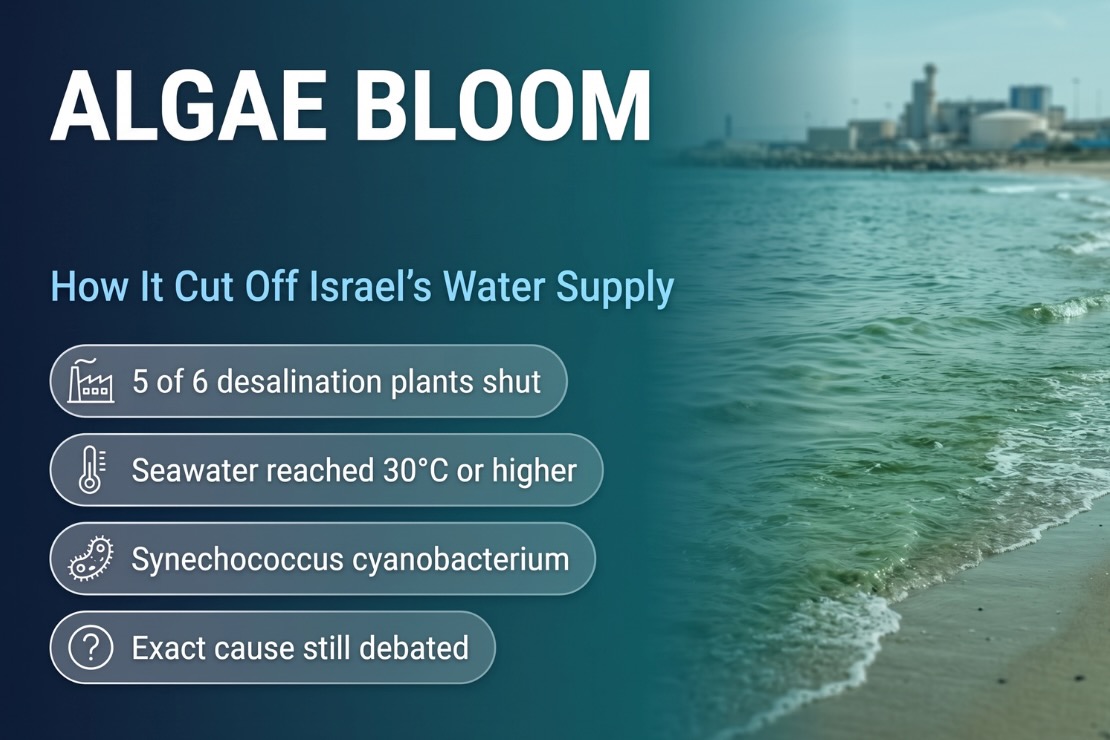
A massive bloom of microscopic algae swept along the Mediterranean coast in late August 2026. The bloom was blamed for temporarily shutting five of Israel’s six coastal desalination plants, threatening the country’s main source of drinking water. Consequently, the plants that normally convert seawater into tap water simply could not function.
All five stations closed ten days earlier due to algae accumulation and have since reopened, at least partially. Furthermore, only the Hadera plant remained fully operational throughout, since the bloom never reached that far north. In fact, officials described this scale of disruption as historically unusual.
How Rare Was This Algae Bloom, Really?

Israeli officials did not hold back on the severity. A spokesperson called it an “extremely rare event,” noting that facilities have shut before due to algae or jellyfish, but never several plants across such a wide stretch of coast simultaneously. Additionally, a senior water security official said Israel had not seen a bloom like this in 20 or 30 years.
Therefore, this was not a routine seasonal nuisance. The director of the Israel Oceanographic and Limnological Research Institute stated plainly that this was unprecedented and that he had never seen anything like it.
What Species of Algae Caused the Algae Bloom?

Identifying the culprit took time, and the picture is still developing. Researchers identified the organism as a cyanobacterium of the genus Synechococcus. Though the exact species and the reason for its sudden explosion remain under investigation. Cyanobacteria are technically bacteria, not true algae, but they behave the same way in a bloom: rapid, light-driven, nutrient-fueled reproduction.
Mechanically, the problem was physical rather than toxic. The algae became trapped in the reverse-osmosis filters, which forced Israel to close five of its plants. Specifically, officials said the concentration of microscopic algae and suspended material impaired pretreatment systems and threatened the reverse-osmosis membranes themselves. As a result, an energy minister warned that membranes rated for roughly seven years of use could clog far sooner under these conditions.
What Actually Triggered This Algae Bloom?

A bloom does not appear from nothing. A marine ecologist explained that blooms occur when nutrients, temperature, light, currents, and mixing all align at once. In this case, several factors converged.
Origin and Currents: Researchers say the algae appear to have originated near Egypt’s Nile Delta and moved north along Mediterranean coastal currents. Similarly, a water authority official said high sea temperatures pushed the bloom northward. And that a combination of unique circumstances came together at once.
Heat. Mekorot cited a sea storm that increased turbidity and pushed seawater temperatures to 86°F (30°C) or higher. This matters because warmer water accelerates algal reproduction significantly.
Nutrients — and the disputed part. Here, the reporting genuinely diverges, so it is worth laying out both sides plainly. Untreated sewage from Gaza may have contributed. With roughly 40,000 cubic meters of untreated wastewater reportedly flowing into the sea daily due to damage to Gaza’s treatment infrastructure. A Ben-Gurion University climate scientist also noted satellite imagery showed similar algae-filled waters around Egypt’s Nile Delta, where agricultural runoff enters the Mediterranean.
However, Israeli marine scientists have pushed back on the sewage explanation specifically. A marine ecologist at Israel’s National Institute of Oceanography stated the probability that Gaza sewage was the main driver was relatively low. Likewise, engineering reporting noted that untreated sewage may have provided nutrients that intensified the bloom. But available evidence does not establish it as the actual cause. Consequently, the honest answer is that scientists have not reached consensus, and readers should treat any single-cause explanation with caution.
Is the Mediterranean Sea Actually Changing?

Yes, and this bloom fits a documented pattern rather than standing alone. July 2026 was the month the world’s seas hit their hottest surface temperature on record, with sea surface temperatures in the Mediterranean running as much as 6°C above normal in June. Consequently, marine heatwaves of this intensity are no longer rare events; they are becoming the expected summer condition.
The broader consequences extend well past one algae bloom. Extremely high sea surface temperatures and marine heatwaves have caused mass mortality events among habitat-forming species such as corals, sponges, and macroalgae. Specifically, losing these foundation species affects the structure of the entire ecosystem, not just the individual organisms.
Long-term projections are equally direct. With an additional 0.8°C of warming, seagrass meadows like Posidonia oceanica could decline massively and vanish entirely by 2100, while fish stocks could shrink by 30 to 40 percent and shift northward. In fact, researchers note that toxic algal blooms and bacteria are already occurring more frequently as the sea warms and acidifies.
What Is Happening to the Sea’s Creatures?

The eastern Mediterranean, where this bloom occurred, is already one of the most biologically disrupted parts of the sea. This stretch of coast near Israel has warmed faster than almost anywhere else in the Mediterranean, and at least 1,000 tropical species have migrated in through the Suez Canal since it was built. As a result, native fisheries have been displaced by newcomers; several Pacific prawn species now support a valuable Egyptian fishery but have pushed out a local species that once mattered to Israeli fishing.
This particular bloom was not reported to have caused a mass fish kill on the scale seen elsewhere in the world. However, the broader warming trend behind it has already produced real mortality events nearby. Record sea temperatures in the wider Mediterranean have caused catastrophic fish die-offs in Italy and Greece in recent summers, which underscores why scientists are watching events like this one closely rather than dismissing them as isolated.
My Experience: Why This Story Hits Close to Home
I run aquariums out of Cairo, so news of a bloom starting near Egypt’s own coastline felt personal rather than abstract. Managing a healthy tank means constantly balancing nutrients, light, and temperature to prevent exactly the kind of algae explosion this bloom represents, just at an ocean scale instead of a 60-liter one. Watching officials scramble to explain sudden turbidity and clogged filtration membranes reminded me of every time I’ve had to diagnose a cloudy tank after overfeeding or a heater malfunction. The difference is unsettling: my mistakes affect a handful of fish, while this event affected millions of people’s drinking water. It’s a genuine reminder that the same basic chemistry governing a home aquarium governs an entire sea, just with far higher stakes.
Sources
- CNN
https://edition.cnn.com/2026/09/04/climate/microalgae-bloom-israel-water-deasalination-shutdown - Haaretz
https://www.haaretz.com/israel-news/2026-09-01/ty-article/.premium/five-of-israels-six-desalination-plants-shut-as-algae-hits-mediterranean-coast/000001a0-5d8d-dcca-ade6-5fff0c630000 - Haaretz
https://www.haaretz.com/israel-news/2026-09-03/ty-article/.premium/sea-of-green-this-is-the-algae-shutting-down-israels-desalination-plants/000001a0-673e-def7-a7f7-6fff4a070000 - Haaretz
https://www.haaretz.com/science-and-health/2026-09-04/ty-article/.premium/israels-water-crisis-eases-but-algae-bloom-still-threatens-desalination/000001a0-6b8d-d6d9-a5b4-7bef06d70000 - Engineering News-Record
https://www.enr.com/articles/63627-algae-bloom-disrupts-five-plants-in-desalination-dependent-israel - JNS
https://www.jns.org/news/israel-news/two-israeli-desalination-plants-offline-after-microalgae-plume-from-egypt - Middle East Eye
https://www.middleeasteye.net/news/gaza-destroyed-sewage-system-linked-rare-algae-bloom-shutting-israel-desalination-plants - The Media Line
https://themedialine.org/headlines/nile-delta-algae-bloom-shuts-down-israels-desalination-plants/ - The Times of Israel
https://www.timesofisrael.com/liveblog_entry/all-5-desalination-plants-shut-last-week-due-to-algae-have-reopened-at-least-partially/ - The Jerusalem Post
https://www.jpost.com/environment-and-climate-change/article-908208 - Calcalist (Ctech) – https://www.calcalistech.com/ctechnews/article/bydltpb00gx
- World Weather Attribution
https://www.worldweatherattribution.org/climate-change-is-driving-unprecedented-european-ocean-temperatures-with-severe-impacts-for-marine-life/ - MedECC
https://www.medecc.org/what-climate-change-means-for-the-mediterranean-sea/ - Inside Climate News
https://insideclimatenews.org/news/03042024/mediterranean-sea-marine-ecosystems-global-warming/ - Sea Shepherd Global
https://www.seashepherdglobal.org/latest-news/record-heat-med/

Leave a Reply
You must be logged in to post a comment.