
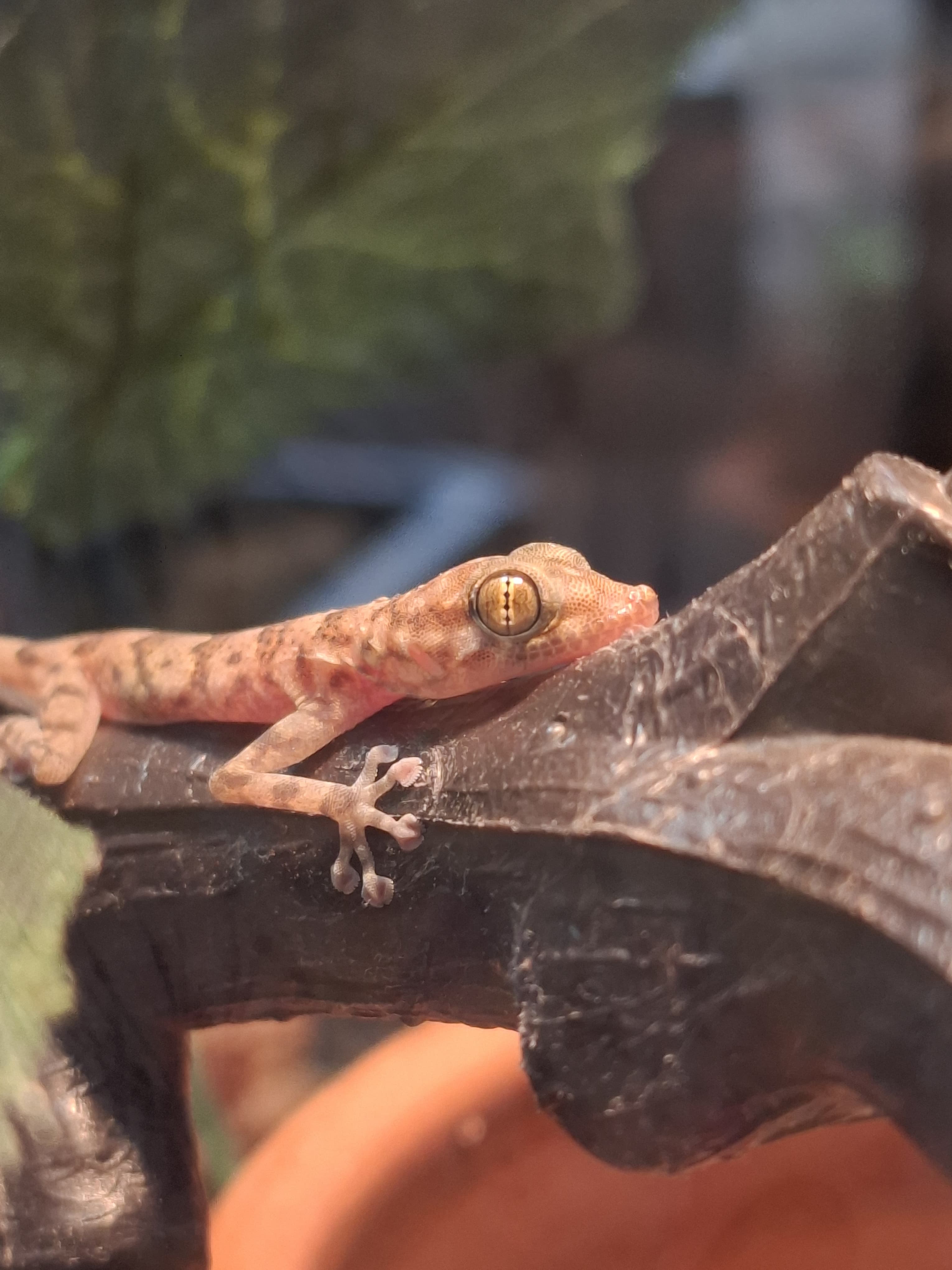
House geckos are the silent, lightning-fast hunters of the night, masters of climbing, and a familiar sight in homes across the world. Among these, the Mediterranean House Gecko (Hemidactylus turcicus) is one of the most widespread andsuccessful geckos on the planet. But what does it take to care for one? This guide, therefore, born from a surprising new arrival, will explore everything you need to know about this tiny, charismatic reptile.
The Day Coconut Arrived
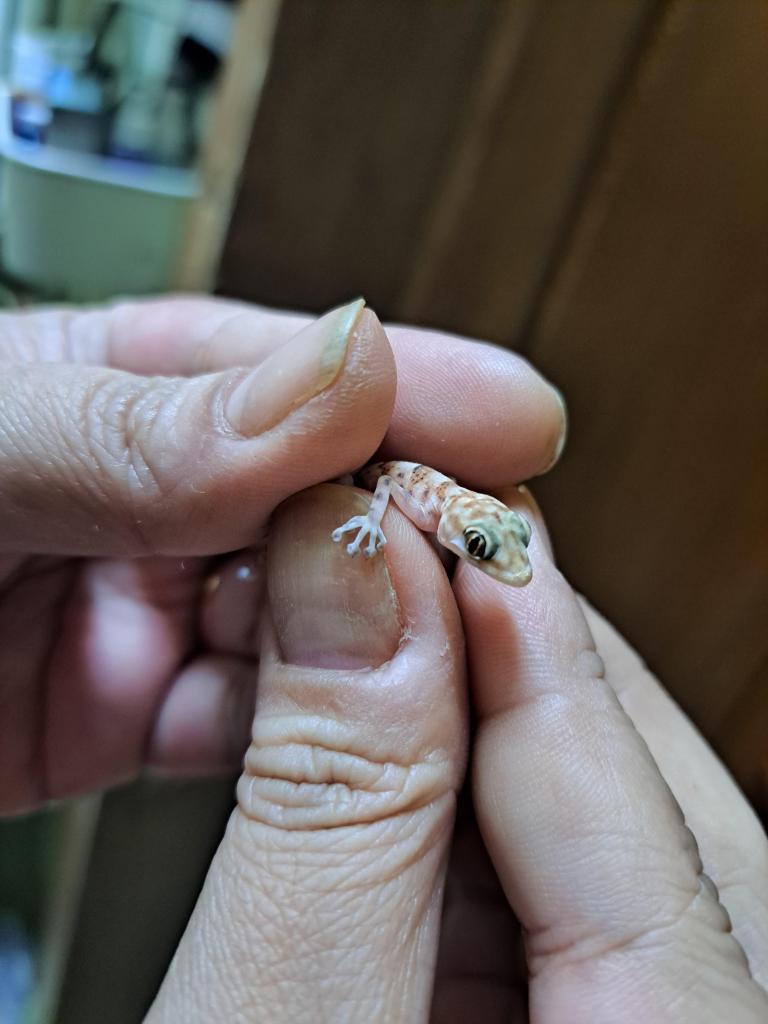
This article is being written on Day 1 of my journey as a Mediterranean House Gecko parent. It all started yesterday. I’d been wanting a Leopard Gecko for a while, but then a tiny, almost translucent baby gecko made its way into our house. It was cuteness overload!
I caught it as gently as I possibly could, my heart pounding, hoping not to injure its delicate body or spook it into dropping its tail. Success! My daughter was instantly smitten and named him (or her) “Coconut.”
Thankfully, due to a classic case of Multiple Tank Syndrome (MTS), I had a spare nano glass tank. As a reptile keeper, I also had extra UVB bulbs, heat lamps, and coco husk substrate. Consequently, in less than an hour, Coconut had a fully furnished, bioactive-ready home. The only problem was food; my chameleon’s roaches were gargantuan compared to this tiny gecko.
So, today, as I wait for a delivery of micro-roaches and watch Coconut bask on a fake branch, I’m writing this. This ismy journey of learning in real-time, and I’m sharing it with you as we begin our adventure with this fast, fascinating, andutterly adorable little gecko.
What is the “Abu Kaff” House Gecko in Egypt?
In my home country, this gecko is affectionately called Abu Kaff (أبوكف). This translates to “father of the palm” or “paw-handed,” and this is a perfect description. It refers to the gecko’s most famous feature: its wide, flat toe pads. These pads are equipped with specialized scales called lamellae, and they give its feet a distinct, hand-like appearance. Consequently, this allows it to perform the amazing feat of climbing sheer walls and even ceilings with ease.
While the name is most famously applied to the Mediterranean House Gecko, it’s sometimes also used for the similar White-spotted Wall Gecko (Tarentola annularis). Ultimately, people consider these geckos to be harmless and beneficial house guests, since they are expert hunters of mosquitoes, spiders, and other pests.
What Do Mediterranean House Geckos Look Like?
These are small, slender geckos.
Size: Adults typically grow to be 4-5 inches (10-13 cm) in total length.
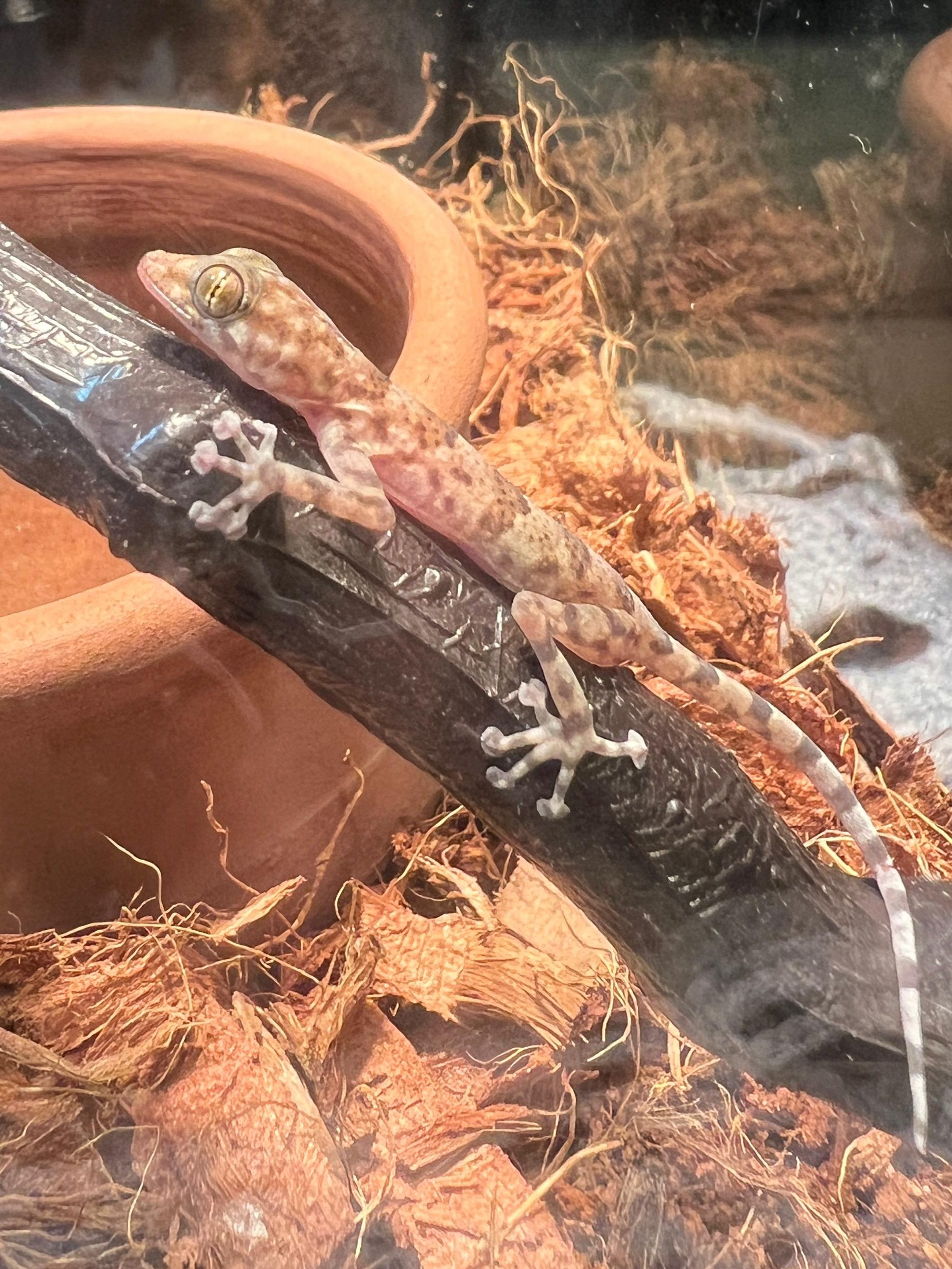
Color & Pattern: They have bumpy skin and are typically a pale, translucent pinkish-tan to a grayish color, covered in small dark spots. Their belly is usually white.
Eyes: They have large, lidless eyes with vertical pupils, a classic trait of nocturnal hunters.
What is Their Behavior?
Nocturnal Hunters: They are most active at night, when they hunt for small insects.
Vocalizations: Males are known for making chirping or clicking sounds. They use these vocalizations to communicate with females or defend their territory from other males.
Non-Venomous: They are completely harmless and non-venomous.
Why Keep a Mediterranean House Gecko as a Pet?
While they may not fit the mold of a typical “pet store” reptile, these geckos are truly captivating companions. They are low-maintenance as long as their basic needs are fulfilled, and they provide an unparalleled glimpse into the world of nocturnal predators. Consequently, they make an outstanding display animal for enthusiasts who take pleasure in crafting naturalistic vivariums.
What Are the Mediterranean House Gecko’s Terrarium Size Requirements?
Enclosure: These geckos are climbers, so a vertically-oriented tank is better than a horizontal one. A 10-gallon (approx. 40 liters) tall glass terrarium is an excellent size for one or two geckos.
Lid: A secure mesh lid is essential, as they can and will climb out of any open space.
What Substrate Do They Need?
A substrate that holds some humidity is ideal. Good choices include coco fiber, sphagnum moss, dried coco husk, or cypress mulch. A bioactive setup with live plants and a cleanup crew (isopods and springtails) is a fantastic option for these small geckos.
What Are Their Heating and UVB Requirements?
Heat: A low-wattage heat lamp should be used to create a basking spot of 85-90°F (29-32°C) at one end of the tank. The ambient temperature should remain in the mid-to-high 70s F (around 24-26°C).
UVB Lighting: As nocturnal animals, their UVB needs are lower than a sun-basking lizard. However, a low-level UVB light (like a 2.0 or 5.0 linear T5 bulb) is highly recommended. It should be on a 12-hour cycle to provide a proper day/night rhythm and aid in D3 synthesis.
A Closer Look at Their Eyes: Will UVB Hurt Them?
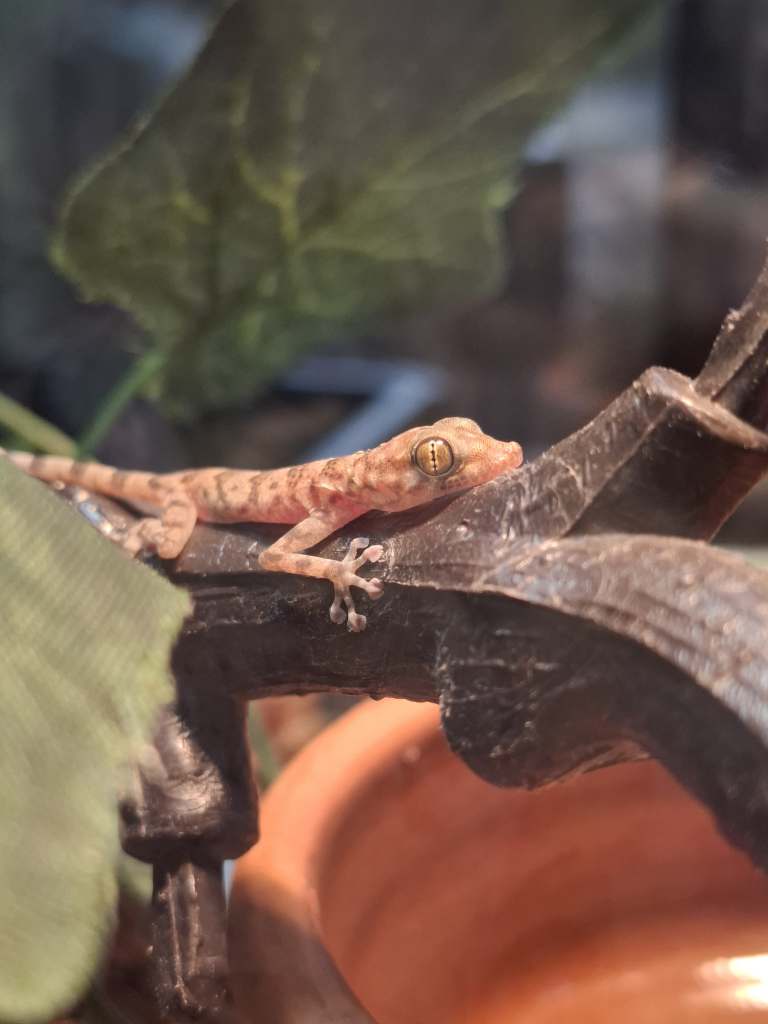
One of the most captivating features of a Mediterranean House Gecko is its large, seemingly alien eyes. They are lidless, meaning the gecko cannot blink. Instead, it has a clear, protective scale called a “spectacle” covering each eye, which it periodically cleans with a flick of its tongue. The vertical pupils are a classic adaptation for a nocturnal hunter. They allow them to open wide in near darkness to let in maximum light. They also constrict to a thin slit in bright light to protect the sensitive retina. This leads to a very important and common question from new keepers.
Will the bright basking and UVB lights hurt their eyes?
Many keepers observe their gecko choosing to bask directly under the lamp, even when shady hiding spots are available. This is a perfect example of a natural, instinctual behavior. Rest assured, they absolutely know what they are doing and are masters of self-regulation Reptiles are masters of self-regulation. Their bodies instinctively know when they need to absorb heat and when they need to process UVB for Vitamin D3 synthesis. The act of a nocturnal gecko briefly sitting out under a light is sometimes called “cryptic basking.” They are absorbing the energy they need to fuel their nighttime activities. Their eyes are perfectly adapted for this. When they are under the bright light, their pupils will constrict into a tiny vertical line. This drastically reduces the amount of light that enters, much like a cat’s eyes in the sun. This protects them from the brightness.
So, as long as you are using the correct type and strength of UVB (a low-level, linear tube is best) at a safe distance, and you provide shady areas for them to retreat to, you don’t need to worry. You have created a proper environment with choices, and your gecko is simply using it exactly as its instincts tell it to.
What is the Safe Distance to Place My UVB Lamp?
The safe distance is determined by the percentage (%) of UVB the bulb emits. Crucially, placing a strong desert bulb too close can be just as harmful as not having one at all. Therefore, for a nocturnal/crepuscular gecko like the Mediterranean House Gecko, you should be using a lower-strength UVB bulb.
The Mesh Factor: A Critical Consideration
A standard mesh screen on top of a terrarium can block 30% to 50% of the UVB rays from reaching your pet. This is a huge reduction. Therefore, you must adjust the recommended distances to compensate. Consequently, all distances below are given assuming the bulb is placed directly on a standard mesh lid with a good reflector.
Recommended Distances for a Low-UVB Species like Your Gecko
Here are the safe distances for the most common and recommended UVB bulbs:
T5 HO 5.0 or 6% UVB Bulb (Ideal Choice for your Gecko):
Safe Basking Distance: 20 – 30 cm (8 – 12 inches)
This is the most recommended bulb for your species. At this distance, it provides a safe and effective low-level of UVB (a UVI of around 0.7-1.0), perfect for their needs without being overpowering.
T5 HO 10.0 or 12% UVB Bulb (Strong Desert Bulb – Use with Caution):
Safe Basking Distance: 38 – 45 cm (15 – 18 inches)
This bulb is much stronger and designed for sun-basking desert animals. Consequently, you must place it significantly further away to ensure it remains safe for a low-UVB species. Furthermore, using a strong bulb like this also requires you to provide a lot more shade and hiding spots so the gecko can fully escape the UV rays when it wants to. Therefore, the 6% bulb is the safer choice.
T8 Linear Bulb (Lower Output):
If using an older, lower-output T8 bulb (like a 5.0), the distance would need to be much closer, likely around 15-20 cm from the basking spot, as they are less powerful than T5 HO bulbs.
For Compact Fluorescent Bulbs (Coil or “Mini” Bulbs):
We generally do not recommend these lights. This is because they produce a very narrow and intense beam of UVB, which is less natural and can potentially cause eye issues if the animal stares into it. If you must use one, however, ensure it’s a low-strength version and follow the manufacturer’s specific distance guidelines very carefully.
What Are Their Humidity Requirements and How Do They Drink?
Humidity: They need a moderate humidity level of 60-75%. Mist the enclosure thoroughly once or twice a day to maintain this level.
Water: They do not drink from bowls. They will lick water droplets off the glass and decor after misting.
What Do I Feed a Pet Mediterranean House Gecko?
They are insectivores with a voracious appetite. Their food must be very small.
Diet: Feed them a variety of small, gut-loaded insects. Include pinhead crickets, flightless fruit flies, and bean beetles. Also offer baby dubia roaches and baby red runner roaches.
Supplementation: Dust the feeder insects with a calcium with D3 powder at every feeding to prevent Metabolic Bone Disease.
What is a Good Feeding Schedule for a Mediterranean House Gecko?
A proper feeding schedule depends on the gecko’s age, as their metabolism and growth rate change significantly. However, the most important rule for any age is to only offer insects that are no larger than the space between the gecko’s eyes to prevent choking.
For Hatchlings and Juveniles (like Coconut): These tiny geckos are growing rapidly and have a high metabolism. Therefore, they should be fed daily. Offer as many appropriately-sized baby dubia roaches or pinhead crickets as they will enthusiastically eat in a 10-15 minute period. Furthermore, it is essential to dust all feeder insects with a high-quality calcium with D3 powder at every feeding to support proper bone growth.
For Adults: Once the gecko is fully grown (around 8-12 months), their metabolism slows down. Therefore, they should be fed every other day, or about 3-4 times per week. A typical adult meal consists of 4-6 appropriately-sized roaches or crickets. Continue to dust feeders with calcium with D3 at most feedings, and substitute with a reptile multivitamin powder once a week to ensure a well-rounded diet.
It’s always best to feed them in the evening when they naturally become active. Always observe your gecko’s body condition—a healthy gecko will have a nice, rounded tail where it stores fat reserves. Finally, adjust the feeding amount as needed to maintain this healthy weight.
How Should I Decorate the Terrarium?
Create a vertical world for them.
Climbing: Provide plenty of cork bark flats, branches, and vines.
Hiding: Offer hiding spots both on the ground (like small cork tubes or coconut huts) and up high.
Plants: Live plants like Pothos and Dracaena are excellent for providing cover and helping maintain humidity.
Can Multiple Geckos Be Housed Together?
You should never house two males together, as they are territorial and will fight. However, you can house a single gecko, a pair (male and female), or a group of females in an appropriately sized enclosure.
Should I Handle My Mediterranean House Gecko?
It’s best to treat them as display animals. This is because they are extremely fast and skittish, and their tails can detach easily if they feel threatened (a process called autotomy). Consequently, you should keep handling to an absolute minimum to avoid stress and injury.
How Do They Reproduce?
Females can lay several clutches of two hard-shelled eggs throughout the breeding season. Afterward, they will often hide their eggs in small, secure crevices within the terrarium.
How Long Do They Live?
Mediterranean House Geckos (Hemidactylus turcicus) generally live for 4 to 9 years in captivity. In fact, some sources indicate a potential lifespan of up to 8 to 10 years with excellent care. Conversely, in the wild, their lifespan can be shorter, often ranging from 4 to 9 years as well, but it can be more variable due to factors like predation, food availability, and environmental conditions.
House Gecko Care FAQ
Mediterranean House Geckos are completely safe in homes, since they are non-venomous and harmless to humans. They actually benefit households by hunting mosquitoes, spiders, flies, and other small pests. Many cultures across the Mediterranean and Middle East welcome them as natural pest control allies.
Nocturnal geckos like the Mediterranean House Gecko benefit from low-level UVB lighting despite older keeping advice. Recent research confirms that even nocturnal species engage in cryptic basking to synthesize Vitamin D3. A T5 HO 5.0 bulb at 20 to 30 cm provides safe, beneficial exposure.
A house gecko basks under bright lights through cryptic basking behavior, briefly absorbing heat and UVB to fuel nocturnal hunting. Their vertical pupils constrict to thin slits, protecting the retina from bright exposure. This natural self-regulation indicates a healthy, properly equipped enclosure setup.
Safe UVB distance for a Mediterranean House Gecko depends on bulb strength and mesh blockage. A T5 HO 5.0 bulb works at 20 to 30 cm through a standard mesh lid. Stronger 10.0 desert bulbs require 38 to 45 cm and additional shaded retreat zones.
Two male Mediterranean House Geckos cannot live together because territorial aggression leads to severe fights. Pairs work only as one male with one or several females. Single-gecko housing eliminates social stress entirely and remains the safest option for first-time keepers of this species.
A Mediterranean House Gecko drops its tail through autotomy when threatened, grabbed, or severely startled. The detached tail wriggles to distract predators while the gecko escapes. Regrown tails appear shorter, lack the original coloration, and contain cartilage instead of vertebrae, never fully matching the original.
Baby Mediterranean House Geckos eat insects no larger than the space between their eyes to prevent choking. Pinhead crickets, flightless fruit flies, bean beetles, and baby dubia roaches fit safely. Larger prey causes gut impaction or fatal choking incidents in these tiny, delicate hatchlings.
Mediterranean House Geckos do not tolerate handling well due to their fast, skittish nature. Frequent contact triggers tail drops, stress, and escape attempts. Treat them as display animals and limit interaction to enclosure maintenance, rare health checks, and necessary transfers between containers.
Sources
- National Science Foundation
https://www.nsf.gov/news/news_summ.jsp?cntn_id=105820 - Journal of Herpetological Medicine and Surgery
https://herpmed.org/doi/abs/10.5811/westjem.2011.5.2273 - Arcadia Reptile
https://www.arcadiareptile.com/lighting/guide/ - MSD Veterinary Manual
https://www.msdvetmanual.com/exotic-and-laboratory-animals/reptiles/management-of-geckos


Leave a Reply
You must be logged in to post a comment.