
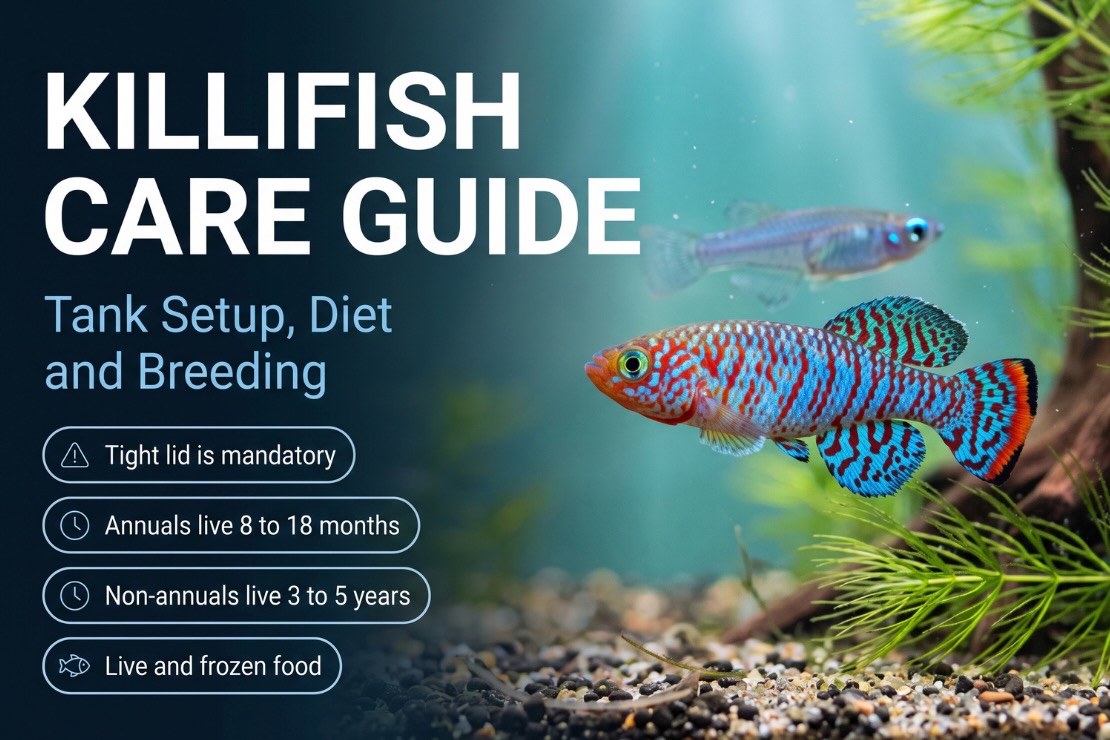
For the aquarist looking to venture beyond the common community tank, a world of dazzling color, fascinating behavior, and extraordinary life cycles awaits. Specifically, welcome to the world of killifish. Although these small, vibrant fish are often overlooked in mainstream pet stores, they represent a vast and rewarding corner of the hobby. Therefore, thisguide will explore everything you need to know about these aquatic jewels.
I’ll be honest: I don’t currently keep killifish, but they live at the top of my “someday” list. In fact, after years of enjoying the simple, chaotic joy of my livebearer tanks where new fry are a happy, monthly surprise I’ve become deeply fascinated by the deliberate, almost ritualistic breeding of killifish.
The idea of annual killifish laying drought resistant eggs in peat moss, which you then collect, dry, and store for months before “raining” on them to trigger hatching, is a level of dedication that I deeply respect. Clearly, they represent a challenge and a connection to the natural world that is profoundly different from any fish I’ve kept before. Consequently, this guide is the result of that admiration and research, a map for both you and me for this adventure.
Are Killifish Easy to Care For?
This is a “yes and no” question. On one hand, certain species (especially non-annuals like the Lampeye) can be quite hardy. However, the group as a whole is best for an “intermediate” hobbyist or a dedicated beginner. Ultimately, they are not difficult in the way a saltwater tank is, but they require more specific care than a guppy.
What Do Killifish Eat?
Killifish are primarily carnivores and thrive on a diet rich in protein. Although they can be trained to eat high-quality flakes or pellets, their health and color are best sustained when fed a varied diet of live and frozen foods like brine shrimp, daphnia, and bloodworms.
Killifish Care Guide
Tank & Setup: Most killifish are small and don’t require huge tanks. A 10-gallon (approx. 40 liters) or 20-gallon (approx. 75 liters) tank is perfect for many species. They appreciate a well-planted tank with plenty of hiding spots and dimmer lighting.
Water Parameters: While it varies by species, many popular killifish prefer soft, slightly acidic water (pH 6.0-7.0) with a stable temperature between 72-76°F (22-24°C).
A Critical Warning: Do They Jump? YES. Killifish are notorious jumpers. A tight-fitting lid on the aquarium is not a suggestion; it is an absolute necessity. Even the smallest gap is an escape route.
What Are the Different Types of Killifish?
The term “killifish” covers over 1,200 species, but they are generally split into two main groups based on their incredible life cycles:
Annual Killifish

These species originate from temporary, seasonal pools of water that dry up completely. Because of this environment, they live fast and die young, with a lifespan of about a year. Therefore, before the pool dries, they lay hardy, drought-resistant eggs in the mud (or peat moss in an aquarium). These survival pods can remain dry for months, only hatching when the rains return. A classic example is the stunningly colorful Bluefin Notho (Nothobranchius rachovii).
Non-Annual Killifish

These fish live in permanent bodies of water like streams and ponds. They have a longer lifespan and lay their eggs on plants or spawning mops. They are generally easier for beginners. A perfect example is the Norman’s Lampeye Killifish (Poropanchax normani), a peaceful, shoaling species famous for the bright, iridescent blue “lamp” above its eye that seems to glow in the aquarium.
What is Their Temperament? Are They Aggressive?
Temperament varies wildly. Many species are peaceful, but males can be aggressive toward each other. A common setup is to keep one male with two or three females. Are Killifish Good Community Fish? It depends. Peaceful, shoaling species like the Norman’s Lampeye Killifish are excellent community residents and do well in groups. However, many of the more colorful, semi-aggressive species are best kept in a “species-only” tank to truly appreciate their behavior without risk to other fish.
How Long Do They Live?
This is entirely dependent on the type. Annual Killifish have a naturally short lifespan, often just 8 to 18 months. Non-Annual Killifish can live much longer, typically 3 to 5 years with proper care.
How Do You Breed Killifish?
Breeding is one of the most rewarding aspects of keeping killifish and is often the main goal for hobbyists.
Non-Annuals (Plant Spawners): These fish will lay their eggs on floating plants or, more commonly, on a synthetic “spawning mop” that the keeper provides. The mop can then be removed to a separate hatching tank.
Annuals (Peat Spawners): This is a more complex and fascinating process. The keeper provides a container of peat moss on the tank bottom. The fish dive into the peat to lay their eggs. The keeper then removes the peat, gently dries it to a damp, tobacco-like consistency, and stores it in a baggie for 1-3 months (or longer, depending on the species). To hatch the eggs, the peat is simply submerged in fresh water.
In conclusion, killifish are a wonderfully diverse group for the aquarist ready to take the next step. They offer a rewarding experience in breeding and a chance to keep some of the most beautifully colored fish in the freshwater world.
Killifish Care FAQ
Killifish are best described as intermediate-level fish — more demanding than guppies but far less complex than saltwater setups. Most species require soft, slightly acidic water, tight-fitting lids, and a protein-rich diet that standard community fish do not need. A dedicated beginner who researches the specific species before purchasing will do well with killifish.
Killifish are notorious jumpers — even a small gap in the lid is sufficient for escape, and most escapes result in death. A tight-fitting lid or mesh cover is an absolute requirement for any killifish tank, without exception. No killifish setup is safe without a secure, gap-free cover — this applies to all species regardless of size.
Annual killifish come from seasonal pools that dry up completely — they live only 8 to 18 months and lay drought-resistant eggs in substrate. Non-annual killifish live in permanent water, survive 3 to 5 years, and lay eggs on plants or spawning mops. Annual species are more demanding to breed but offer the most fascinating life cycle in freshwater fishkeeping.
Annual killifish bury their eggs in peat moss on the tank floor, where eggs remain viable through simulated drought conditions. The keeper removes the peat, dries it to a damp consistency, and stores it sealed for one to three months. Submerging the stored peat in fresh water triggers hatching, mimicking the arrival of seasonal rain.
Killifish are carnivores that thrive on live and frozen foods — brine shrimp, daphnia, and bloodworms optimize health and coloration. Most species can be trained to accept pellets or flakes, but these should supplement rather than replace live protein. A dry-food-only diet will sustain killifish but produce noticeably duller coloration and reduced vitality over time.
Annual killifish live only 8 to 18 months — this is not a captivity limitation but an evolutionary adaptation to seasonal drought. Non-annual killifish live significantly longer, typically 3 to 5 years, under the same care conditions. Understanding which type you are keeping is essential for setting realistic expectations about your killifish’s natural lifespan.
Killifish compatibility varies by species — peaceful types like the Norman’s Lampeye thrive in communities, while semi-aggressive species suit species-only tanks. Male killifish are frequently aggressive toward each other — one male to two or three females is the standard group setup. Researching each species’ temperament before purchasing determines whether a community or species-only setup is appropriate.
Sources
- Seriously Fish (Bluefin Notho Profile)
- Aquarium Co-Op (Clown Killifish & Jumping)
- National Geographic (Killifish Jumping Facts)
- Aquatic Arts (Norman’s Lampeye Care)
Leave a Reply
You must be logged in to post a comment.