
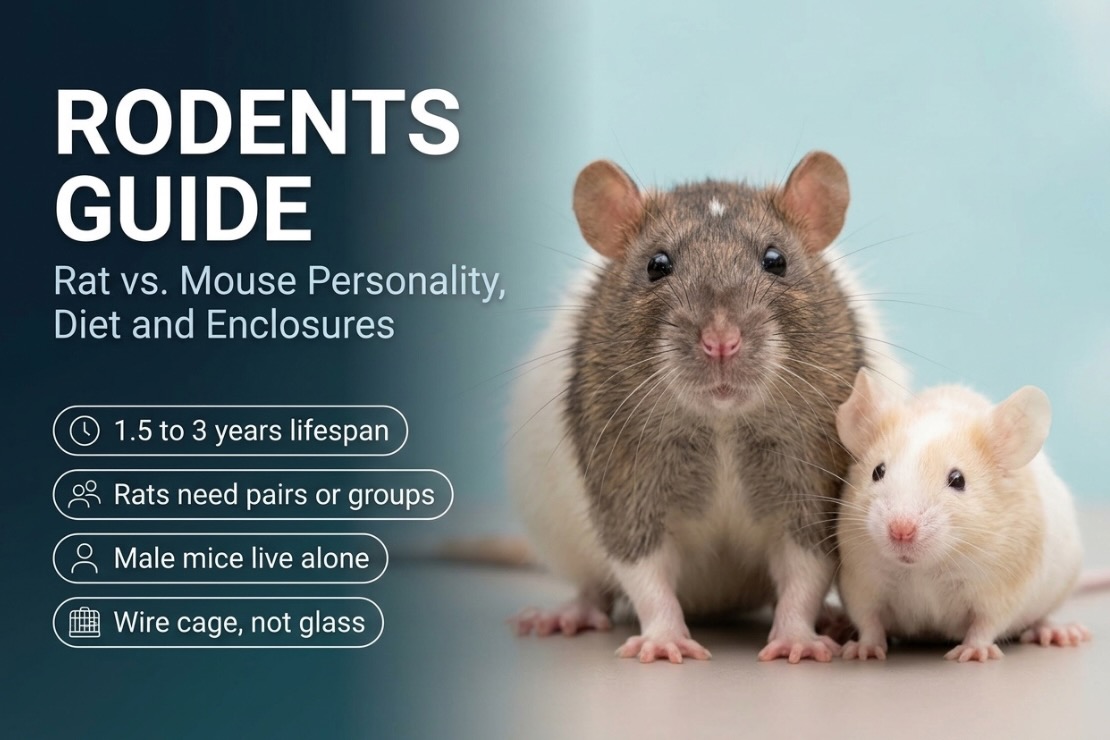
Rats and mice share a family tree, a talent for squeezing into small spaces, and an unfair reputation. However, their personalities, care needs, and social dynamics are surprisingly different. Choosing the wrong species for your lifestyle is the most common beginner mistake. Furthermore, keeping either species incorrectly leads to stress, illness, and a very short, unhappy life. This guide breaks down both species honestly, so you make the right call before anyone goes home in a cardboard box.
What is Their Personality Really Like?
This is the question that actually matters before any purchase decision. In fact, personality drives compatibility between keeper and animal far more than size or cost. The classic analogy compares rats to small dogs and mice to small cats. However, that comparison only scratches the surface. Understanding both species honestly will save you from a significant mismatch.
Rats

Rats are genuinely social animals with measurable emotional intelligence. Consequently, they form observable bonds with their owners that go well beyond simple food association. A well-socialized rat learns its name within days. Furthermore, it actively seeks human interaction, climbs onto your shoulder without prompting, and grooms your fingers as a bonding gesture. These are not exaggerations. They are documented behaviors observed consistently across the species.
Their problem-solving ability is equally impressive. Rats navigate mazes, open latches, and retrieve objects on command. In fact, laboratory studies have demonstrated that rats display empathy — they free trapped companions even when no reward is offered. Additionally, they show regret-like responses when they make suboptimal choices. For a creature weighing under 500 grams, that is a remarkable cognitive profile.
However, none of this social richness develops in isolation. A single rat is a stressed rat. Therefore, you must keep them in same-sex pairs or small groups without exception. A lone rat develops anxiety, repetitive behaviors, and a weakened immune system. Furthermore, males can cohabit peacefully when introduced young. Females generally tolerate group living more easily. Neutering is an option worth discussing with a vet for mixed-sex setups.
Mice

Mice operate on a different social frequency entirely. They are curious and quick-witted, but independence defines their character. Consequently, they observe the world from a safe distance before engaging. A mouse will investigate every corner of a new enclosure before acknowledging your presence. That is not fear — it is a thorough risk assessment. In contrast to rats, mice rarely seek out physical contact unprompted.
However, taming is absolutely achievable with patience and consistency. A mouse that associates your hand with food will eventually climb onto it voluntarily. Furthermore, female mice thrive in pairs or small groups and develop clear social hierarchies. They are genuinely fascinating to observe. Their nest-building behavior, foraging patterns, and communication through ultrasonic vocalizations make them compelling pets even without cuddling.
Male mice are an entirely different situation. They are highly territorial toward other males. As a result, two adult male mice in the same enclosure will fight, and the outcome is frequently fatal for one or both. Therefore, males must live alone without exception. This is not negotiable and not something patience or space will resolve. A male mouse lives a perfectly content solo life with enough enrichment and daily interaction.
What Kind of Enclosure Do these small rodents Need?
Proper housing is not a preference — it is the single largest determinant of respiratory health for both species. Furthermore, the wrong enclosure choice will cause illness regardless of diet, handling, or every other care variable. Get this right first.
Housing Requirements
Cage Type: A wire cage with a solid floor base is the correct choice for both rats and mice. Glass aquariums have critically poor airflow. Ammonia from urine accumulates rapidly in still air. Consequently, respiratory infections follow with near certainty in poorly ventilated setups. Wire construction solves this problem directly.
Rat Cage Size: Two rats require a minimum of two cubic feet of usable space per animal. However, vertical height matters as much as floor area. Rats climb actively and benefit enormously from multi-level platforms, hammocks, and rope ladders. Furthermore, a larger cage reduces territorial tension in group setups. The Critter Nation and Ferplast Furet models are widely used and functionally appropriate.
Mouse Cage Size: A pair of female mice requires a minimum 10-gallon tank equivalent or a wire cage with bar spacing no wider than 6mm. However, modern welfare standards strongly favor larger setups. A 20-gallon long footprint allows meaningful enrichment and reduces stress-related behaviors. Furthermore, if you use a glass tank, increase cleaning frequency significantly. Ammonia builds faster in enclosed glass than in wire.
Enrichment: Both species need more than food and shelter. Specifically, they need items to chew, tunnels to explore, and nesting material to manipulate. Toilet paper rolls, untreated wood blocks, and paper-based bedding at a minimum depth of 15cm address these needs. In fact, deep substrate is particularly important for mice, which spend significant time digging and burrowing.
What Should I Feed Them?
Diet is where most rodent keepers make their most expensive mistake — not financially, but biologically. Furthermore, the pet trade actively contributes to this problem by marketing colorful seed mixes as complete nutrition. They are not. Understanding the difference between a staple diet and a treat changes long-term health outcomes dramatically.
The Diet: Rats vs. Mice
Both species are omnivores with broadly similar nutritional requirements. However, rats have a higher protein requirement than mice, particularly during growth and pregnancy. Mice are slightly more adapted to seed-based foraging in nature. Consequently, protein ratios in commercial foods differ between species-specific formulations. Always select a product labeled specifically for the species you keep.
The Staple Diet
A high-quality commercial lab block or extruded pellet should constitute at least 80% of the daily diet. These products are nutritionally complete and prevent selective feeding. Furthermore, they provide the correct calcium-to-phosphorus ratio and protein percentage for long-term health. Brands like Oxbow Essentials, Science Selective, and Mazuri Rat & Mouse Diet are consistently recommended by exotic veterinarians. Consequently, they represent the baseline from which all other feeding decisions should start.
The Problem with Seed Mixes
Colorful seed mixes are nutritionally deceptive. They look varied and appealing, but both rats and mice selectively eat the high-fat components — sunflower seeds and peanuts — and leave everything else. As a result, animals fed exclusively on seed mixes develop obesity, vitamin deficiencies, and fatty liver disease. Furthermore, the selective eating behavior means keepers often believe the animal is eating well when it is actually malnourished. Seed mixes belong in the treat category only, offered in small amounts no more than twice weekly.
Healthy Supplements
Fresh vegetables and small amounts of fruit expand the dietary profile meaningfully. Specifically, broccoli, peas, carrots, cucumber, and leafy greens are appropriate for both species. Cooked plain rice, pasta, and small pieces of hard-boiled egg provide additional variety. However, avoid citrus fruits entirely for male rats — they contain d-limonene, which is linked to kidney disease in males specifically. Furthermore, grapes, raisins, and onions are toxic to rodents and must be excluded completely.
How Do I Handle Them and Build a Bond with these small rodents?
Patience is the only reliable method. Furthermore, rushing the taming process causes setbacks that take weeks to reverse. Both species respond to consistent, positive, low-pressure interaction. However, the timeline differs between rats and mice, and between individual animals within the same species.
- Acclimation period: Give new animals 48 to 72 hours in their enclosure before any handling attempts. They need to establish scent markers and locate food, water, and shelter before engaging with you.
- Hand feeding first: Offer a small high-value food item — a sunflower seed, a small piece of cooked chicken — from a flat, open palm. Do not reach into the enclosure. Let the animal approach the food at its own pace. Repeat this twice daily for several days.
- Introduce your scent passively: Place a worn piece of cloth inside the enclosure. Animals that are comfortable with your scent will investigate, sleep on, and carry the cloth. This is a reliable indicator of readiness for direct handling.
- Scooping technique: Use both hands to support the full body from underneath. Never grab from above — it mimics a predator strike and triggers a fear response. Never pick up by the tail. The tail is not a handle; it is a spinal extension with blood vessels and nerves.
- Session length: Start with two to three minutes of handling per session. Consequently, increase duration gradually as the animal demonstrates relaxed body language — loose posture, exploratory behavior, and voluntary return to your hand.
What Are Their Common Health Issues?
Both species are fragile in specific, predictable ways. Furthermore, most health problems are directly traceable to husbandry errors rather than genetic misfortune. Knowing the risks in advance allows you to prevent rather than treat.
Respiratory Infections: This is the leading cause of death in both captive rats and mice. Their respiratory systems are highly sensitive to ammonia, dust, and temperature fluctuations. Consequently, dirty enclosures and glass tanks with poor ventilation are the primary triggers. Symptoms include clicking or crackling breath sounds, labored breathing, nasal discharge, and sudden lethargy. These symptoms require an exotic vet visit within 24 hours — respiratory infections progress rapidly in small mammals.
Mammary Tumors in Female Rats: Female rats develop mammary tumors at a significantly higher rate than most other small mammals. Furthermore, these tumors can appear as early as 12 months of age. The majority are benign fibroadenomas, but they grow quickly and affect quality of life if untreated. Surgical removal is effective and commonly performed by exotic vets. Spaying at a young age substantially reduces tumor risk — a conversation worth having with your vet at the first health check.
Mites and External Parasites: Both species are susceptible to fur mites, particularly when introduced from pet stores. Consequently, a 30-day quarantine period for any new animal is strongly recommended before contact with existing animals. Symptoms include excessive scratching, hair loss, and visible skin irritation. Treatment with ivermectin or selamectin under veterinary guidance resolves infestations effectively.
Dental Malocclusion: Both species have continuously growing incisors. In fact, misaligned teeth do not wear correctly and eventually prevent normal feeding. Providing appropriate chew materials reduces the risk significantly. However, genetic malocclusion requires veterinary trimming at regular intervals.
How Long Do These Cute Rodents Live?
This is the part of the conversation nobody opens with, but it is the part that matters most to long-term emotional preparedness. Both species have short lives by the standards of most companion animals. Furthermore, the bond you build with a rat or mouse makes that brevity feel disproportionately painful when the time comes.
- Rats: 2 to 3 years on average. Well-cared-for individuals occasionally reach 3.5 years, but this is the exception.
- Mice: 1.5 to 2.5 years on average. However, some lines bred for show or companionship have slightly extended lifespans under optimal conditions.
Therefore, anyone considering either species must make peace with this reality before bringing an animal home. Furthermore, the emotional cost is real — particularly with rats, which develop deep individual personalities over their short lives. This is not a reason to avoid them. However, it is context that changes the decision for some people, and it deserves to be stated clearly.
My Experience
I have not personally kept rats or mice as companion animals. That is the honest answer, and anything else would be manufactured credibility. However, I grew up in a household where animals were everywhere my mother was completely fearless with every creature she encountered, snakes included. Consequently, I developed an early familiarity with animal behavior that extends well beyond the species I personally own.
What I can speak to directly is the pattern I observe consistently in the exotic pet community. Rats, specifically, are the most commonly underestimated small mammal in the hobby. Furthermore, people buy them expecting a passive cage animal and discover something that actively seeks their company, learns their schedule, and notices when they are absent. That cognitive and emotional gap between expectation and reality produces either deep attachment or complete surprise rarely anything in between.
My experience with the animals I do keep, from my chameleon Cosmo, to Mike and Frida, my red-eared sliders — has taught me one consistent lesson. Specifically, the species that demand the most from you intellectually are the ones that reward you most visibly. Rats appear to operate on exactly that principle. Therefore, if your lifestyle allows for daily interaction and the short lifespan does not deter you, a pair of rats is among the most enriching small-animal choices available.
Rats & Mice Care FAQ
Rats are the better choice for most beginners. They tolerate handling more readily, form clear bonds with their owners, and recover better from minor care mistakes. Mice are rewarding but harder to handle confidently. Male mice must also live alone, which limits enrichment options compared to paired or grouped rats.
Rats and mice must never share an enclosure. Rats are predators relative to mice, and housing them together causes stress, injury, and frequently the death of the mouse. Their social structures, space requirements, and dietary needs are incompatible. Keep both species in completely separate, appropriately sized setups at all times.
Repeated sneezing in rats signals a respiratory infection and requires prompt veterinary attention. Rats have sensitive respiratory systems that react quickly to ammonia buildup, dusty bedding, and temperature inconsistency. A single sneeze may be harmless. Clicking breath sounds, lethargy, or nasal discharge alongside sneezing confirm infection. Delayed treatment significantly worsens the outcome.
A solitary female mouse displays stereotypic behaviors — repetitive movements, bar-chewing, and disrupted sleep — that signal chronic stress. Female mice require a same-sex companion for psychological stability. Male mice are the exception and must live alone due to lethal territorial aggression. Adding a quarantined, compatible female is the correct solution for a solitary female.
Using a colorful seed mix as the primary diet is the most damaging and widespread error in rodent care. Both species selectively eat the high-fat seeds and ignore everything else, producing obesity and nutritional deficiency simultaneously. A complete lab block must form at least 80% of the diet. Seeds and fruit belong in the remaining 20% only.
Mammary tumors in female rats are common, frequently benign, and surgically treatable. They grow quickly and affect mobility if left unaddressed. Surgical removal is safe and routinely performed by exotic vets. Spaying before six months of age dramatically reduces tumor risk. Tumors appearing in older unspayed females should be assessed promptly — delayed intervention complicates surgical options considerably.
Rats live an average of 2 to 3 years under good care, with occasional individuals reaching 3.5 years. Mice average 1.5 to 2.5 years. Both lifespans are short relative to most companion animals. The depth of bond that develops — particularly with rats — makes this timeline emotionally significant for most committed keepers. Factor this in before acquiring either species.
Sources
- National Library of Medicine
https://www.ncbi.nlm.nih.gov/pmc/articles/PMC6115930/ - MSD Veterinary Manual
https://www.msdvetmanual.com/exotic-and-laboratory-animals/rodents/management-of-mice-and-rats - University of California, Davis
https://ccac.ca/documents/education/training-modules/mice/care-and-feeding-of-mice.pdf - LafeberVet
https://lafeber.com/vet/basic-information-sheet-for-the-fancy-rat/ - Veterinary Partner
https://veterinarypartner.vin.com/default.aspx?pid=19239&id=4952042
Leave a Reply
You must be logged in to post a comment.