

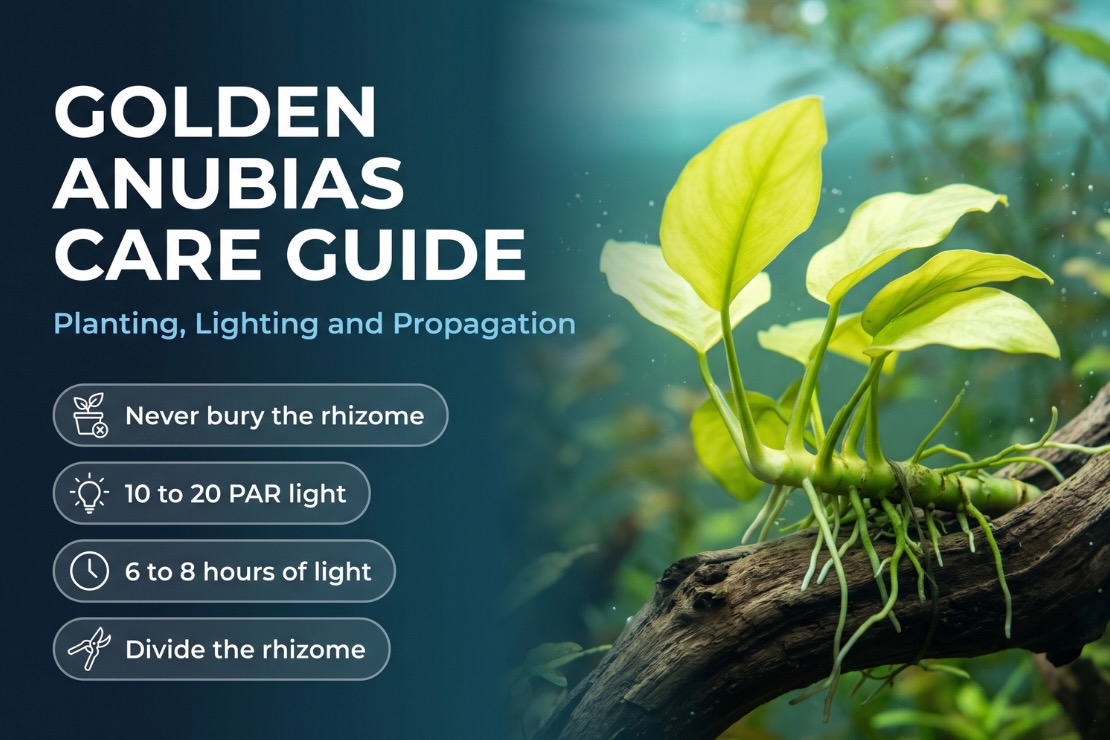
Golden Anubias (Anubias barteri var. nana ‘Gold’) is a yellow-leaved form of the popular dwarf Anubias. It belongs to Araceae, the same plant family as philodendrons and peace lilies. Its parent variety grows in Cameroon, in shallow stretches of fast-flowing forest rivers. The gold form, however, comes from cultivation rather than the wild. In fact, Dennerle reports that growers first discovered it in a Taiwanese nursery. This guide covers attachment, lighting, feeding, propagation, algae control, and troubleshooting. Most importantly, it explains why this plant must never be planted like an ordinary stem plant.
Physical Features of Golden Anubias

Golden Anubias stands out because its leaves grow lime yellow to light green instead of dark green. Otherwise, it shares the leaf shape and size of standard Anubias barteri var. nana. Mature plants usually reach 5 to 10 cm tall and 5 to 20 cm wide. The leaves are thick, leathery, and pointed oval in shape. All leaves rise from a thick, creeping horizontal stem called a rhizome. Furthermore, roots grow from the underside of that rhizome and grip wood or stone.
Color is where the sources disagree, so an honest summary matters. Aquasabi notes that young leaves show the brightest lemon yellow, while older leaves shift toward light green. Similarly, Dennerle and Garnelio report that weak light pushes the foliage toward green. However, TFH Magazine describes the gold color as a stable trait that does not fade with age. In practice, many keepers see bright new leaves sitting above calmer, greener older ones. Growth is also slower than the already slow standard nana. As a result, one plant can take months to fill even a small space. The upside is longevity, because individual leaves can last for several years.
Can you push Golden Anubias into gravel like other aquarium plants?

No, you should never bury the rhizome of Golden Anubias in gravel or soil. Anubias rhizomes tend to rot when substrate covers them. Instead, attach the plant to driftwood or rock, where water flows freely around the rhizome. First, remove the nursery pot and pick out as much rock wool as possible.
Three attachment methods work well:
- Gel superglue: Apply a small dot of cyanoacrylate gel under the rhizome only. Then press the plant onto damp hardscape until it grips.
- Cotton thread or fishing line: Tie the rhizome loosely to wood. Cotton thread breaks down over time, while fishing line needs removal later.
- Wedging: Slip the rhizome into a tight crevice between two stones.

Use glue sparingly. Hobbyists report that heavy glue coverage on the rhizome or roots can contribute to decay. Meanwhile, the roots themselves may enter the substrate, provided the rhizome stays above it. Over time, the roots wrap around the hardscape and anchor the plant permanently. Consequently, you can remove any thread once the plant holds on by itself.
Lighting Needs for Golden Anubias
Golden Anubias needs low to moderate light, roughly 15 to 30 PAR at the plant itself. PAR stands for photosynthetically active radiation, the 400 to 700 nm light plants use. Low-light plants like Anubias generally grow anywhere from 10 to 30 PAR. However, the gold form benefits from the upper half of that range. Both Aquasabi and Dennerle advise against keeping it too dim.

In weak light, growth stalls further and new leaves may come in greener. On the other hand, strong light gives algae an advantage on leaves that persist for years. Therefore, partial shade under taller plants or a driftwood branch usually works best. Keep the photoperiod around 6 to 8 hours daily, and use a timer for consistency. If green spot algae appears, shortening the light period to 6 or 7 hours often helps.
Do I Need to Use CO2 or Fertilizer?
Will Golden Anubias survive without CO2 injection?
Yes, Golden Anubias grows well without CO2 injection. Dennerle lists its CO2 range as 0 to 10 mg/l, which fits a low-tech aquarium. Added CO2 can speed growth slightly, but it remains optional.
Fertilizer helps, though only in modest amounts. A liquid micronutrient supplement such as Seachem Flourish supplies iron, manganese, magnesium, and other trace elements. The label directs 5 mL (about 5 g) per 250 L of aquarium water, once or twice weekly. For example, a 60 L tank needs about 1.2 mL (about 1.2 g) per dose. Conveniently, each cap thread measures roughly 1 mL, which simplifies small doses.

However, Flourish is not a meaningful potassium source. Its label lists only 0.37% soluble potash. Seachem also recommends separate products for nitrogen, phosphorus, and potassium. Consequently, plants with pinholes in older leaves may need a dedicated potassium supplement. In stocked tanks, fish waste already supplies some nitrogen and phosphorus. As a result, a lightly stocked low-tech tank often needs only trace elements plus occasional potassium.
Is leaf loss always a sign that your Golden Anubias is dying?
No, leaf loss is not always fatal, and the rhizome tells you which situation you face. Most nursery plants grow emersed, with their leaves above water. After submersion, some of those older leaves may die back while the plant adapts. In this case, the rhizome stays firm, and new underwater leaves eventually appear.

Rhizome rot is the serious alternative. Aquarium Co-Op lists the classic signs: leaves detaching at the stalk base, discolored roots, and a mushy rhizome. Many hobbyists also report a foul smell from the rotting tissue. Notably, researchers have not identified a definitive cause of so-called Anubias rot. Therefore, isolate any plant with a soft rhizome and cut back to firm, healthy tissue.
Brown or dark patches have other causes too. Algae films can darken leaves, while physical damage leaves torn, irregular edges. Meanwhile, round pinholes with yellowish rims on older leaves often point to potassium shortage. Remove fully decayed leaves promptly, because rotting tissue adds organic waste to the water.
Propagation of Golden Anubias
You propagate Golden Anubias by cutting the rhizome into sections. Each section should keep at least two to three healthy leaves. Garnelio suggests a minimum of two leaves per cutting, while other growers recommend at least three nodes. Use clean, sharp scissors or a sterilized blade, because blunt tools crush the tissue. Then attach each section to hardscape exactly as you would a new plant.

Additionally, the plant sometimes forms side shoots along the rhizome. You can separate these daughter plants once they carry their own leaves and roots. Patience matters here, since Golden Anubias grows more slowly than standard nana. Consequently, wait until the parent rhizome is long and healthy before cutting. Over several years, repeated division can cover an entire driftwood branch.
Can I Keep It With Goldfish or Cichlids?
Golden Anubias is one of the more realistic live plant choices for goldfish and many cichlids. Its tough, leathery leaves resist grazing, and most herbivorous fish leave it alone. In fact, Aquasabi classifies it as a cichlid-proof plant. Mounting it on wood or stone also keeps it safe from fish that dig through substrate.
However, resistant does not mean indestructible. Large cichlids can still tear leaves or dislodge loosely tied plants while rearranging decor. Similarly, Aquatic Arts warns that wood-eating Panaque plecos may chew holes in the leaves. Therefore, secure each plant firmly and wedge mounts where heavy fish cannot flip them. Temperature is rarely a barrier, since Aquasabi lists a tolerance of 12 to 30 °C.
Removing Algae From Golden Anubias
Why does algae love Golden Anubias, and how do you remove it safely?
Algae targets Golden Anubias because each leaf stays in place for months or years. That long lifespan gives slow algae, such as green spot algae (GSA), time to settle. GSA forms hard, round green dots that resist wiping. In planted tanks, low phosphate combined with long or intense lighting commonly drives it.

Removal options, from gentlest to strongest:
- Manual cleaning: Rub the leaves gently with a soft toothbrush or your thumb.
- Grazers: Nerite snails are among the few animals that graze GSA effectively.
- Bleach dip: Buce Plant recommends 1 part unscented bleach to 20 parts water. In grams, mix about 50 g of bleach into 1,000 g of water. Dip tough plants like Anubias for no more than 150 seconds. Next, rinse thoroughly and soak the plant in dechlorinated water before returning it.
Keep in mind that hobbyists report older leaves sometimes suffer after bleach treatment. Prevention, therefore, beats scrubbing. Shorten the photoperiod, keep the plant in partial shade, and avoid letting phosphate bottom out. As a result, new leaves stay clean much longer.
Emersed Growth Capabilities
Can Golden Anubias grow out of water?
Yes, Golden Anubias grows emersed, meaning with its leaves in the open air. Anubias are semi-aquatic plants, and nurseries commonly grow them emersed before sale. Singapore’s National Parks Board even notes that Anubias barteri often grows better emersed than submerged. Consequently, it suits the waterline of a paludarium or the humid lower zone of a closed terrarium.

Two conditions decide success: high humidity and permanently moist roots. A dry rhizome dehydrates quickly, so place the plant near the water surface or on wet substrate. Furthermore, avoid pairing it with plants that prefer dry soil. When you move an emersed plant underwater, expect some older leaves to die back. Fortunately, a healthy rhizome usually responds with new, water-adapted growth.
Common Issues and Troubleshooting
How do you diagnose problems quickly before you lose the plant?
Start with the rhizome, then check light, then check nutrients. Most problems trace back to one of those three. Use this quick reference:

- Pale or yellowing older leaves: Possible nitrogen shortage or natural aging. Remember that yellow-green is this cultivar’s normal color, so compare against new growth first.
- Pale new leaves with green veins: Often iron deficiency. A trace-element supplement usually corrects it.
- Round pinholes with yellow rims on older leaves: Often potassium shortage. However, some experienced aquarists argue potassium causes fewer holes than commonly assumed.
- Ragged, irregular holes: Usually snails, fish, or physical damage.
- Hard green dots on leaves: Green spot algae, linked to long lighting and low phosphate.
- Soft, mushy, or smelly rhizome: Rhizome rot. Cut back to firm tissue and isolate the plant.
- Leaves dropping while the rhizome stays firm: Usually the emersed-to-submersed adjustment.
Regular inspection during water changes catches most of these problems early. As a result, you can fix the cause before a slow plant loses months of growth.
Golden Anubias FAQ
No, the rhizome of Golden Anubias should always sit above the substrate. A covered rhizome tends to rot, while its roots can safely grow into the substrate. Glue it to driftwood, tie it with cotton thread, or wedge it between stones instead.
Golden Anubias can shift partly toward green, although sources disagree on how much. Young leaves usually show the brightest lemon yellow, while older leaves often settle into light green. Dennerle and Garnelio link greener growth to weak light, but TFH Magazine calls the gold color stable.
Golden Anubias grows best under low to moderate light, around 15 to 30 PAR at leaf level. Very dim tanks slow growth and may dull the yellow tone. Partial shade under taller plants or driftwood, with a 6 to 8 hour photoperiod, balances color against algae risk.
Follow the label: 5 mL, roughly 5 g, per 250 L of water once or twice weekly. A 60 L tank needs about 1.2 mL, or roughly 1.2 g, per dose. Flourish supplies trace elements like iron, but it contains very little potassium, so pinholes may require a separate potassium product.
A soft, mushy rhizome usually signals rhizome rot, often called Anubias rot. Researchers have not confirmed its cause, though burial and heavy glue coverage are common hobbyist suspects. Cut back to firm tissue, isolate the plant in a separate container, and remove decaying leaves promptly.
Yes, Golden Anubias is one of the most reliable live plants for these fish. Its thick, leathery leaves deter most herbivorous fish, and Aquasabi lists it as cichlid-proof. Large cichlids can still dislodge loose mounts, and wood-eating Panaqueplecos may chew holes, so anchor every plant firmly.
A brief, diluted bleach dip is generally safe for tough Anubias when done carefully. Mix 50 g unscented bleach into 1,000 g water, then dip for no more than 150 seconds. Rinse thoroughly, then soak it in dechlorinated water before returning it to the tank.
Yes, Golden Anubias grows emersed, with its leaves in open air. Nurseries commonly produce Anubias this way, and Singapore’s National Parks Board notes it often thrives better emersed than submerged. It suits paludarium waterlines or humid terrariums, provided the rhizome and roots stay permanently moist.
Sources
- Wikipedia – https://en.wikipedia.org/wiki/Anubias_barteri_var._nana
- Wikipedia – https://en.wikipedia.org/wiki/Anubias
- Tropical Fish Hobbyist Magazine – https://tfhmagazine.com/articles/aquatic-plants/anubias-barteri-var-nana-gold
- Aquasabi – https://www.aquasabi.com/Anubias-barteri-var-nana-Golden-Heart
- Aquasabi – https://www.aquasabi.com/anubias-barteri-var-nana
- Garnelio – https://www.garnelio.de/en/dwarf-spear-leaf-on-root-anubias-nana-var.gold-on-root-dennerle
- McMerwe Aquatics (Dennerle Anubias nana Gold) – https://mcmerwe.co.za/shop/dennerle-anubias-nana-gold/
- Aquarium Co-Op – https://aquariumcoop.com/blogs/aquarium/anubias-rot
- Aquarium Co-Op – https://aquariumcoop.com/blogs/aquarium/par-for-planted-tanks
- 2Hr Aquarist – https://www.2hraquarist.com/blogs/light/par-for-aquarium-plants
- 2Hr Aquarist – https://www.2hraquarist.com/blogs/algae-control/green-spot-algae-planted-tank
- Gensou Aquascaping – https://gensou.sg/?p=21975
- Buce Plant – https://buceplant.com/blogs/news/how-to-perform-a-bleach-dip-for-aquarium-plants
- PetSmart (Seachem Flourish label) – https://www.petsmart.com/5272981.html
- Aquatic Arts – https://aquaticarts.com/products/golden-anubias-nana-pot
- National Parks Board Singapore – https://www.nparks.gov.sg/nparksbuzz/issue-14-vol-3-2012/gardening/anubias–not-just-for-aquariums
- UKAPS Forum – https://www.ukaps.org/forum/goto/post?id=724500
Leave a Reply
You must be logged in to post a comment.