For the longest time, I was perfectly happy with plastic plants. The idea of keeping plants alive under water seemed way too complicated and scientific for me. Then, on a whim, I bought a single Anubias. I didn’t have special lights or fertilizers; I just tied it to a piece of driftwood and hoped for the best. A few weeks later, I saw a tiny, bright green new leaf slowly unfurling. It was a small victory, but it felt huge. That little leaf taught me that starting with live plants doesn’t have to be hard. This guide is here to help you find the joy of aquatic plants.
What Are the Benefits of Aquatic Plants?

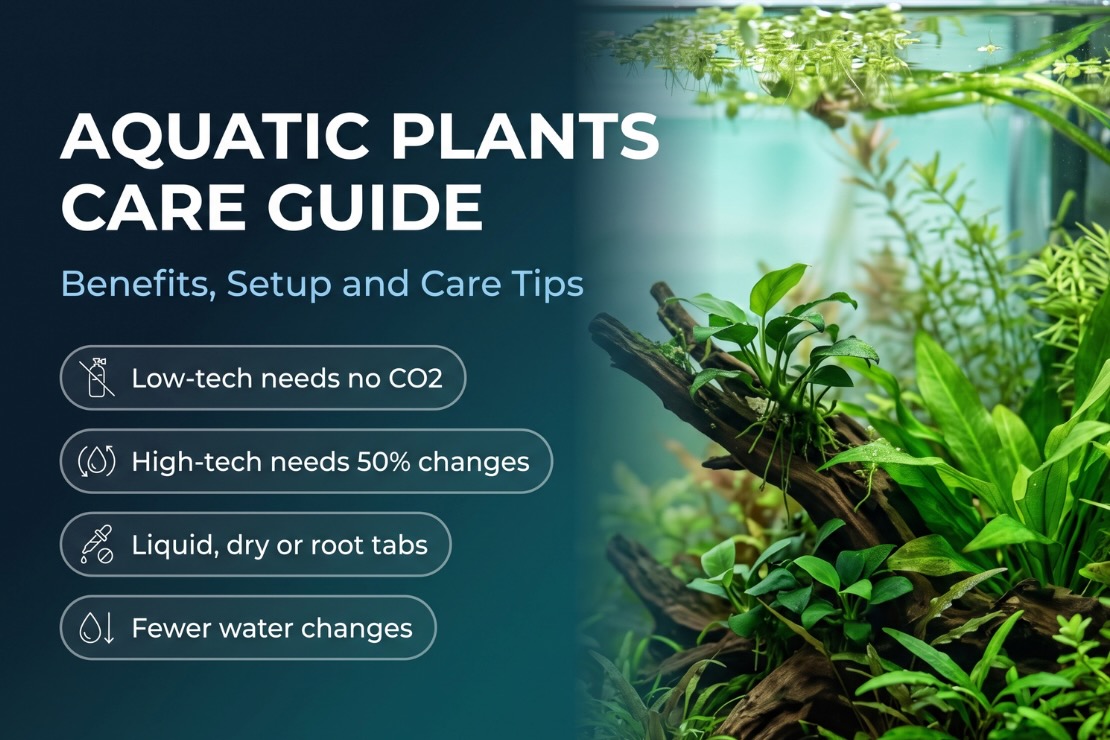
Your little aquatic world will become complete with the addition of aquatic plants. It’s best to stop using plastic alternatives, unless you’re keeping herbivorous fish. Live plants play a crucial role in enhancing your aquatic ecosystem and are vital for completing the nitrogen cycle. For most fish keepers, performing 25% water changes weekly is ideal. However, in heavily planted tanks, plants can significantly lower the need for such frequent changes. The efficiency of your filtration system also contributes to this reduction, allowing water changes to be reduced to a monthly schedule. Some hobbyists eventually reach a point where the ecosystem achieves self-balance. To facilitate this, it’s important to test your water for ammonia, nitrites, and nitrates, usually using test strips from your local fish store. Continuously monitor these levels until you determine the optimal frequency for water changes.
All aquatic plants require similar nutrients; however, the concentration of each nutrient varies. They need macronutrients such as nitrogen, phosphorus, and potassium, as well as micronutrients like calcium, magnesium, copper, iron, boron, and manganese. Low-tech plants are simpler to maintain and care for, while high-tech plants have more requirements for management within your tank. The approaches to setup and maintenance differ significantly between low-tech and high-tech tanks.
Types of Aquatic Plants

Aquatic plants fall into three practical groups: stem plants, epiphytes, and floating plants. Each group collects nutrients and carbon from a different place. Consequently, each group needs its own planting method.
Stem Plants

Stem plants grow upright along a stem and send roots into the substrate. They prefer nutrient-rich, soil-type substrates. However, they also grow in gravel when the water column holds enough nutrients. Light strength changes their shape. Specifically, medium light tightens the spacing between leaves and improves color. Leggy growth usually signals weak light. Increase the light slightly, or trim and replant the tops.
- Ludwigia repens: A hardy stem plant with a colorful upper canopy. Under moderate to high light with CO2, the upper leaves turn deep red to burgundy. The undersides stay green.
- Rotala rotundifolia: Hobbyist guides rate it among the easiest red stem plants. With moderate to high light and CO2, the tips turn pink, orange, or red. In fact, it tends to melt without enough light.
Epiphytes
Epiphytes grow on rocks, wood, or other plants instead of in the substrate. They grow from a rhizome, a horizontal stem that produces both leaves and roots. Therefore, never bury the rhizome, because a buried rhizome rots. Most epiphytes are hardy, slow growing, and comfortable in low light. In fact, they pull nutrients directly from the water column. Attach them to hardscape with cotton thread or fishing line.

- Anubias (Anubias barteri and relatives): This plant belongs to the family Araceae and comes from tropical Central and West Africa. It thrives in low to medium light. However, its slow-growing leaves collect algae under high light or nutrient imbalance. To propagate, cut the rhizome into pieces of about four to five leaves.
- Java Fern (Microsorum pteropus): This fern does best in low to medium light. Its roots are black, which is normal. Propagate it by cutting the rhizome.
- Java Moss (Taxiphyllum barbieri): This moss grows well in low to medium light. It needs no substrate at all. As a result, it pairs easily with Anubias and Java fern in low-light tanks.
Floating Plants
Floating plants sit on the water surface, where they get direct light and atmospheric CO2. Research on freshwater plants confirms that floating or aerial leaves are one strategy to overcome carbon limitation underwater. Furthermore, they absorb excess nutrients from the water, which earns them the nickname nitrate sponges. However, dense cover limits the light reaching plants below. Therefore, thin the cover when lower plants need light.

- Amazon Frogbit (Limnobium sp.): A beginner-friendly floater. It draws carbon from the air and nutrients from the water.
- Duckweed (Lemnaceae): A 2023 review describes duckweeds as efficient at removing CO2 from the atmosphere, with exceptionally high growth rates. Consequently, plan to remove the excess regularly.
- Red Root Floater (Phyllanthus fluitans): After shipping, it may melt for three to seven days. Give it low stress and shorter light periods. Transparent leaves signal low nutrients, so add root tabs.
Care and Requirements

Aquatic plants need three things in balance: light, nutrients, and carbon dioxide. Specifically, submerged leaves have a low photosynthetic capacity that matches the limited supply of CO2 and light underwater. As a result, a shortage or excess of any single input shows up quickly. In fact, the usual warning sign is algae.
Lighting

Every aquatic plant needs light for photosynthesis. Even low-light species need about 6 to 8 hours of LED light daily. Anubias and Java fern do well in low to medium light. Carpeting plants generally prefer medium light or higher. However, more light is not automatically better. Strong light combined with weak nutrients or weak flow feeds algae on slow-growing plants.
Nutrients

Plants need macronutrients and micronutrients, and they absorb them from the water and the substrate. Epiphytes take most of their nutrients from the water column. Root tabs feed plants through the roots, while liquid fertilizer feeds them through the water. Even low-tech plants benefit from an occasional all-in-one liquid fertilizer, because water changes remove nutrients. However, ferns need little extra, so avoid excess micronutrients.
Carbon Dioxide (CO2)

No, low-tech plants do not need injected CO2, but every aquatic plant still needs carbon. Dissolved CO2 in a tank without injection often sits below 5 ppm. Nevertheless, hardy plants such as Anubias grow without injection. In fact, research shows about half of tested submerged plants can also use bicarbonate as a carbon source. Furthermore, floating leaves skip the problem by taking CO2 from the air. Injection, usually 20 to 30 ppm, speeds growth and suits demanding plants.
What are Low Tech and High Tech Plants Setups?
In low-tech environments, aquatic plants tend to grow naturally and at a slower pace. This type of growth demands fewer nutrients, making it ideal for novice hobbyists. All that’s needed is a basic substrate, full-spectrum lighting, and an effective filtration system. As slower growth is expected, maintenance is simpler and requires fewer nutrients, less pruning, and fewer water changes compared to high-tech setups.

High-tech tanks utilize systems that incorporate additional CO2 injections and ample lighting. These setups greatly enhance the rate of aquatic plants growth, consequently increasing the demand for nutrients. As a result, a nutrient dosing schedule becomes essential since these nutrients will deplete more rapidly. Moreover, more frequent water changes may be necessary, potentially needing at least a 50% water change on a weekly basis. This approach certainly demands more effort and maintenance compared to a low-tech planted tank.
Managing Algae and Trimming in Low Tech Tanks
Control light and flow first, then trim on a steady schedule. Algae thrives when light outpaces what slow-growing plants can use. Therefore, shorten the photoperiod or reduce the intensity when algae appears on carpets or slow leaves. Black beard algae shows up under high light with low CO2 and weak flow. As a result, reduce the light and increase circulation. Healthy plants also starve algae of nutrients, so keep plant growth steady. Weekly water changes of 20 to 30% keep nutrients balanced in fern and Anubias tanks.

Trimming stays gentle in low-tech tanks because growth is slow. Remove yellowing Java fern leaves, and cut damaged fronds at the rhizome. Specifically, new growth emerges from the rhizome. For stem plants, trim and replant the tops when growth turns leggy. Anubias can be divided by cutting the rhizome into pieces. Patience also matters. A tank built from ferns and Anubias takes six to twelve months to fill in completely. Plants, unlike deadlines, do not negotiate.
Can I use Fertilizers for my Aquatic Plants?

Fertilizing your aquatic plants with macro and micro nutrients will help them thrive. There are different types of fertilizers. First we have liquid fertilizers. They are the most popular in the aquarium hobby. They are easy to use and supply all required nutrients. These fertilizers contain both macro and micro nutrients. Second, dry fertilizers are cheaper than liquid fertilizers. They need more work for the aquarist. The aquarist must figure out what and how much of each fertilizer to add into the aquarium. Finally, substrate fertilizers are basically root tabs or capsules. You place them into the substrate. They will be slowly released and absorbed by the plant’s roots.
How to dose Fertilizers for Aquatic Plants?
Aquatic Plants vary greatly in their growth rate and nutritional needs. Liquid fertilizers are great and easy to use. They come with instructions for a recommended dosing schedule. Still, it’s best to check the plants. Adjust the quantity and frequency of adding the fertilizer accordingly. Also, some plants will absorb more nutrients over the first few weeks. One last thing to consider is your tank’s bioload. The more fish you have, the less you will need to use fertilizers.

You need to grasp an important concept: attaining equilibrium or a balanced ecosystem in which both your fish and plants flourish demands some effort. Familiarize yourself with using test strips available at local fish stores or pet shops. Conduct weekly tests to monitor your tank’s water parameters. Eventually, you will reach a stage where you understand your tank’s needs; this might involve 25% weekly water changes for some setups, while others may only require top-offs or even 50% water changes in high-tech tanks. You’ll also determine the optimal schedule for fertilizing, which distinguishes a basic tank from one that features a stunning underwater garden.
1- Give plenty of nutrients. As a result, your plants will always have the nutrients they need. adopting this method requires weekly large water changes.
2- Having an enriched substrate and also dosing limited liquid fertilizers into the water column.
3- Perpetual preservation system. This idea is that each tank is different and unique. It involves a DIY method for dosing the tank.
What is a high-tech aquatic plant setup?

A high-tech setup combines strong lighting, injected CO2, and regular nutrient dosing. These three inputs must stay in balance. In fact, high light without enough CO2 usually produces an algae farm instead of a lush garden. Most guides target 20 to 30 ppm of dissolved CO2. Consequently, growth is faster, but dosing, trimming, and water changes all increase.
What equipment do I need for high tech plants?
A pressurized CO2 system, a strong LED light, and a nutrient-rich substrate form the core of a high-tech tank. The CO2 system has several parts:

- CO2 cylinder and regulator: The regulator controls how much gas leaves the cylinder. Choose a reputable dual-stage model.
- Solenoid valve: It switches CO2 on and off automatically. Leaving CO2 on around the clock causes pH fluctuations. One guide suggests starting CO2 30 minutes before the lights turn on and stopping it 30 minutes before they turn off.
- Bubble counter and check valve: The counter lets you track bubbles per second. The check valve stops water from entering the regulator, which would damage it.
- Diffuser: It dissolves the gas into the water. Place it near the filter intake so the flow spreads CO2 through the tank.
- Drop checker: This glass vessel holds a 4 dKH reference solution and a pH indicator. Blue means too little CO2, green means roughly 30 ppm, and yellow means too much. Hang it opposite the diffuser, midway up the tank.
The drop checker lags behind the real level by one to two hours. Therefore, wait 24 hours before adjusting the bubble rate. For lighting, one retailer guide recommends at least 40 to 50 PAR at plant level for most red species. Dark aquasoil also supports root feeding.
Which plants work best in high-tech tanks?
Carpeting plants, high-light stem plants, and a few demanding epiphytes thrive in high-tech tanks. Each group uses the extra light and CO2 differently.
Carpeting Plants
Dwarf baby tears and Glossostigma suit high-tech tanks best, while Monte Carlo offers a more forgiving option. Most carpeting plants need medium to high light and at least 8 hours of light per day.

- Dwarf Baby Tears (Hemianthus callitrichoides ‘Cuba’): This is one of the smallest aquarium plants, with millimeter-sized round leaves. It needs strong light, added CO2, water circulation, and fertilizer. In addition, trim it regularly. Otherwise, the lower parts lose light and the roots die.
- Glossostigma (Glossostigma elatinoides): The classic carpet of nature-style aquascapes. Retailer guides list high light and CO2 as mandatory. Under low light, it grows tall and stem-like.
- Monte Carlo (Micranthemum tweediei ‘Monte Carlo’): An easier alternative to dwarf baby tears. It carpets slowly without CO2. However, injecting 20 to 30 ppm of CO2 transforms its growth.
High-Light Stem Plants
Red and fine-leaved stems need high light and CO2 to reach their full color and growth rate.

- Rotala macrandra: Famous for intense wine-red leaves. One guide reports growth of up to 5 cm per week under strong light and CO2. Place it in the background, where it catches the most light.
- Ludwigia sp. ‘Super Red’: Reported as one of the most intensely red commonly available plants. It needs high light and CO2.
- Rotala wallichii: It has fine, hair-like leaves that turn pink to red under high light. CO2 is required.
Epiphytes & Midground
Epiphytes still work in high-tech tanks, and CO2 makes them stronger. Anubias grown with CO2 become more robust and algae resistant. Moreover, some rare Anubias varieties require high light, CO2, and nutrients to look their best.

- Bucephalandra: An epiphyte in the same group as Anubias and Java fern. Attach it to hardscape and never bury the rhizome.
- Cryptocoryne wendtii ‘Bronze’: Listed among the easiest plants that color up. It fills the midground without demanding extreme light.
- Ammannia and Nesaea: Lighter copper-orange species that work well in the midground.
Why do high-tech plants turn red?
Aquatic plants turn red because they produce anthocyanin pigments as protection against strong light. In other words, red is a stress response, so a vivid red plant is technically a plant wearing sunscreen. Under low light, plants make more chlorophyll to capture photons, and they turn green again. Consequently, high light is the first requirement.

Hobbyist guides add three more factors. First, stable CO2 matters, because drops below about 25 ppm stress red plants and trigger melting. Second, red plants consume large amounts of iron and potassium, both essential for anthocyanin synthesis. Third, light-colored substrates wash out the color. However, some plants are genetically green and never turn red, regardless of conditions.
How often do I need to perform maintenance for high tech plants?
Plan on daily checks, weekly water changes and dosing, and trimming whenever growth demands it. Check the drop checker when the lights turn on, and confirm it reads solid green. Weekly water changes of 30 to 40% are standard in high-light, high-CO2 tanks. However, your article’s earlier section suggests at least 50%, and sources vary between 30 and 50%. Therefore, test your nitrate and adjust to your tank.
Trimming depends on the plant. In a high-tech tank, Monte Carlo may need trimming every three to four weeks. Dwarf baby tears need regular trimming to protect the lower layer. Stem plants need trimming and replanting when growth turns leggy. Finally, a quality regulator can last five to ten years with proper care.
Aquatic Plants Care FAQ
Live aquatic plants support the nitrogen cycle by absorbing ammonia, nitrites, and nitrates from the water column. A heavily planted tank can reduce water change frequency significantly, with some setups needing only monthly changes rather than weekly. Plants also provide oxygen, shelter, and natural environmental conditions that plastic alternatives cannot replicate.
A low-tech planted tank uses basic substrate, full-spectrum lighting, and filtration without CO2 injection, producing slower growth and minimal maintenance requirements. A high-tech tank adds CO2 injection and enhanced lighting, accelerating growth but depleting nutrients faster and requiring weekly 50 percent water changes. High-tech setups deliver better results but demand significantly more maintenance.
Aquatic plants require both macronutrients — nitrogen, phosphorus, and potassium — and micronutrients including calcium, magnesium, and iron. These can be delivered through liquid fertilizers (most practical), dry fertilizers (cheaper but requiring individual nutrient calculations), or substrate fertilizers such as root tabs absorbed directly through the roots. Each method suits different skill levels and tank types.
Fish bioload directly reduces the amount of supplemental fertilizer a planted tank requires, because fish waste produces ammonia that bacteria convert into plant-absorbable nitrates. A heavily stocked tank may sustain moderate plant growth through biological waste alone. A lightly stocked or fish-free planted tank requires more frequent fertilizer dosing to compensate.
Starting with low-tech plants such as Anubias significantly reduces early failure risk, as these species need no CO2 injection, tolerate variable lighting, and establish without specialist fertilizer schedules. Anubias and Java Fern attach directly to driftwood and succeed in most basic setups. Early success with undemanding plants builds the experience needed before attempting demanding species.
Sources
- Functional Plant Biology (Maberly and Madsen, 2002) https://publish.csiro.au/FP/PP01187
- Frontiers in Plant Science (Ottelia cordata CO2 study) https://www.frontiersin.org/journals/plant-science/articles/10.3389/fpls.2020.01261/full
- Plants, MDPI via DOAJ (Lemnaceae and CO2) https://doaj.org/article/4838c48f96244c70a0f41161430f2427
- Aquasabi https://www.aquasabi.com/aquascaping-wiki_aquatic-plants_epiphytes
- Buce Plant (epiphytes) https://buceplant.com/blogs/aquascaping-guides-and-tips/how-to-plant-aquatic-plants-epiphytes
- Buce Plant (CO2 equipment) https://buceplant.com/blogs/news/guide-to-equipment-needed-for-planted-tank
- Buce Plant (red plants) https://buceplant.com/blogs/aquascaping-guides-and-tips/how-to-trigger-color-changes-in-red-aquatic-plants
- ADA Aqua Journal https://www.adana.co.jp/en/aquajournal/open-green-lab_01/
- UKAPS (Tropica description of HC Cuba) https://www.ukaps.org/forum/plants/hemianthus-callitrichoides-cuba.72/
- Your Local Fish Store (Tropica plant guide) https://yourlocalfishstore.com/blogs/news/beginner-friendly-aquarium-plants-that-thrive-in-most-aquariums
- Cuboid Easy Plant Guide https://cdn.shopify.com/s/files/1/0804/8748/1655/files/Cuboid_Easy_Plant_Guide_Rev_20251110.pdf
- 2Hr Aquarist https://www.2hraquarist.com/en-fr/blogs/freshwater-aquarium-plants-guide/how-to-grow-anubias-species
- Fishyhub (low maintenance plants) https://fishyhub.com/sg/blogs/blog-detail/low-maintenance-aquarium-plants
- Fishyhub (red plants) https://fishyhub.com/sg/blogs/blog-detail/red-aquarium-plants
- Gensou Aquascaping (CO2 measurement) https://gensou.sg/aquarium-co2-measurement-guide-drop-checker-ph/
- Gensou Aquascaping (red plants) https://gensou.sg/aquascape-with-red-plants-only/
- Gensou Aquascaping (Monte Carlo) – [https://gensou.sg/monte-carlo-aquarium-plant-guide/]
- Gensou Aquascaping (ferns and Anubias) – [https://gensou.sg/?p=24522]
- Gensou Aquascaping (CO2 setup) – [https://gensou.sg/?p=24955]
- Tank Flare – [https://www.tankflare.com/blogs/co2-injection-for-planted-tanks]
- Dustin’s Fish Tanks – [https://dustinsfishtanks.com/blogs/dustins-blog/redplants101]
Leave a Reply
You must be logged in to post a comment.