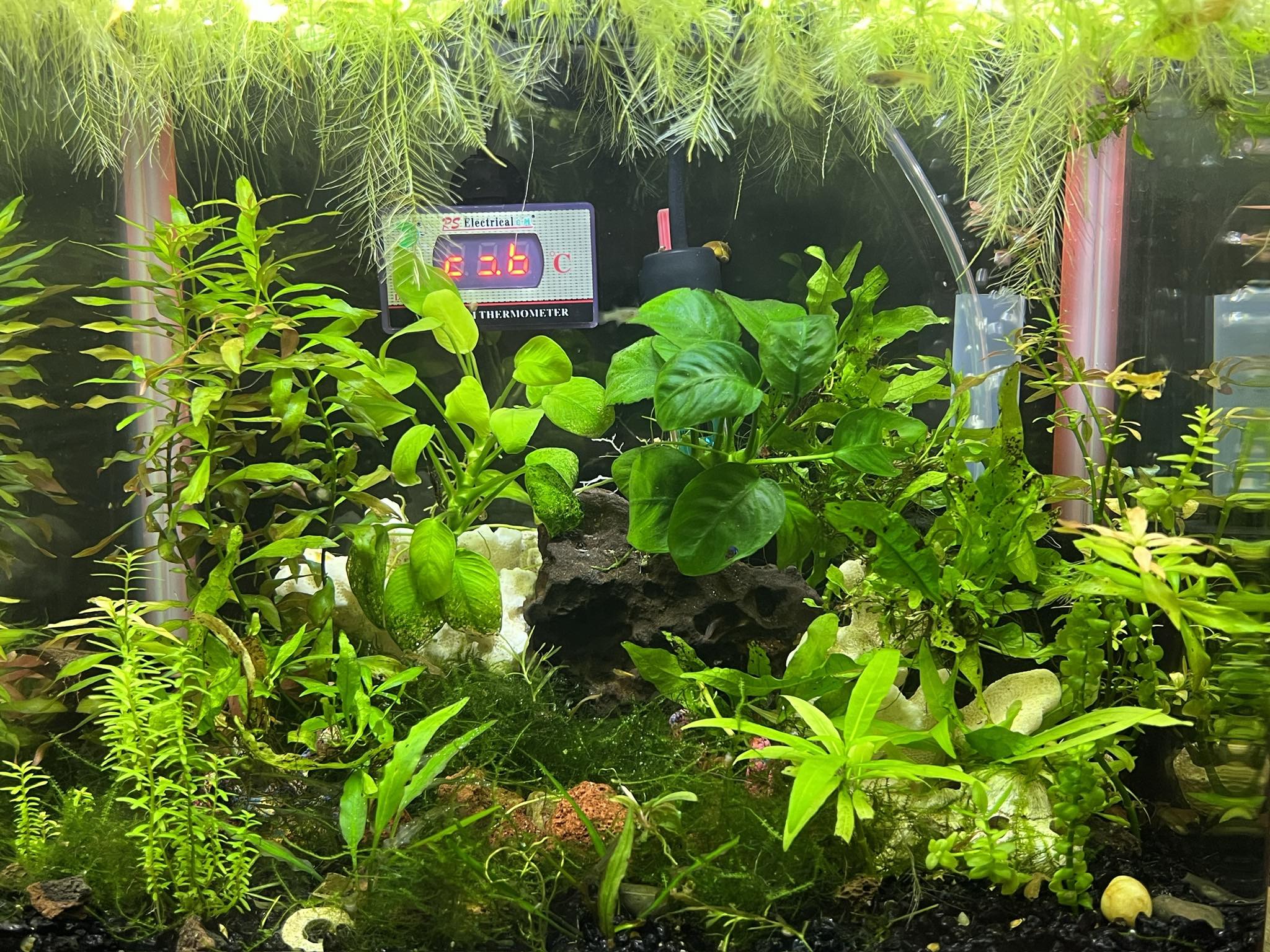
For many, the dream of a lush, green underwater world seems complex and expensive. It appears like a science experiment reserved only for expert aquascapers. But what if you could have a stunning planted aquarium without the need for high-tech gadgets and a degree in botany? Welcome to the world of the low-tech planted tank. This guide will demystify the process, addressing all your questions. Ultimately, you will learn how to build a beautiful, stable, and low-maintenance ecosystem.
I was perfectly happy with plastic plants. In fact, the idea of keeping plants alive underwater with all the talk of CO2, special lights, and complicated fertilizers seemed way too intimidating for me. Then, on a whim, I bought a single Anubias. I didn’t have any fancy gear; I just tied it to a piece of driftwood and hoped for the best. A few weeks later, I saw a tiny, bright green new leaf slowly unfurling. It was a small victory, but it felt huge. That little leaf taught me that a beautiful planted tank doesn’t have to be hard. Instead, it just has to be balanced. This guide is here to help you find that same simple, rewarding joy.
What is a Low-Tech Planted Tank?
A low-tech (or “low-light”) planted tank is an aquarium that is set up to create a balanced, near self-sustaining ecosystem without the use of high-tech equipment. Specifically, this means:
- No injected Carbon Dioxide (CO2)
- Low to moderate lighting
- Minimal fertilization
The overall goal is to create a stable environment where plants grow slowly but healthily, thereby naturally keeping algae at bay.
What Are the Advantages of a Low-Tech Plants?
Less Maintenance: Since growth is slower, you get less trimming and fewer water changes.
Lower Cost: Consequently, you save a significant amount of money by not buying CO2 systems, expensive lights, and heavy fertilizers.
More Stable: Furthermore, these tanks are far less prone to the sudden algae outbreaks that can plague high-tech setups when something goes wrong.
How Do I Set Up a Low-Tech Tank?
What is the Best Substrate for Low-Tech Plants?
Inert Substrate + Root Tabs: Use simple sand or fine gravel. Although it’s clean and easy, it contains no nutrients. Therefore, you must place “root tabs” (solid fertilizer capsules) deep in the substrate to feed root-feeding plants.
Nutrient-Rich Substrate: Alternatively, use a layer of organic soil capped with sand, or an aquarium “aquasoil.” This provides long-term nutrients for your plants but can be messier to set up. For this reason, inert substrate with root tabs is often the easiest starting point for beginners.
What Kind of Light Do I Need for a Low-Tech Tank?
A simple, low-to-moderate output LED light is perfect. You don’t need the expensive, high-intensity lights used for high-tech tanks.
How many hours should the lights be on?
A consistent light period of 7-9 hours per day is ideal. Use a timer to keep it consistent and prevent algae.
What Are the Easiest Plants for a Low-Tech Tank?
These are the “bulletproof” plants that thrive in low-tech conditions.
- Anubias (e.g., Anubias nana): A tough, slow-growing plant with beautiful dark green leaves.
- Java Fern (Microsorum pteropus): Incredibly hardy and forgiving. It will even grow new plantlets from its leaves.
- Cryptocoryne (e.g., Cryptocoryne wendtii): A classic root-feeder that comes in many colors and textures.
- Java Moss (Taxiphyllum barbieri): A versatile moss that can be attached to wood or rocks.
- Amazon Sword (Echinodorus species): A larger plant that makes a great background centerpiece.
How Do You Plant Anubias or Java Fern?
This is the most critical planting rule: Do not bury the rhizome! The rhizome is the thick, horizontal green stem that the leaves and roots grow from. To clarify, if you bury it under the substrate, it will rot, which means the plant will die. Therefore, you must attach these plants to driftwood or rocks, either using super glue or cotton thread.
How Do I Grow Carpeting Plants in a Low-Tech Tank?
This is challenging, as most dense carpeting plants require high light and CO₂
However, some options can work, though they will grow very slowly:
Dwarf Sagittaria (Sagittaria subulata)
Marsilea Hirsuta
Java Moss can be attached to mesh to create a “carpet” effect.
Do Low-Tech Tanks Need Fertilizer?
Yes, but much less than high-tech tanks. Your fish provide some fertilizer in the form of waste, but you will likely need to supplement.
What is the best fertilizer for low-tech plants?
To fertilize, use a comprehensive, “all-in-one” liquid fertilizer (like Aquarium Co-Op’s Easy Green or Seachem Flourish) dosed once or twice a week. You should also combine this with root tabs for your root-feeding plants. While Easy Green is a true “all-in-one” (high in Macros: Nitrogen, Phosphorus, Potassium), Seachem Flourish is primarily a Micronutrient supplement (trace elements). It contains almost no Nitrogen or Phosphorus.
Impact: If a tank has a low fish load (low waste), using only Seachem Flourish might lead to macro-nutrient deficiencies. It is better described as a “trace supplement” rather than a complete all-in-one.
How Do I Prevent and Control Algae?
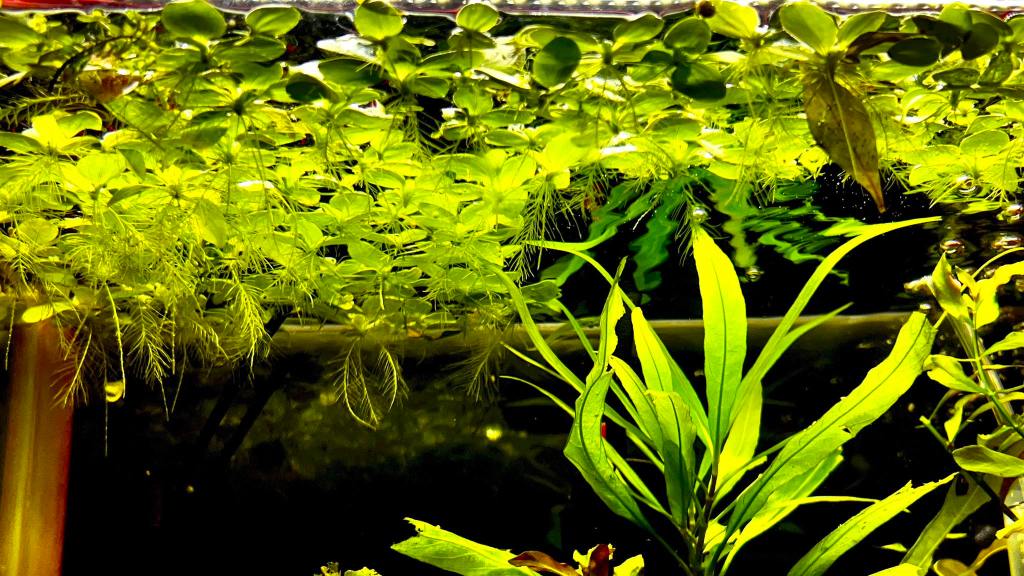
The key to preventing algae in a low-tech tank is balance. Algae appears when there is an imbalance between light and nutrients.
- Keep your light period consistent and not too long (7-9 hours).
- Don’t overfeed your fish.
- Perform regular water changes (25-30% every 1-2 weeks is a good starting point).
What Are Good Fish for a Low-Tech Planted Tank?
The best fish are small, peaceful community fish that will not disturb the plants. For example, think Neon Tetras, Ember Tetras, Corydoras catfish, Rasboras, and Guppies. Furthermore, snails and shrimp are also fantastic additions.
Why Isn’t My Tank as Lush as the Ones Online?
This is about managing expectations. The stunning “contest” aquascapes you see online are almost always high-tech tanks. While they grow incredibly fast, they are also incredibly unstable and require hours of maintenance each week. In stark contrast, the beauty of a low-tech tank is its slow, steady, and stable growth. Therefore, be patient, and you will be rewarded with a beautiful, natural ecosystem that is truly your own.
Low Tech Aquatic Plants FAQ
A low-tech planted tank is an aquarium that sustains plant life without injected CO₂, high-intensity lighting, or heavy fertilization. The goal is a slowly growing, self-regulating ecosystem where plant health and fish waste maintain a natural nutrient balance. Growth is slower than high-tech setups but the tank is far more stable and low-maintenance.
Anubias and Java Fern must never have their rhizome buried in substrate — covering it causes rot and kills the plant. The rhizome is the thick horizontal stem from which all leaves and roots emerge, and must remain fully exposed to water. Attach both species to driftwood or rocks using super glue or cotton thread.
Inert substrate such as sand or fine gravel is the easiest low-tech planted tank option, requiring root tabs placed deep in the substrate to feed root-feeding plants. Nutrient-rich aquasoil provides superior long-term nutrition but involves a messier initial setup. For most beginners, inert substrate with root tabs offers the best balance of simplicity and effectiveness.
Seachem Flourish is not a complete planted tank fertilizer — it is a trace element supplement with almost no nitrogen or phosphorus. Low-fish tanks relying solely on Flourish will develop macronutrient deficiencies that stunt plant growth. A true all-in-one fertilizer like Easy Green must be combined with Flourish to supply the full nutrient range.
A low-tech planted tank requires a consistent light period of 7–9 hours per day, slightly shorter than fish-only setups. Keeping the schedule strictly consistent using a timer matters more than the exact duration chosen. Irregular or excessively long light periods are the primary driver of algae outbreaks in low-tech planted tanks.
The five most reliable low-tech planted tank species are Anubias, Java Fern, Cryptocoryne, Java Moss, and Amazon Sword. All five thrive in low to moderate light without injected CO₂ and tolerate beginner maintenance mistakes. Java Fern is uniquely valuable because it propagates new plantlets directly from its existing leaves without any intervention from the keeper.
The stunning planted aquascapes seen online are almost exclusively high-tech setups running injected CO₂ and high-intensity lighting — not low-tech planted tanks. These systems grow rapidly but require intensive maintenance and crash easily when parameters shift. A low-tech planted tank grows slowly but remains stable for years — patience is the most critical tool a beginner needs.
Sources
- Aquarium Co-Op
https://www.aquariumcoop.com/blogs/aquarium/anubias-care-guide - Tropica Aquarium Plants
https://tropica.com/en/guide/make-your-aquarium-a-success/light/ - The 2Hr Aquarist
https://www.2hraquarist.com/blogs/fertilize-planted-tank/how-to-choose-fertiliser - Buce Plant
https://buceplant.com/blogs/aquascaping-guides-and-tips/guide-to-aquarium-substrates-planted-tank-101 - Aquarium Source
https://www.aquariumsource.com/dwarf-sagittaria/

Leave a Reply
You must be logged in to post a comment.