
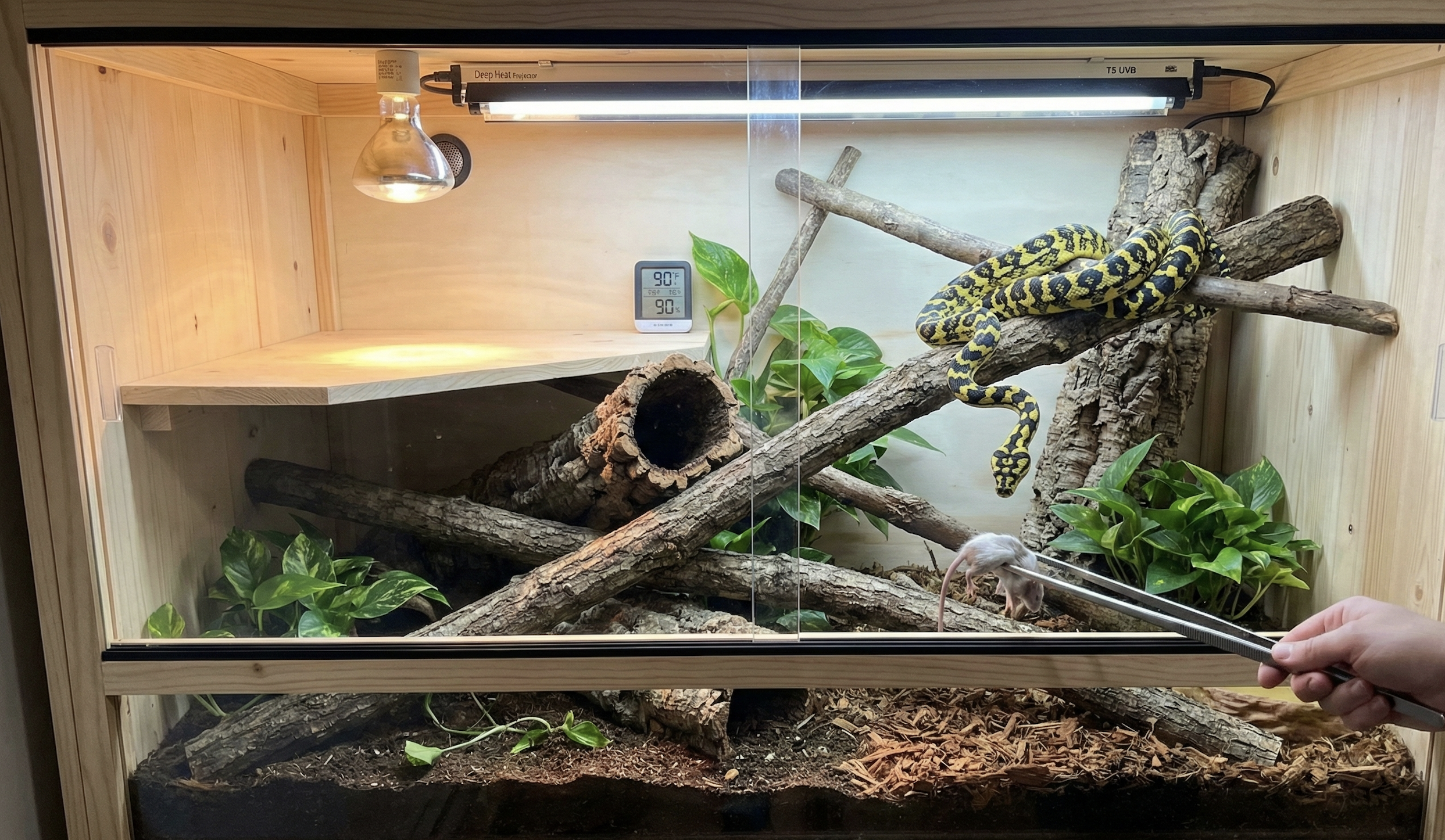
The Carpet Python (Morelia spilota) is a diverse group of snakes from Australia and New Guinea, prized for their breathtaking patterns. They are not a beginner’s snake, but for the keeper ready to take the next step, they are one of the most rewarding pythons in the entire hobby.
Is the Carpet Python a suitable choice for a beginning reptile keeper?
The Carpet Python is definitively an intermediate-level species that requires more environmental complexity than common starter snakes. Specifically, their semi-arboreal nature demands a tall, robust enclosure with precise thermal gradients. Furthermore, hatchlings often exhibit a defensive “nippy” phase that can be intimidating for a first-time owner. Consequently, I reject the assumption that these are “beginner-friendly” animals. Therefore, they serve as the perfect “second snake” for those who have mastered the basics of husbandry. In fact, their high intelligence and active nature provide a much more engaging experience for the dedicated hobbyist.
What are the realistic growth and longevity expectations for a Carpet Python?
A Carpet Python represents a thirty to forty-year commitment to a large and powerful predator. Specifically, size varies dramatically across the Morelia spilota complex, with some subspecies reaching nearly ten feet. Furthermore, they are heavy-bodied animals that require substantial physical support during handling. Consequently, you must be prepared for the long-term logistical and financial costs of housing a large serpent. Therefore, I prioritize the “brutal honesty” of their lifespan over their initially small hatchling size. As a result, many keepers find their Carpet Python becomes a lifelong companion that requires evolving care.
Why is vertical space non-negotiable for a “Vertical World” habitat?
Housing a Carpet Python requires an enclosure that prioritizes height just as much as floor space. Specifically, they are evolved to climb and spend a significant portion of their time off the ground. Furthermore, providing a network of sturdy branches and elevated basking ledges is essential for their natural behaviors. Consequently, a flat, terrestrial setup leads to muscle atrophy and chronic stress. Therefore, I advocate for enclosures that are at least 4 to 6 feet tall for adult specimens. In fact, watching a python navigate a complex vertical environment is the most rewarding aspect of their care.
How do you manage the heat gradient and lighting for a Carpet Python?
Replicating the intense sun of the Australian outback requires overhead heating and specialized UVB lighting. Specifically, a Deep Heat Projector (DHP) is the best way to provide bio-available infrared heat to an elevated basking spot. Furthermore, you must use a reliable thermostat to ensure surface temperatures do not exceed 92∘F. Consequently, providing a low-output T5 UVB tube significantly enhances their natural activity levels and bone health. Therefore, I recommend a “basking shelf” near the heat source to allow the snake to thermoregulate effectively. As a result, you create a diverse thermal landscape that mimics their wild habitat.
What constitutes a scientifically balanced diet for a large constrictor?
In captivity, the Carpet Python thrives on a diet of frozen-thawed rodents that scales with their size. Specifically, juveniles start on mice while adults eventually transition to large rats or even small rabbits. Furthermore, because they have a slow metabolism, overfeeding leads directly to obesity and organ failure. Consequently, adults generally only require a meal every 14 to 28 days depending on their activity. Therefore, I prioritize the use of frozen-thawed prey because it is safer for the snake and more humane. In fact, a lean, muscular python is far more active and long-lived than an overfed one.
What is the biological significance of “periscoping” and alert behavior?
One of the most charming traits of the Carpet Python is its tendency to “periscope” to observe its environment. Specifically, the snake raises the front portion of its body vertically to get a better vantage point. Furthermore, this behavior indicates an alert, curious, and engaged animal that is actively exploring its surroundings. Consequently, an active python is a clear sign that your husbandry parameters are meeting its psychological needs. Therefore, I reject the assumption that snakes are “brainless” or inactive animals. In fact, their high degree of environmental awareness makes them fascinating subjects for behavioral research.
How do the various subspecies and “Jaguar” morphs differ in care?
The Carpet Python complex includes various subspecies like the Jungle and Coastal, each with unique patterns and sizes. Specifically, Jungle Carpet Pythons are famous for their brilliant yellow and black contrast. Furthermore, breeders have developed designer morphs like the “Jaguar,” which unfortunately carries a genetic neurological “wobble.” Consequently, you must research the specific lineage of your animal to understand its unique health and temperature needs. Therefore, I prioritize the care of wild-type or health-stable morphs over those with known genetic issues. As a result, you ensure the best quality of life for your animal.
Sources
- Australian Museum
https://australian.museum/learn/animals/reptiles/carpet-python/ - Reptiles Magazine
https://reptilesmagazine.com/carpet-python-care-sheet/ - Smithsonian’s National Zoo
https://nationalzoo.si.edu/animals/carpet-python - Advancing Herpetological Husbandry
https://www.facebook.com/groups/AdvancingHerpetologicalHusbandry/ - ReptiFiles
https://reptifiles.com/carpet-python-care-guide/ - Animal Diversity Web
https://animaldiversity.org/accounts/Morelia_spilota/ - San Diego Zoo Wildlife Alliance
https://animals.sandiegozoo.org/animals/python


Leave a Reply