
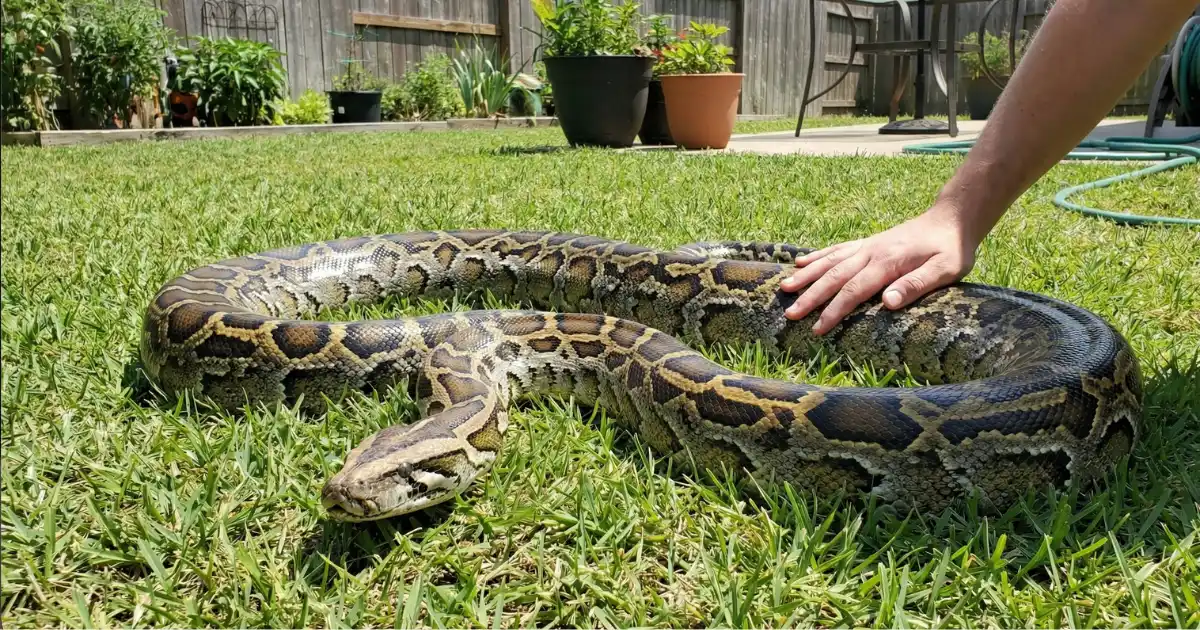
There’s a fundamental shift in perspective that happens when you’re in the presence of a truly giant snake. You understand that your relationship with this animal is built on a foundation of profound respect for its gentle nature and its immense, world-changing power. The Burmese Python (Python bivittatus) is one of the largest snakes on the planet. Its famously docile temperament has made it a favorite among giant snake enthusiasts, but its care is a monumental, lifelong commitment that must not be underestimated.
Is a Burmese Python suitable for a beginner reptile keeper?
The Burmese Python is strictly an expert only species because of its massive size and crushing strength. Specifically, an adult can easily overpower an inexperienced human during a feeding response. Furthermore, the high costs of housing and food make them a significant financial burden. Consequently, I reject the assumption that these are “starter” giants for casual hobbyists. Therefore, you must have years of experience with large constrictors before considering one. In fact, foundational mistakes with this species can lead to life-threatening accidents.
What is the realistic growth and longevity of a captive Burmese Python?
A Burmese Python represents a thirty year commitment to a powerful and thick-bodied apex predator. Specifically, females often reach lengths of 16 to 18 feet and weigh over 70,000 grams. Furthermore, they possess a robust metabolism that requires a consistent supply of large prey items. Consequently, you must prepare for a decades-long stewardship of a 150-pound animal. Therefore, I prioritize the “brutal honesty” of their lifespan over the initial novelty of their size. As a result, owning one is a permanent life-stage decision.
How do you design a custom built room for a giant snake?
Housing a Burmese Python requires building a custom, room-dominating structure rather than buying a standard tank. Specifically, the enclosure length should ideally match the total length of the snake. Furthermore, you must use high-quality PVC or sealed wood to maintain high humidity levels. Consequently, a lack of space leads directly to muscle atrophy and chronic lethargy. Therefore, I prioritize the engineering of a secure, floor-to-ceiling habitat for mature adults. In fact, an 8-foot cage is merely a temporary solution for a growing giant.
What are the critical heating and humidity requirements for a Burmese Python?
Replicating the humid jungles of Southeast Asia requires precise overhead heating and stable moisture levels. Specifically, you should use Radiant Heat Panels to create a basking spot of 90–92∘F (32–33∘C). Furthermore, the ambient humidity must remain between 60% and 70% to prevent respiratory infections. Consequently, providing a massive water tub for full soaking is a biological necessity. Therefore, I recommend the use of digital thermostats to monitor these parameters constantly. As a result, your snake maintains a healthy shed and metabolic rate.
What constitutes a scientifically balanced diet for a 150-pound python?
The Burmese Python requires a diet that evolves from rats to large rabbits and small livestock. Specifically, you must feed them whole prey items to ensure a complete nutritional profile. Furthermore, because they are prone to obesity, you must strictly monitor their body condition. Consequently, I prioritize the use of frozen thawed prey because it prevents the snake from being injured by live animals. Therefore, I suggest feeding adults only every 4 to 6 weeks. In fact, overfeeding is the leading cause of organ failure in large captive pythons.
Why is the “Two-Person Rule” the most important safety protocol?
Managing an adult Burmese Python requires an unbreakable commitment to the “two-person rule” during handling sessions. Specifically, you must never handle a snake over eight feet long without another experienced adult present. Furthermore, even a docile snake can constrict if it is spooked or smells food. Consequently, a second person is necessary to unwrap powerful coils in an emergency. Therefore, I reject the idea that “tame” snakes do not pose a physical risk. In fact, respecting the physics of a 150-pound animal is essential for safety.
How do different genetic morphs impact the care of a Burmese Python?
Genetic morphs like Albino or Granite alter the appearance but do not change the biological needs of the Burmese Python. Specifically, an Albino snake still requires the same massive enclosure and safety protocols as a wild-type. Furthermore, the “designer morph” revolution has made these giants more popular in the pet trade. Consequently, you must not let a beautiful pattern distract you from the reality of their size. Therefore, I prioritize welfare-driven care over aesthetic collecting. In fact, every morph remains an 18-foot predator at maturity.
What is the legal status of owning a Burmese Python today?
The legal status of the Burmese Python is highly restrictive due to its invasive impact in Florida. Specifically, many states have implemented total bans on ownership or breeding within their borders. Furthermore, federal laws previously prohibited all interstate transport, though current court rulings have complicated this. Consequently, you must verify your specific local and state ordinances before attempting a purchase. Therefore, I recommend checking with your local wildlife agency to avoid heavy fines or confiscation. In fact, legal compliance is a non-negotiable part of responsible keeping.
Burmese Python Care FAQ
Female Burmese Pythons reach 16 to 18 feet and exceed 70,000 grams in weight. Males stay smaller at 12 to 14 feet on average. Captives with steady feeding reach adult size within four to five years.
Burmese Pythons pose a serious physical threat through constriction strength, not venom. Adult specimens can overpower an unprepared keeper during a feeding response. Documented fatalities led to the two-person handling rule for any snake exceeding eight feet.
Adult Burmese Pythons require large prey such as rabbits, costing roughly $15 to $30 per item. With feedings every 4 to 6 weeks, annual prey costs reach $150 to $300. Electricity for heating a room-sized enclosure adds substantial costs, often exceeding $500 per year.
Standard reptile tanks fail completely for Burmese Pythons beyond their first year of life. A glass aquarium cannot retain 60 to 70 percent humidity or contain an adult safely. Custom-built PVC enclosures or dedicated reptile rooms become mandatory once the snake exceeds six feet.
Burmese Pythons devastated the Everglades ecosystem after escaped or released pets established a breeding population in the 1990s. The invasive snakes wiped out roughly 90 percent of small mammals across vast wetland areas. Florida classified them as prohibited species, and federal rules restrict interstate transport.
Burmese Pythons make poor pets for the vast majority of keepers despite their famously docile temperament. Their adult size demands a permanent dedicated room and their thirty-year lifespan outlasts most relationships. Only experienced large-constrictor keepers with substantial financial resources should consider ownership.
Burmese Pythons grow heavier and bulkier while Reticulated Pythons grow longer and leaner. Burmese specimens average 16 feet but reach 200 pounds, whereas Reticulated Pythons exceed 20 feet at lighter body weights. The Reticulated has a sharper feeding response, while the Burmese exhibits a calmer temperament.
Sources
- U.S. Geological Survey
https://www.usgs.gov/faqs/how-did-burmese-pythons-get-florida-everglades - Florida Fish and Wildlife
https://myfwc.com/wildlifehabitats/nonnatives/python/fast-facts/ - Animal Diversity Web
https://animaldiversity.org/accounts/Python_bivittatus/ - University of Florida
https://edis.ifas.ufl.edu/publication/UW286 - Reptiles Magazine
https://reptilesmagazine.com/burmese-python-care-sheet/ - U.S. Fish & Wildlife Service
https://www.fws.gov/injurious-wildlife/burmese-python - Advancing Herpetological Husbandry
https://www.facebook.com/groups/AdvancingHerpetologicalHusbandry/


Leave a Reply