
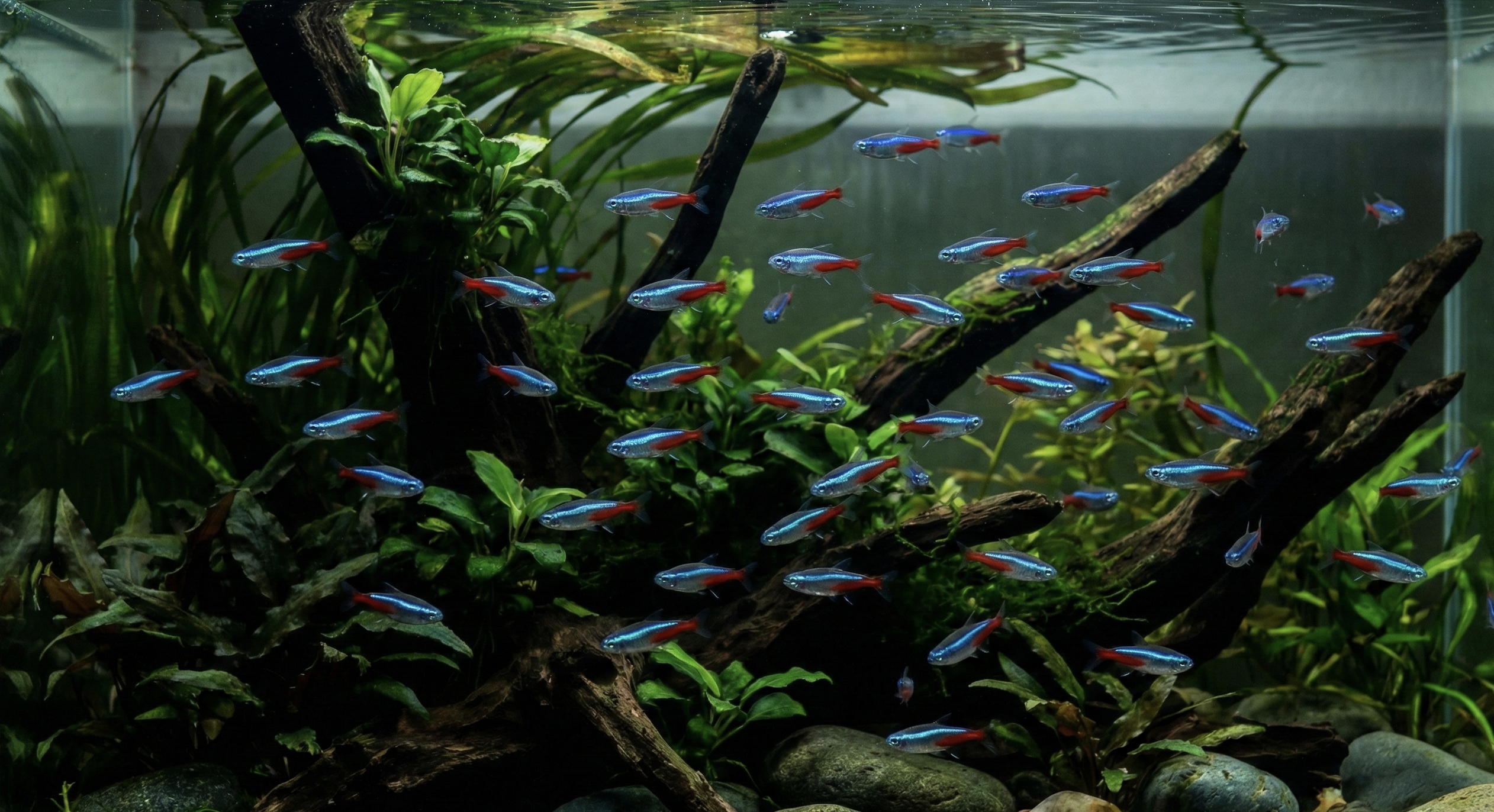
It is a flash of impossible color, a living river of electric blue and a deep, full body crimson that flows through the dark waters of a planted tank. The Cardinal Tetra (Paracheirodon axelrodi) is the breathtaking cousin of the Neon Tetra, and for many, it is the pinnacle of the shoaling fish world. Larger, more robust, and with an even more stunning color pattern, they are a deeply rewarding fish for the aquarist who is ready to meet their needs. This guide will be your deep dive into their care, from creating the perfect blackwater habitat to understanding their sensitive nature.
How does the Cardinal Tetra differ from the common Neon Tetra?
The Cardinal Tetra (Paracheirodon axelrodi) possesses a distinct red lateral stripe that extends the entire length of its body. Specifically, this full body coloration serves as the primary visual marker to separate it from the Neon Tetra. Furthermore, this species reaches a slightly larger adult size and displays more intense iridescence under proper lighting. Consequently, I reject the assumption that these two species are interchangeable in high-end aquascaping. Therefore, I prioritize the Cardinal for its robust visual impact and superior longevity in stable acidic systems. In fact, their aesthetic dominance is a hallmark of professional community displays.
What are the analytical minimums for tank size and schooling numbers?
Housing the Cardinal Tetra requires a focus on horizontal swimming space to accommodate their active shoaling behavior. Specifically, a 20 gallon long aquarium is the analytical minimum for a small group. Furthermore, to observe their most natural and confident behaviors, you must maintain a school of at least 15 individuals. Consequently, smaller groups often lead to extreme shyness and a total loss of color intensity. Therefore, I prioritize a high volume school as the best defense against environmental stress. As a result, a large, synchronized group becomes a living pulse of energy within the habitat.
What constitutes a “Blackwater” setup for Cardinal Tetra?
Replicating the dark, acidic streams of the Rio Negro requires a specialized focus on tannins and structural clutter. Specifically, you should integrate driftwood and leaf litter to release humic substances into the water. Furthermore, a heavily planted environment with floating vegetation provides the dim lighting these fish need to feel secure. Consequently, a bare or overly bright tank causes chronic stress and weakens their immune systems. Therefore, I prioritize a “blackwater” aesthetic to maximize the health and vibrancy of the school. In fact, tannins act as a natural antibacterial agent for these sensitive tetras.
How do you manage the delicate water parameters for wild caught Cardinal Tetra?
The Cardinal Tetra is hyper sensitive to nitrogenous waste and requires a mature, fully cycled environment for survival. Specifically, you must maintain water temperatures between 73–81∘F (23–27∘C). Furthermore, they require very soft water with a pH level ideally between 5.0 and 6.5. Consequently, I reject the assumption that they can thrive in newly established or hard water systems. Therefore, I prioritize the use of reverse osmosis water to reach these specific chemistry goals. As a result, you avoid the rapid mortality rates often associated with improper acclimation.
What is the scientifically balanced diet for maximizing color intensity?
Unlocking the brilliant reds and blues of the Cardinal Tetra requires a diet rich in high quality carotenoids and proteins. Specifically, a varied rotation of micro-pellets and frozen foods like daphnia or cyclops provides the best results. Furthermore, you should feed small amounts multiple times per day to accommodate their high metabolism. Consequently, relying solely on low quality flake food leads to nutritional deficiencies and dull coloration. Therefore, I prioritize live or high quality frozen snacks to replicate their natural foraging behaviors. In fact, their color is a direct analytical indicator of their nutritional health.
Which tank mates are safe for a school of Cardinal tetras?
Selecting tank mates for the Cardinal Tetra requires a focus on peaceful, soft water species that occupy different zones of the tank. Specifically, Corydoras, dwarf cichlids, and peaceful loaches act as excellent companions. Furthermore, you must strictly avoid any predatory species, such as adult Angelfish, that can fit a tetra in their mouth. Consequently, even “peaceful” fish can become predators if the size differential is too extreme. Therefore, I prioritize the use of small, non aggressive dither fish to ensure a harmonious community. As a result, your school can swim openly without fear of predation.
What are the symptoms and prevention methods for Neon Tetra Disease?
The Cardinal Tetra is unfortunately susceptible to Neon Tetra Disease, a parasitic infection that currently has no known cure. Specifically, symptoms include white patches of muscle, spinal curvature, and a total loss of lateral coloration. Furthermore, this disease is highly contagious and spreads through the ingestion of infected carcasses or waste. Consequently, a rigorous 4 to 6 week quarantine protocol for all new arrivals is your only defense. Therefore, I prioritize the “brutal honesty” of this risk to protect your established aquarium colony. In fact, prevention is the only reliable way to manage this specific health threat.
How do you manage the challenge of breeding Cardinal Tetra?
Breeding the Cardinal Tetra is an advanced pursuit that requires extreme environmental manipulation and technical precision. Specifically, you must use a dedicated breeding tank with extremely soft water (1–2 dGH) and a pH of approximately 5.0. Furthermore, the eggs are light-sensitive and require almost total darkness to develop without fungal infection. Consequently, the parents must be removed immediately after spawning to prevent them from consuming the eggs. Therefore, I reject the idea that this species will breed casually in a community setup. In fact, it remains a benchmark of success for expert aquatic researchers.
Cardinal Tetra FAQ
The key difference is the red stripe. A Cardinal Tetra (Paracheirodon axelrodi) has a deep red stripe that runs the full length of its body. A Neon Tetra’s red only covers the rear half. Cardinals are also slightly larger, more intensely coloured, and longer-lived in stable acidic systems.
A minimum of 15 individuals is strongly recommended. Smaller groups cause extreme shyness and a total loss of colour intensity. Cardinal Tetras are obligate schooling fish — a large, synchronized school is also their best defence against environmental stress.
They require soft, acidic water with a pH between 5.0 and 6.5 and temperatures between 73–81°F (23–27°C). They are hypersensitive to nitrogenous waste and must never be added to a newly set up aquarium. Reverse osmosis water is the most reliable way to achieve the required water chemistry.
Yes — Cardinal Tetras are susceptible to Neon Tetra Disease, a parasitic infection with no known cure. Symptoms include white muscle patches, spinal curvature, and complete loss of lateral colour. The only reliable protection is a strict 4–6 week quarantine for all new arrivals before they enter the main tank.
It is a high-risk combination. Adult Angelfish are large enough to eat Cardinal Tetras and frequently do. Safe tank mates include Corydoras, dwarf cichlids, and peaceful loaches — species that share similar soft water requirements and pose no size-based predation threat.
Sources
- Seriously Fish
https://www.seriouslyfish.com/species/paracheirodon-axelrodi/ - Animal Diversity Web
https://animaldiversity.org/accounts/Paracheirodon_axelrodi/ - Aquarium Care Basics
https://www.aquariumcarebasics.com/freshwater-aquarium-fish/cardinal-tetra/ - FishBase
https://www.fishbase.se/summary/Paracheirodon-axelrodi.html - Tropical Fish Hobbyist
https://www.tfhmagazine.com/articles/freshwater/paracheirodon-axelrodi-the-king-of-the-aquarium


Leave a Reply