


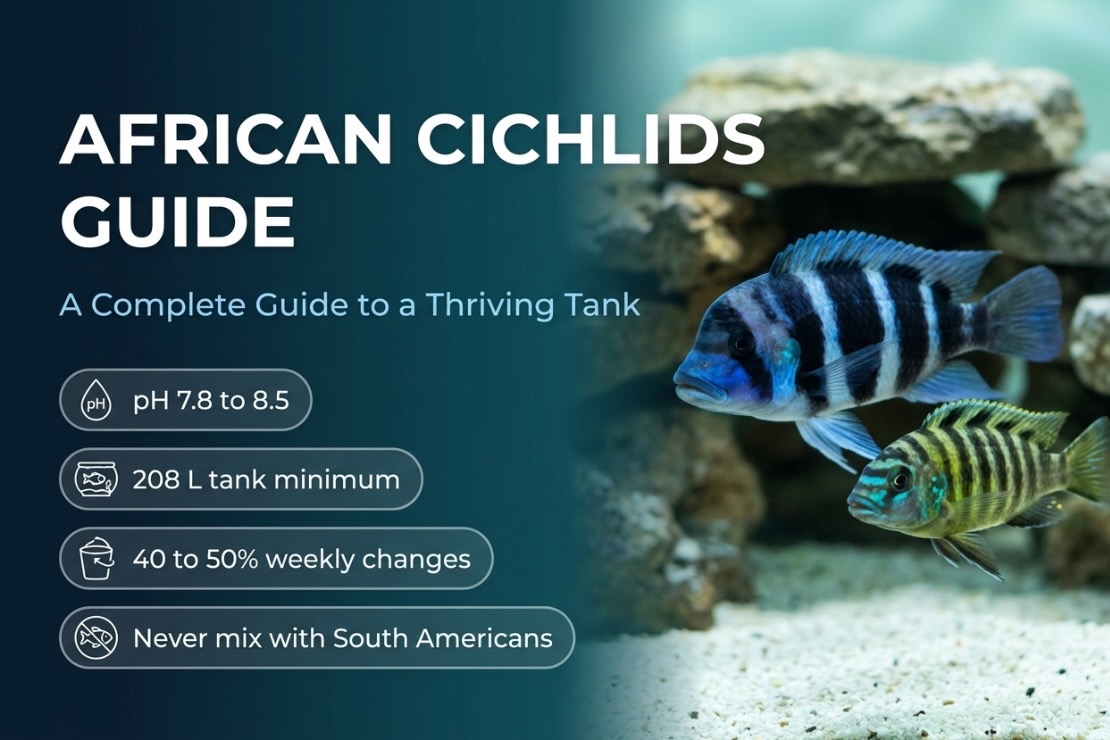
Welcome to one of the most dynamic and colorful corners of the freshwater world. The cichlids of Africa’s Rift Lakes come from three famous waters: Lake Malawi, Lake Tanganyika, and Lake Victoria. In fact, Lake Tanganyika alone holds at least 250 cichlid species, and almost all of them live nowhere else. However, these fish are not peaceful community residents. Instead, they behave like intelligent, territorial neighbors with strong opinions about property lines. As a result, a Rift Lake aquarium works like a small society with its own politics. Therefore, this guide answers the key questions before you commit to this rewarding challenge.
My aquarium bestie keeps a massive African cichlid tank, and I am endlessly captivated by it. It is a chaotic world of electric blues and brilliant yellows. In fact, every visit feels like watching a reality show with fins. Territories shift, standoffs erupt, and somehow everyone still shows up for dinner. My own tanks tell a very different story. I love low tech planted aquariums, slow green growth, and driftwood. Indeed, my biggest aquarium holds a large driftwood piece I am genuinely proud of. However, Rift Lake keepers avoid driftwood because wood tends to lower pH. Consequently, my favorite decoration would actively work against these fish.
My cichlid experience actually comes from the other side of the world. Specifically, my American cichlid tank housed red spotted severums, green severums, red head tapajos, Guiana cara, and uaru. Those fish taught me how cichlid territories and personalities work. They also taught me that cichlid water needs are never one size fits all. Therefore, I have admired African cichlids from afar, through my friend’s tank and obsessive research. This guide is the product of that admiration. It bridges my world of quiet greens and their world of vibrant chaos.
How Do I Create the Right Water for African Cichlids?
You create the right water by copying the hard, alkaline chemistry of the Rift Lakes. This is the non-negotiable foundation of African cichlid care. Get it wrong, and every other effort stands on sand. Ironically, these fish love sand.

Lake Malawi water typically sits at a pH of 7.7 to 8.6. Its carbonate hardness (KH) measures around 10 to 12 degrees. Surprisingly, its general hardness (GH) sits lower, at roughly 7 degrees. Lake Tanganyika is even more extreme. In fact, its pH ranges from about 8.7 to 9.4. Lake Victoria species sit closer to Malawi conditions, so many buffer products serve both lakes.
Your practical aquarium targets look like this
- Lake Malawi and Lake Victoria species: pH 7.8 to 8.6, with high KH.
- Lake Tanganyika species: pH 8.0 to 9.0, with hard water around 12 to 15 dKH.
- The absolute floor: never let a Malawi tank fall below pH 7.0.
So why does KH matter so much? KH works as the pH safety net. Specifically, fish waste constantly releases acids into the water. A high KH neutralizes those acids before they drag the pH down. As a result, the pH stays stable instead of crashing overnight.
However, stability matters more than chasing a perfect decimal. A steady pH with clean water beats a perfect pH with dirty water. Furthermore, skip plain table salt and standard aquarium salt. Sodium chloride adds minerals but raises neither hardness nor pH. Instead, use a dedicated cichlid salt mix when your water needs more GH.
How can I achieve and maintain high pH and hardness?
You achieve it by combining materials that release carbonate slowly and steadily. Think of it as a layered defense rather than one magic product. In fact, most successful Rift Lake tanks use two or three methods together.

- Use a buffering substrate. Aragonite sand and crushed coral consist mainly of calcium carbonate. As a result, they dissolve slowly and release carbonate into the water. On their own, these materials typically hold pH around 8.2. Aragonite may cloud the water briefly after setup, which is normal.
- Add crushed coral to your filter. A mesh bag of crushed coral or aragonite in the filter adds extra buffering. This trick also suits peacock tanks, since peacocks often show better color over darker sand.
- Choose buffering rock. Limestone, including Texas holey rock and crumbly tufa, releases minerals over time. Consequently, your decor quietly works as a chemistry department.
- Use commercial buffers when needed. Seachem Malawi/Victoria Buffer, for example, targets a pH of 7.8 to 8.4. Tanganyika species need a Tanganyika buffer to reach higher values. The label dose is 5 g per 38 to 76 liters (10 to 20 gallons). Dissolve it in fresh water before adding it.
- Boost GH with cichlid salts. If your GH runs too low, add a cichlid salt mix first. Then adjust KH and pH with a buffer.
Finally, always test your source water’s pH and KH before adding anything. If your tap water is already hard and alkaline, congratulations. You may have won the cichlid lottery without buying a ticket.
How often should I do water changes for African Cichlids?
You should change 40 to 50 percent of the water every week. African cichlids are active, hungry, and messy, so waste builds quickly. Furthermore, crowded mbuna tanks carry a heavy bioload by design. Consequently, nitrate climbs fast between changes. Some species demand even more. For example, Fishkeeper recommends about 25 percent twice weekly for frontosa. These large fish react badly to deteriorating water.
Follow these habits for safe, effective changes
- Match the temperature of the new water to the tank.
- Treat new water with a conditioner that removes chlorine and chloramine.
- Pre-mix buffers so new water matches the tank’s pH and hardness before it goes in.
- Vacuum behind rocks, where uneaten food and waste collect out of sight.
Yes, this means a lot of buckets. However, consider it a free gym membership with much better scenery.
What is the Best Tank Setup for African Cichlids?
The best setup gives every fish enough floor space, rockwork, and filtration to stay out of trouble. Tank size matters most, and length matters more than height. Specifically, territories form along the bottom, so a longer tank creates more real estate.

Use these size guidelines as your starting point
- Shell dwellers: a 20-gallon (76-liter) tank works for a small colony.
- Mbuna and peacocks: 55 gallons (208 liters) is the usual minimum.
- A better minimum for mixed mbuna: a tank at least 4 feet (122 cm) long.
- The comfortable range: 75 to 125 gallons (284 to 473 liters), or tanks 5 to 6 feet long.
- Frontosa: far larger, as their own section explains.
Furthermore, larger tanks keep temperature and water quality more stable. As a result, small mistakes take longer to become emergencies. Choose filtration rated well above your tank volume, because generous biomedia handles the heavy bioload. Finally, leave out driftwood and almond leaves, since wood tends to lower pH.
What kind of substrate should I use?

Use sand or fine gravel, ideally a buffering type such as aragonite. Many African cichlids dig constantly, and peacocks sift sand for food. Consequently, coarse or sharp gravel works against their natural behavior.
- Aragonite sand: buffers the water and suits diggers and sifters.
- Crushed coral: buffers strongly but feels coarser, so mix it in or use it in the filter.
- Inert sand: looks clean, but it needs a separate buffering source such as rock or filter media.
- Darker substrate: helps peacocks feel safer and show stronger color.
In addition, avoid sharp-edged substrate in Tanganyikan setups. Their bottom-focused behavior makes smooth grains the safer choice.
How should I arrange rocks and decor?
For mbuna, build dense rockwork packed with caves, tunnels, and stacked ledges. Their wild home is a rocky landscape, so rocks are not decoration. They are the housing market. Specifically, each cave gives a fish a territory to defend and a place to retreat. Rockwork also breaks lines of sight. A fish that cannot see a rival constantly has fewer reasons to chase it. Therefore, stack rocks high enough to block views across the tank.

Safety comes next. Place the bottom rocks directly on the glass before adding sand. Cichlids dig, and frontosa in particular are powerful diggers. Consequently, rocks resting on sand can collapse once fish undermine them. Each group needs a different layout:
- Mbuna: heavy rockwork from bottom to near the surface.
- Peacocks: open sand areas with a few sturdy rock structures.
- Shell dwellers: open sand covered with shell beds.
- Frontosa: large caves plus generous open swimming space.
Should I use live plants?
Live plants are optional, and most mbuna treat them as a free salad bar. In fact, the mbuna’s wild rocky habitat has no higher plants, only algae. Therefore, plants are unnecessary for fish health in a mbuna tank.

However, you can still try tough, hard-leaved plants. Anubias and Java fern work best when tied or glued to rocks. Their leathery leaves resist grazing, and rock attachment protects them from digging. Peacock and Tanganyikan tanks are sometimes more forgiving. Still, even tiny shell dwellers may uproot plants buried in sand. As a result, attach plants to hardscape instead of planting them in the substrate. As a planted tank lover, I consider this the hardest rule in the entire guide.
Is It True That Slight Overstocking Can Reduce Aggression between African Cichlids?
Yes, controlled overstocking is a common strategy for aggressive mbuna. Heavier stocking spreads aggression across many individuals. Consequently, no single fish can claim a huge territory. It also reduces the chance that one weak fish becomes a permanent target. Ratios matter as much as numbers. Specifically, aim for one male to at least three or four females per species. Some species need even more females. For example, dominant Melanochromis auratus males may try to kill rival males.

However, overstocking does not mean cramming. The goal is enough fish to diffuse aggression, not a fishy rush hour. Furthermore, the method only works with oversized filtration and strict weekly water changes. Not every keeper agrees on exact numbers. Some report peaceful mbuna tanks at moderate stocking levels. In addition, juvenile mbuna often all look like their mothers, which makes sexing difficult. Therefore, buy a group, watch behavior closely, and prepare to rehome extra males.
What Do I Feed My African Cichlids?
Feed according to each group’s natural diet, because one food does not fit all Rift Lake cichlids. In fact, diet sits at the center of many health problems in these fish.

Herbivores (Mbuna): Most mbuna graze on aufwuchs. This German word describes the algae film on rocks and the tiny organisms living in it. Furthermore, a 1989 study found that mbuna diet correlates with intestine length. Feed a spirulina-based or vegetable-based flake or pellet as the staple. Offer blanched spinach or cucumber occasionally. Since mbuna are natural grazers, two small meals daily suit them well. Avoid bloodworm, tubifex, and beefheart.
Sand Sifters (Peacocks): In the wild, peacocks hunt small invertebrates hidden in the sand. Therefore, use a quality cichlid pellet as the staple. Add frozen mysis or brine shrimp for variety.
Haps: This group varies widely in size and diet. Consequently, research the exact species before choosing a food.
Carnivores (Frontosa): Frontosa eat mysis, krill, and chopped prawns. They come from deep water, so they rarely feed at the surface. As a result, sinking foods work best.
Finally, feed only what the fish finish quickly. Leftovers rot behind rocks, where you will not notice them until the nitrate test does.
What is Malawi Bloat?
Malawi bloat is a serious, often fatal digestive disease of African cichlids. Despite its name, it also affects fish from Lake Tanganyika and Lake Victoria. Furthermore, cichlid experts rank it among the most common diseases in these tanks. Here is the honest part: its exact cause remains unclear. Vets highlight three significant factors: diet, water quality, and inappropriate salt use. Specifically, diets low in greens and fiber but rich in protein and fat may predispose herbivores. However, some aquarists dispute the protein theory. They point instead to diets high in easily digestible carbohydrates. Therefore, treat diet as one major risk factor, not the whole story.

Symptoms: Loss of appetite usually appears first. A swollen belly, white stringy feces, and hiding may follow. Later stages can bring raised scales and bulging eyes. However, a fish that refuses food may simply be a holding female.
Treatment: Vets usually treat Malawi bloat with metronidazole. Treatment works best in the early stages, so act quickly. Consult an aquatic vet whenever possible.
Prevention:
- Feed herbivores a fiber-rich, spirulina-based staple.
- Keep water pristine with large weekly changes.
- Use cichlid salt mixes, never plain sodium chloride.
- Reduce chronic stress with proper stocking and rockwork.
How Do I Manage African Cichlids Aggression and Choose Tank Mates?
You manage aggression through tank size, rockwork, stocking ratios, and careful species choices. Tank mates must handle hard water, fast action, and the occasional eviction notice.

Q: Can I mix African cichlids with fish from other regions?
A: No, not with South American cichlids such as severums or angelfish. Rift Lake cichlids need hard, alkaline water. In contrast, those South American species come from soft, acidic waters. Furthermore, their aggression styles clash badly. As a result, one group always ends up living in the wrong conditions. My own severum and uaru tank taught me this lesson clearly. “Cichlid” is a family name, not a care sheet.
Q: What are good non-cichlid tank mates?
A: Robust Synodontis catfish are the classic choice. Synodontis multipunctatus and Synodontis petricola both come from Lake Tanganyika. However, Synodontis multipunctatus carries a famous secret. Nicknamed the cuckoo catfish, it drops its eggs among spawning mouthbrooders’ eggs. The cichlid mother then carries the catfish eggs too. The catfish hatch first and eat the cichlid eggs. Therefore, avoid it if you plan to raise cichlid fry. Other options exist as well. For example, Australian rainbowfish can act as dither fish that distract a dominant male. On the other hand, avoid Corydoras in mbuna tanks.
Q: Can I mix similar-looking African cichlids?
A: Mix them with caution. Closely related species can hybridize, especially peacocks. Consequently, keep only one peacock species if females share the tank.
A Deep Dive into the Rift Lakes: Species-Specific Guides
Each Rift Lake group needs a different setup, so plan around one lake or one group. Lake Malawi gives the hobby its mbuna, peacocks, and haps. Lake Tanganyika, the deepest of the three lakes, offers shell dwellers and frontosa. Furthermore, mixing groups blindly invites trouble. For example, small Tanganyikan shell dwellers do not belong with Malawi mbuna.

Mbuna from Lake Malawi (The Rock Scrapers)
Aggression: Mbuna are the classic, highly territorial rock dwellers. Therefore, manage aggression with slight overstocking and heavy rockwork. Keep one male with at least three or four females per species. For example, Melanochromis auratus needs one male only, with four or five females.
Diet: Mbuna are primarily aufwuchs grazers. To protect their long digestive tracts, feed a spirulina-based, high-fiber staple.
Tank Setup: Stack rocks from the glass to near the surface. In addition, choose a tank at least 4 feet long.
Breeding: Mbuna breed readily when water quality stays high. In fact, many keepers get fry without even trying.
Peacocks and Haps from Lake Malawi (The Sand Sifters and Open Water Cruisers)

Aggression: Peacocks are generally less aggressive than mbuna but remain territorial. For this reason, many keepers choose an all-male show tank. This approach prevents breeding and reduces female-related fights. As a result, you get a permanent fashion show with no dating drama. If you keep females, stick to one peacock species to avoid hybrids.
Habitat and Tank Setup: Peacocks live where rocky areas give way to open sand. Therefore, provide wide sand areas and a few sturdy rock structures. Adults typically reach 5 to 6 inches (13 to 15 cm), so plan for at least 55 gallons.
Diet: Peacocks sift sand for invertebrates. Consequently, feed quality cichlid pellets plus frozen mysis or brine shrimp. Haps vary widely, so always research the exact species.
Shell-Dwellers from Lake Tanganyika (The Tiny Architects)

Size and Habitat: Neolamprologus multifasciatus ranks among the smallest cichlids in the world. Males reach about 5 cm (2 inches), and females only about 2.5 cm (1 inch). In the wild, they form colonies of thousands in Neothauma snail shell beds.
Specific Needs: Provide a sandy bottom and at least one shell per fish, ideally two. Empty escargot shells from a gourmet food section make good substitutes. Furthermore, expect constant digging, as these fish rearrange their own neighborhood.
Breeding: The female lays about 5 to 20 eggs inside a shell and guards them. Meanwhile, the male defends the shell area. After 7 to 10 days, the fry begin venturing out.
Compatibility: A 20-gallon species tank suits a small colony. In larger tanks, they may share space with rock dwellers such as Julidochromis. However, keep the shell beds away from rock piles to limit conflict.
Frontosa Cichlids from Lake Tanganyika (The Gentle Giants)
Size and Origin: Cyphotilapia frontosa males reach about 35 cm (14 inches), and females about 25 cm (10 inches). They live in the northern half of Lake Tanganyika, mostly 30 to 120 meters deep. Interestingly, the largest specimens live in the deepest water.
Tank Size: Juveniles need a tank 5 to 6 feet long. Adults need roughly 8 feet by 2 feet by 2 feet (240 by 60 by 60 cm). Therefore, frontosa demand a serious long-term commitment.
Temperament: Frontosa are calm and not overly aggressive. However, they are opportunistic carnivores. Consequently, any fish small enough to fit in their mouths becomes a snack.
Colony Life: Keep one male with three or four females. These fish mature slowly, so patience is essential. Published lifespans range from 10 to 25 years. In other words, frontosa are a retirement plan with fins.
How Do I Breed African Cichlids?
Most African cichlids in the hobby breed through maternal mouthbrooding. However, shell dwellers break the rule and lay their eggs inside snail shells. In mouthbrooders, the female lays her eggs and quickly collects them in her mouth. She then carries the eggs and, later, the fry. Many mbuna hold for about 21 to 28 days. In fact, some species hold for up to 40 days. During this time, the female eats little or nothing. You can often spot a bulging throat and even the tiny eyes of the fry.

You have three options for raising fry
- Leave her in the main tank. Some fry survive among rocks, but many become snacks.
- Move her to her own tank. She releases the fry naturally, which is the gentler option.
- Strip the fry manually. Experienced breeders use this method, but it stresses the female.
Mbuna fry are larger than the fry of many species. As a result, they eat baby brine shrimp right away. As a livebearer keeper, I find this contrast hilarious. My guppies and platies drop fry and immediately forget about them. Meanwhile, African cichlid mothers skip meals for weeks to protect theirs.
African Cichlid Fish FAQ

Lake Malawi and Lake Victoria cichlids thrive at a pH of roughly 7.8 to 8.6 with high carbonate hardness. Lake Tanganyika species prefer higher values, around 8.0 to 9.0. High KH absorbs acids from fish waste and prevents pH crashes. Weekly 40 to 50 percent water changes keep nitrates low.
Malawi bloat is a frequently fatal digestive disease of African cichlids. Vets link it to diet, poor water quality, and misuse of plain salt. Its exact cause remains debated. Prevention relies on a fiber-rich, spirulina-based diet for mbuna, pristine water, and cichlid salt mixes instead of sodium chloride.
Mbuna and peacocks need at least a 55-gallon (208-liter) tank. A tank 4 feet (122 cm) long works better because length creates more territories. Many keepers prefer 75 to 125 gallons (284 to 473 liters). Shell dwellers are the exception and can live in a 20-gallon (76-liter) aquarium.
African and South American cichlids should not share a tank. Rift Lake species need hard, alkaline water, while severums and angelfish come from soft, acidic waters. Their aggression styles also differ sharply. Keeping both in one tank forces at least one group into chronically unsuitable conditions.
Controlled overstocking is a common strategy for aggressive mbuna. A dominant male cannot harass one victim when many fish share the space. Keepers pair it with one male to three or four females per species. The method demands strong filtration and large weekly water changes.
Most Rift Lake cichlids in the hobby are maternal mouthbrooders. The female collects her eggs in her mouth and carries eggs and fry for about 21 to 28 days. She eats little or nothing during that time. Shell dwellers differ, laying their eggs inside empty snail shells.
Sources
- MalawiCichlids.com (Rift Lake Water Chemistry) – https://malawicichlids.com/mw01011.htm
- MalawiCichlids.com (Melanochromis auratus) – https://www.malawicichlids.com/mw09002a.htm
- The Tropical Tank (Mbuna Water Chemistry) – https://thetropicaltank.co.uk/mbuna2.htm
- The Tropical Tank (Mbuna Tank Setup) – https://www.thetropicaltank.co.uk/mbuna1.htm
- The Tropical Tank (Mbuna Feeding) – https://thetropicaltank.co.uk/mbuna4.htm
- The Tropical Tank (Mbuna Breeding) – https://www.thetropicaltank.co.uk/mbuna5.htm
- The Tropical Tank (Frontosa) – https://thetropicaltank.co.uk/Fishindx/frontosa.htm
- Seachem (Malawi/Victoria Buffer) – https://seachem.com/malawi-victoria-buffer.php
- LiveAquaria (Malawi/Victoria Buffer Dosing) – https://www.liveaquaria.com/products/seachem-malawi-victoria-buffer
- OATA (Malawi Cichlid Care Sheet) – https://ornamentalfish.org/wp-content/uploads/African-Malawi-cichlids-Sept-2022.pdf
- That Pet Place (Lake Tanganyika Cichlids) – https://www.thatpetplace.com/articles/tanganyikan-cichlids-article
- Wikipedia (Neolamprologus ocellatus, Tanganyika pH) – https://en.wikipedia.org/wiki/Neolamprologus_ocellatus
- Bulk Reef Supply (Aragonite Substrate) – https://bulkreefsupply.com/african-cichlid-aragonite-substrate-aqua-natural.html
- Chewy (Malawi Bloat) – https://www.chewy.com/education/fish/general/dropsy-edema-malawi-bloat-and-similar-syndromes
- Aquarium Science (Malawi Bloat) – https://aquariumscience.org/11-3-malawi-bloat/
- Cichlid-Forum (Malawi Bloat) – https://www.cichlid-forum.com/posts/3153176
- Marine Info (Reinthal 1989, Mbuna Intestine Study) – https://marineinfo.org/id/publication/2502
- AqAdvisor (Introduction to Mbuna) – https://aqadvisor.com/articles/MbunaIntro.php
- FishBase (Aulonocara stuartgranti) – https://fishbase.se/summary/2190
- Fishkeeper (Flavescent Peacock) – https://fishkeeper.co.uk/fish/freshwater/cichlids/blue-peacock
- Aquatics Unlimited (Peacock Cichlids) – https://aquaticsunlimited.com/product/cichlid-peacock-bargin-mystery-box/
- Wikipedia (Neolamprologus multifasciatus) – https://en.wikipedia.org/wiki/Neolamprologus_multifasciatus
- Fishkeeper (Multifasciatus Shell Dweller) – https://www.fishkeeper.co.uk/fish/freshwater/cichlids/multifasciatus-shelldweller
- TFH Magazine (Shell Dweller Care) – https://tfhmagazine.com/articles/freshwater/the-best-dwarf-cichlid-for-the-beginner-full-article
- Aquatics Unlimited (Multifasciatus Tank Size) – https://aquaticsunlimited.com/product/cichlid-shell-dweller-multifasciatus-neolamprologus-multifasciatus/
- Fishkeeper (Frontosa Cichlid) – https://www.fishkeeper.co.uk/fish/freshwater/cichlids/frontosa-cichlid
- The Fish Barn (Frontosa Care Sheet) – https://thefishbarn.co.uk/product/black-widow-frontosa-cyphotilapia-frontosa/
- Wikipedia (Synodontis multipunctatus) – https://en.wikipedia.org/wiki/Synodontis_multipunctatus
- Seriously Fish (Cuckoo Synodontis) – https://seriouslyfish.com/species/synodontis-multipunctata
- University of St Andrews (Cuckoo Catfish Research) – https://research-repository.st-andrews.ac.uk/handle/10023/16188
- Cichlid Press, Ask Pam (Mouthbrooding Duration) – https://ftp.cichlidae.com/askpam/viewtopic.php?p=736
- Aquarium Co-Op Forum (Holding Females) – https://forum.aquariumcoop.com/topic/10353-close-up-of-african-mouthbrooder-with-fry-also-need-guidance/
Leave a Reply
You must be logged in to post a comment.