
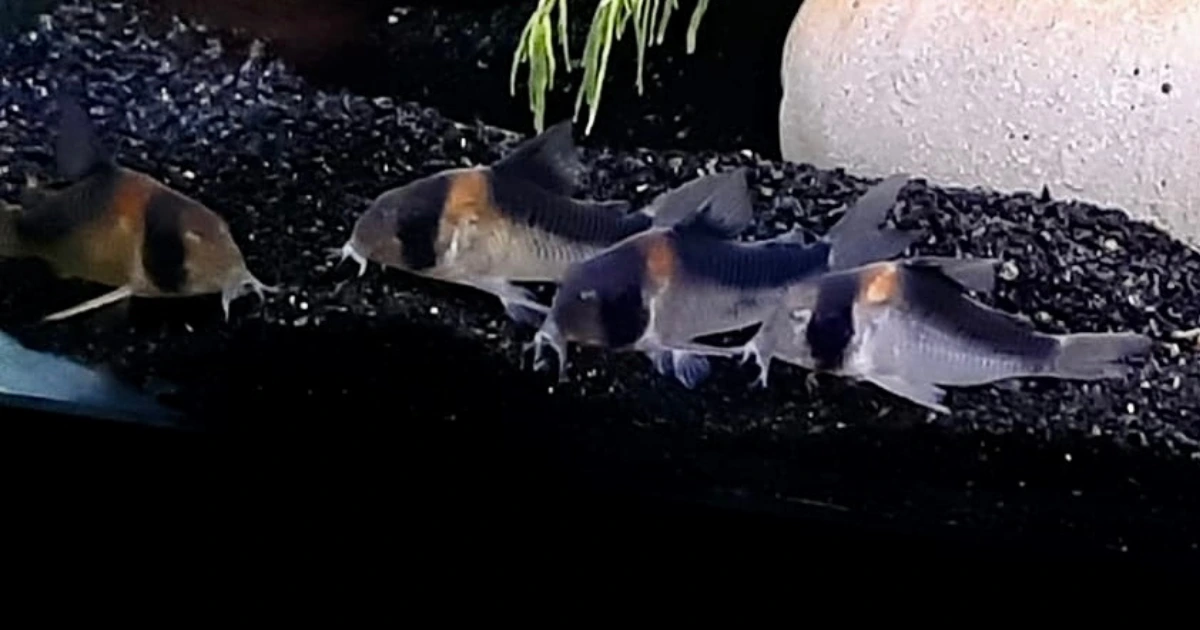
There are over 150 species of Corydoras, and while I adore every single one of them for their playful, puppy-like energy, some are simply works of art. Indeed, my first time seeing Adolfo’s Corys, I audibly gasped. It was everything I loved about a Cory, the wiggling, the social chaos, and the constant, happy work.
Article Photo: Credit goes to Bill Cottrell’s school of Adolfo’s Corys.
Adolfo’s Corydoras (Corydoras adolfoi) is a highly sought-after and breathtakingly beautiful catfish from the blackwater streams of the Rio Negro in Brazil. Although its striking appearance makes it a true prize, thankfully, its care is a straightforward joy for any keeper who is willing to provide for its basic, essential needs.
Adolfo’s Corys General Information and Temperament
Yes, they are an excellent choice for a beginner who is committed to providing pristine water conditions and the correct setup. They are hardy and peaceful, but their higher price point and origins in clean, soft water mean they are best for a beginner who has successfully maintained a basic aquarium and is ready for a showcase species.
Adolfo’s Cory Lifespan
In a stable environment with proper blackwater parameters, C. adolfoi can easily live for 8 to 10 years, with some documented cases reaching 15 years.
How large do they get?
They are a small to medium-sized Corydoras species, reaching a maximum adult size of about 2.2 inches (5.5 cm).
Adolfo’s Cory temperament
They are the definition of a peaceful community fish. Specifically, they are social, active, and completely non-aggressive. Furthermore, their entire day is spent playfully sifting through the substrate and interacting with their schoolmates.
Do they need to be kept in a school?
Yes, this is an absolute, non-negotiable requirement for their welfare. To clarify, a solitary Corydoras is a stressed and unhappy Corydoras. Because they are social animals that live in large groups in the wild, they derive their sense of safety from numbers. Consequently, you must keep them in a group of at least 6 or more individuals to thrive. In fact, a larger school of 10 or more is even better and will result in more confident and fascinating natural behavior.
Tank Setup
To accommodate a proper school of 6−8 of these active little fish, a 20-gallon long tank is the recommended minimum. Furthermore, a longer, wider tank is always superior to a tall one for bottom-dwellers.
Adolfo’s Corys Substrate: Sand or Gravel?
Sand is the only truly appropriate substrate for all Corydoras, including Adolfo’s. Specifically, they have very delicate whiskers (barbels) around their mouths that they use to feel for food in the substrate. Conversely, coarse or sharp gravel can cut and damage these vital sensory organs, consequently leading to infection and stress. A soft, sandy substrate, therefore, allows them to practice their natural sifting behavior safely.
Do they need hiding spots and plants?
Yes! Providing a sense of security is key. Consequently, a well-decorated tank with smooth driftwood, caves, and plenty of live plants will make them feel safe and thereby encourage them to be more active. Furthermore, they particularly appreciate the shade that broad-leafed plants provide.
Water Parameters and Maintenance
These fish come from the warm, soft, acidic “blackwater” rivers of Brazil. While captive-bred specimens are more adaptable, they still do best in these conditions.
- Temperature: A stable temperature between 75-82°F (24-28°C) is ideal. They appreciate warmer water than some other Corys.
- pH: 6.0 to 7.5.
- Pristine water is paramount. They are sensitive to any buildup of organic waste. Your tank must be fully cycled with 0 ammonia and 0 nitrite, and nitrates should be kept as low as possible (under 20 ppm) with regular, large water changes.
Diet and Nutrition
They are omnivores that need a dedicated diet; therefore, they will not thrive on simple leftovers. Consequently, their primary food source should be a high-quality sinking wafer, pellet, or granule. Furthermore, to keep them in peak health and color, you should supplement this diet several times a week with frozen or live foods like bloodworms, daphnia, and brine shrimp.
Health and Behavior
A healthy Adolfo’s Cory is active, has a plump belly, vibrant colors, and long, intact barbels. It will be constantly schooling with its group. A sick Cory may hide, become lethargic, have clamped fins, or show physical signs like eroded barbels or redness.
The “Adolfoi” Look-Alike
It’s important to know that many fish sold as Corydoras adolfoi are actually their nearly identical cousin, Corydoras duplicareus, often called the “False Adolfoi.” How can you tell the difference?
- C. adolfoi (True Adolfo’s): Has a thinner black stripe down its back and a smaller, more contained orange spot on its head.
- C. duplicareus (False Adolfoi): Has a noticeably thicker, wider black stripe down its back and the orange coloration often extends further down past the head.
Fortunately, their care requirements are exactly the same, so there’s no need to worry if you have one or the other—they are both beautiful, charming fish.
Tank Mates
As a peaceful bottom-dweller, the Adolfo’s Cory is a perfect citizen for a South American community tank. Good tank mates include:
- Small Tetras (Cardinals, Rummynose)
- Hatchet fish
- Dwarf Cichlids like Apistogramma or Rams
- Other peaceful bottom dwellers like Bristlenose Plecos.
- They are completely safe with shrimp and snails.
Avoid any large or aggressive fish that could bully or see them as a potential meal.
Adolfo’s Corydoras Care FAQ
Adolfo’s Corys are a small to medium Corydoras species reaching a maximum adult size of 2.2 inches or 5.5 centimeters. This compact size makes them suitable for aquariums starting at 20 gallons when kept as a proper school. Their small size does not reduce the biological need for pristine water quality and species-appropriate care.
Adolfo’s Corys require soft sand as the only appropriate substrate in their aquarium. Their delicate barbels, the sensory whiskers around their mouth, are damaged and infected by coarse or sharp gravel. Barbel erosion is a serious welfare issue that compromises the fish’s ability to feed and navigate its environment normally.
Adolfo’s Corys must be kept in a school of at least six individuals as a non-negotiable welfare requirement. A solitary Corydoras is a chronically stressed fish that rarely displays natural behavior. A school of ten or more produces the most confident, active, and visually rewarding natural schooling behavior.
Adolfo’s Corys originate from the warm, soft, acidic blackwater rivers of Brazil’s Rio Negro basin. Temperature should remain between 75 and 82°F or 24 to 28°C, with pH between 6.0 and 7.5. Nitrates must stay below 20 ppm through regular, large water changes, with ammonia and nitrite reading at zero.
Corydoras adolfoi and Corydoras duplicareus are nearly identical species frequently confused and mislabeled in the aquarium trade. True Adolfo’s Corys have a thinner back stripe and a smaller, more contained orange head spot. C. duplicareus shows a noticeably wider, thicker back stripe with orange coloration extending further past the head region.
Adolfo’s Corys are omnivores requiring dedicated, species-appropriate feeding rather than relying on tank leftovers alone. High-quality sinking wafers or pellets should form the dietary base of every feeding routine. Live or frozen bloodworms, daphnia, and brine shrimp should supplement the diet several times weekly to maintain peak condition and coloration.
Adolfo’s Corys thrive in South American community setups alongside other peaceful, non-aggressive species. Cardinal Tetras, Rummy Nose Tetras, Hatchet Fish, Apistogramma, and Bristlenose Plecos are all appropriate companions. Large or aggressive fish must be excluded entirely, as these small, passive fish are highly vulnerable to stress and bullying.
Sources
- Seriously Fish (Corydoras adolfoi)
https://www.seriouslyfish.com/species/corydoras-adolfoi/ - Practical Fishkeeping (Corydoras Guide)
https://www.practicalfishkeeping.co.uk/features/a-beginners-guide-to-corydoras/ - Aquarium Co-Op (Corydoras Care Guide)
https://www.aquariumcoop.com/blogs/aquarium/cory-catfish-care-guide


Leave a Reply