
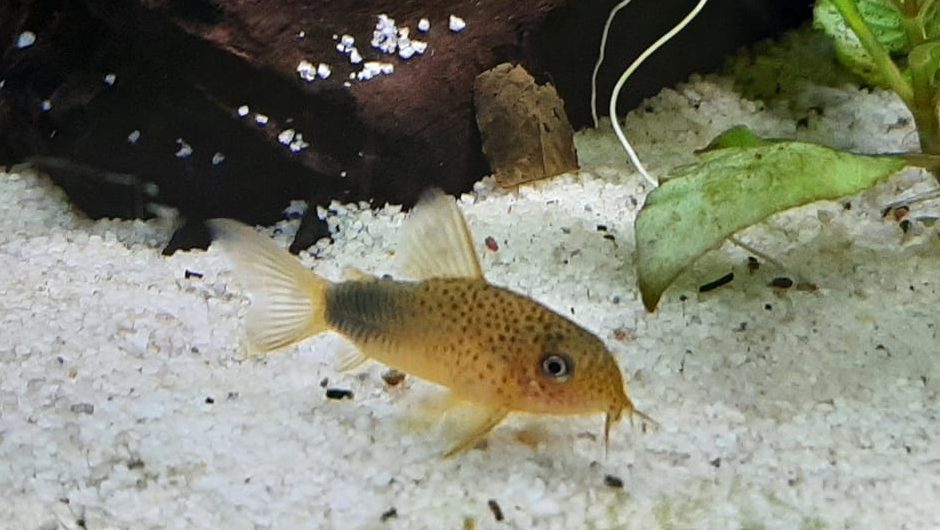
Some fish instantly capture your attention. The Smudge Spot Corys is one of them. Firstly, you notice their active, wiggling behavior. Then, you see that unique “smudge” at the base of their tail. It looks like a little ink blot on a beautiful, shimmering fish. In fact, this distinctive mark makes them a standout in the aquarium hobby. For many keepers, they are the perfect bottom-dweller. They are peaceful, interesting, and incredibly charming. This guide provides everything you need. Specifically, it covers all aspects of Smudge Spot Corys care.
Article Photo: Credit goes to Bill Cottrell’s cutest smudge spot Cory
What Exactly is a Smudge Spot Corys?
The “Smudge Spot Cory” is a common name. Its scientific name is Corydoras similis. People also call it the Violet Cory or Similis Cory. This fish is a species of armored catfish. It is native to the Rio Madeira basin in Brazil. This specific cory is easily identifiable. For instance, it has a dark, smudged spot. This spot sits right at the base of its tail fin. Furthermore, its body can show a lovely violet or blue sheen. This happens under the right lighting. It is a peaceful, schooling fish. Therefore, it makes a wonderful addition to community aquariums. Proper care begins with understanding this fish.
Ideal Tank Setup for Smudge Spot Corys
Firstly, you must consider the tank size. A 20-gallon (75-liter) tank is a good starting point. This provides enough space for a small school. Moreover, a longer tank is better than a tall one. This is because corys use the bottom area most. Next, the substrate is critically important. You absolutely must use a soft substrate. Fine sand or smooth, rounded gravel is ideal. In contrast, sharp gravel can damage their delicate barbels. These barbels are essential for finding food. Consequently, injuries can lead to infection and stress.
For decoration, provide plenty of hiding places. For example, driftwood is an excellent choice. It creates a natural environment. Caves and dense plantings also offer security. Plants like Java Fern and Anubias are great options. They do not require deep substrate. Finally, filtration should be gentle but effective. A sponge filter or a hang-on-back filter with a baffled output works well. Smudge Spot Corys do not appreciate strong water flow.
Water Parameters
Maintaining stable water is key to good health. Consequently, the best Smudge Spot Corys care involves consistent parameters. Since they are tropical fish, they therefore need warm water. Specifically, the ideal temperature range is 72−79∘F (22−26∘C). You should also use a reliable aquarium heater; this will prevent stressful temperature swings.
The pH of the water should be slightly acidic to neutral; aim for a range between 6.0 and 7.5. While these fish prefer softer water, they are, nevertheless, quite adaptable and can tolerate a range of hardness levels. Most importantly, however, the water must be clean. Because Corydoras are sensitive to nitrates and ammonia, you must, as a result, perform regular water changes. A weekly change of 25-30% is a very good routine; this keeps the water pristine and your fish healthy.
Smudge Spot Corys Diet
Smudge Spot Corys are omnivores. In nature, they sift through the substrate, specifically searching for insects, larvae, and plant matter. Therefore, you should offer a varied diet in the aquarium. Consequently, a high-quality sinking pellet or wafer should be their staple food; this ensures food gets past any mid-water fish.
In addition, you should definitely supplement their diet. As a matter of fact, live and frozen foods are fantastic treats. For instance, they absolutely love bloodworms, daphnia, and brine shrimp. This provides essential protein andenrichment. Furthermore, you should feed them once or twice a day, but only give them what they can consume in a few minutes. Ultimately, this prevents overfeeding and waste buildup, and consequently, a balanced diet is a core part of Smudge Spot Corys care.
Best Tank Mates for Smudge Spot Corys?
This species is incredibly peaceful. In fact, they are a model community fish. However, their social needs come first. You must keep them in a group. A school of six or more is the minimum. A larger group will make them more confident. Consequently, you will see more of their natural, playful behavior.
When choosing tank mates, think small and peaceful. For example, small tetras are a perfect choice. Neon, ember, or cardinal tetras work well. Similarly, rasboras like harlequins or chilis are great. Other good options include small gouramis, guppies, and mollies. Avoid large or aggressive fish. Cichlids or large barbs may bully or even eat them. Always choose tank mates that share similar water parameter needs as Smudge Spot Corys needs.
Sources
PlanetCatfish:
https://www.planetcatfish.com/common/species.php?species_id=377
Seriously Fish:
https://www.seriouslyfish.com/species/corydoras-similis/
FishBase:
https://www.fishbase.se/summary/Corydoras-similis.html
ScotCat:
https://www.scotcat.com/factsheets/corydoras_similis.htm
Aquarium Source:
https://www.aquariumsource.com/corydoras-catfish/
The Spruce Pets:
https://www.thesprupets.com/cory-catfish-1380752
Fishkeeping World:
https://www.fishkeepingworld.com/corydoras-catfish/
Aquatic Arts:
https://aquaticarts.com/products/similis-cory-catfish
Aquarium Co-Op:
https://www.aquariumcoop.com/blogs/aquarium/corydoras-catfish-care
Practical Fishkeeping:
https://www.practicalfishkeeping.co.uk/
The Planted Tank Forum:
https://www.plantedtank.net/
UK Aquatic Plant Society Forum:
https://www.ukaps.org/forum/
Leave a Reply
You must be logged in to post a comment.