
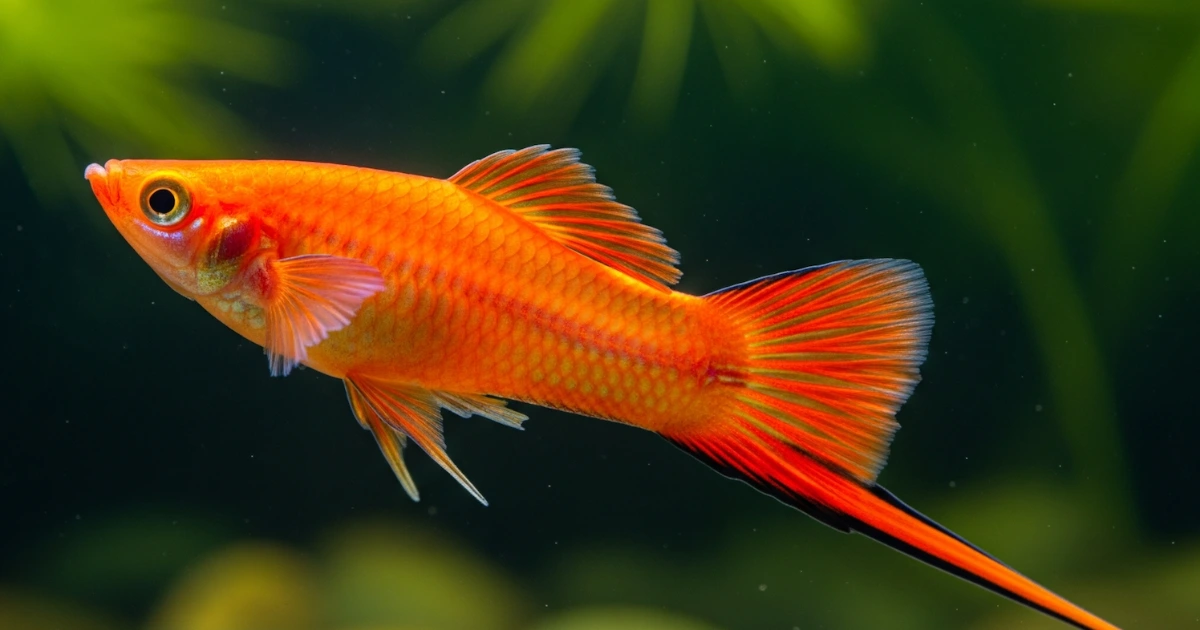
With their sleek bodies, vibrant colors, and the unmistakable “sword” extending from the male’s tail, the Swordtail fish (Xiphophorus hellerii) is a true icon of the freshwater aquarium. They are active, hardy, and bring a dynamic energy to any tank. However, their peaceful reputation can come with a dose of semi-aggressive drama. Consequently, this guide will answer all your questions, from managing their social lives to controlling their prolific breeding.
While I have tanks dedicated to the simple, chaotic joy of guppies and platys, my two Swordtail tanks feel different. They are my intentional project. I was drawn to them not just for their beauty, but also for the challenge of their semi-aggressive nature and the goal of breeding for specific traits.
Where my other livebearers are a happy, free-for-all explosion of life, my Swordtail tanks are a lesson in careful management—managing male aggression, ensuring the right gender ratios, and protecting fry from their surprisingly voracious parents. In fact, they taught me that even within the “easy” world of livebearers, there are levels of complexity and reward that can challenge any hobbyist.
What is the Ideal Tank Size and Environment for Swordtail Fish?
Generally, they are quite hardy and adaptable.
- Temperature: A heater is recommended to keep the water stable between 72−79∘F (22−26∘C).
- pH: They prefer neutral to slightly alkaline water, with a pH of 7.0 to 8.4.
- Swordtails are active swimmers that can grow up to 5-6 inches (including the tail). While 10-gallon tanks are common for Guppies, they are too small for adult Swordtails.
- The industry standard minimum is 20 gallons (preferably “Long” to provide swimming distance), with 29-30 gallons being ideal for a breeding group.
Plants and Decorations
Finally, a well-planted tank with open swimming spaces is ideal. This is because plants provide crucial hiding spots for females and fry.
How Do You Tell a Male Swordtail Fish From a Female?
This is one of the easiest fish to sex once they are mature. One fascinating biological trait of Swordtails is that late-blooming males exist. Some fish may look female for quite a while (no sword) before developing the sword and gonopodium (modified anal fin) later in life.
Males
Are famous for their “sword”, a long, pointed extension on the lower part of their tail fin. They are also generally smaller and more slender than females.
Females
Are larger and have a much rounder, stockier body shape. They have a standard, rounded tail fin with no sword. They also have a visible gravid spot near their anal fin when pregnant.
How Do Swordtails Breed and How Do I Protect the Fry?
Like guppies, Swordtails are prolific livebearers.
Breeding
In general, breeding happens automatically if you have healthy males and females. The male will perform a courtship dance, often swimming backward to impress the female.
Can females store sperm?
Yes, absolutely. A female can store sperm and have several batches of fry over a few months from just one encounter.
Pregnancy & Fry Protection
Pregnancy lasts about 28 days. The female will give birth to 20−100 free-swimming fry. However, the parents are voracious fry eaters. Therefore, to protect them, you must provide extremely dense thickets of floating plants like Hornwort, Guppy Grass, or Java Moss for the fry to hide in. A breeder box is also an option.
How Do I Prevent Swordtail Fish Overpopulation?
Keep a Single-Sex Tank
The most straight forward method is an all-female tank, or alternatively, a carefully managed all-male tank (in a large enough space with no females to fight over).
Let Nature Take its Course
For example, in a community tank with minimal hiding spots, natural predation will keep the population in check.
Rehome Them
Finally, find a local fish store or other hobbyists who will take your extra Swordtails.
What Are the Best Tank Mates for Swordtails?
Swordtails are generally peaceful, but can be semi-aggressive. Males, in particular, can bully each other.
Best Tank Mates
Therefore, the best tank mates are robust, peaceful community fish of a similar size, such as Platys, Mollies, larger Tetras, and bottom dwellers like Corydoras.
Fish to Avoid
Conversely, avoid long-finned, slow-moving fish like Angelfish or Bettas because they can be targets. Furthermore, avoid housing multiple male Swordtails together unless the tank is very large with lots of hiding places.
What Do Swordtails Eat and How Often Should I Feed Them?
Swordtails are omnivores and are not picky eaters.
Diet
Therefore, a high-quality flake food should be their staple. However, their diet should be supplemented with both vegetable matter (like spirulina flakes) and meaty foods (like frozen brine shrimp or bloodworms).
Frequency
As for feeding, provide a small amount once or twice a day, only what they can eat in about a minute.
How Do I Solve Common Problems like Chasing?
Chasing
Males constantly chase females. Therefore, to reduce stress on the females, you must maintain a proper gender ratio of one male to at least three females.
Male Aggression
Male Swordtails will often fight. Consequently, never keep just two males together, as one will likely be bullied to death. However, in a larger tank (55g+), you can keep several males because the aggression will be more spread out.
Stress
Stress is usually caused by bullying or poor water quality. To address this, ensure the gender ratio is correct and that you are performing regular water changes.
What Are Different Types of Swordtails?
Selective breeding has created a beautiful variety of Swordtails:
- Pineapple: A vibrant mix of yellow, orange, and red.
- Black: A deep, velvety black color.
- Koi: Have distinct patches of orange/red and white.
- Red Wag: A bright red body with contrasting black fins.
- Lyretail: A variation where both the top and bottom of the tail fin are extended, creating a “double sword” look.
- Green: The classic wild type, with an olive-green body and a red or yellow stripe.
How Long Do Swordtails Live?
In short, in a well-maintained aquarium, Swordtails have a lifespan of 3 to 5 years.
Swordtail Fish Care FAQ
Swordtail fish (Xiphophorus hellerii) grow up to 5–6 inches (12–15 cm) in total length, with the male’s sword extension accounting for a significant portion of that measurement. Their active swimming nature and adult size make a 20-gallon long tank the minimum viable setup. A 29–30 gallon tank is the recommended size for a breeding group.
Male Swordtails display a long, pointed extension on the lower tail fin lobe called the sword, plus a modified anal fin (gonopodium) used for internal fertilization. Females are larger, stockier, and lack the sword entirely. A key biological quirk is that some late-blooming males appear female for months before the sword and gonopodium develop.
Swordtail fish are generally peaceful toward other species but semi-aggressive among their own males. Two males kept together in a small tank will fight persistently, often resulting in one being bullied to death. A larger tank of 55 gallons or more distributes aggression across more territory, making multi-male setups viable.
Swordtails are livebearers giving birth to free-swimming fry rather than laying eggs, with gestation lasting approximately 28 days. A female can store sperm from a single mating and produce multiple fry batches over several months without a male present. Breeding occurs automatically whenever healthy males and females share the same tank.
Swordtail parents will actively consume their own fry immediately after birth. Dense thickets of floating plants such as Hornwort, Guppy Grass, or Java Moss provide the most natural and effective protection by giving fry immediate cover. A breeder box is an alternative option but requires careful monitoring to avoid stressing the pregnant female.
The correct gender ratio for Swordtail fish is one male to at least three females. This ratio distributes male attention across multiple females, preventing any single female from being harassed to exhaustion and death. Maintaining fewer females than this minimum creates dangerous chronic stress, fin damage, and reproductive exhaustion in the females.
The best tank mates for Swordtail fish are robust, peaceful community species of similar size, including Platys, Mollies, larger Tetras, and Corydoras catfish. Slow-moving, long-finned fish like Angelfish and Bettas should be excluded, as Swordtails may harass them. Multiple male Swordtails require a very large tank with ample hiding areas to coexist.


Leave a Reply
You must be logged in to post a comment.