
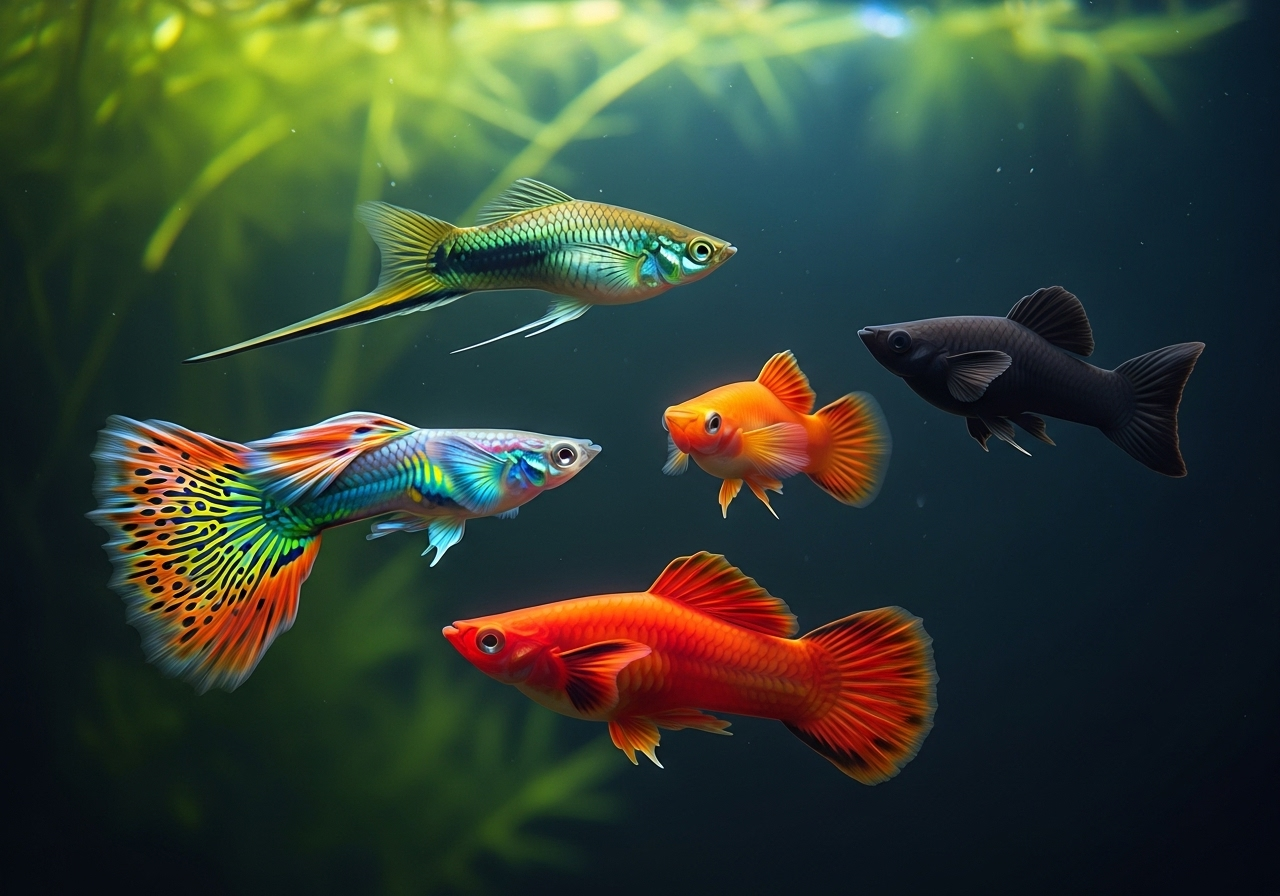
For the new aquarium hobbyist, there is no group of fish more instantly rewarding than the livebearers. Guppies, Platys, Swordtails, and Mollies are the sparkling, active jewels that bring a tank to life. Their most magical trait, and the one that fascinates newcomers, is their ability to give birth to live, free-swimming babies. This guide is, therefore, your complete introduction to these hardy, colorful, and endlessly prolific fish.
The Beautiful Chaos
My journey into the hobby has led me to complex cichlids and fascinating reptiles, but I will always have a special place in my heart for my livebearer tanks. I have dedicated aquariums for my Guppies, Platys, and Swordtails, and they are a constant source of uncomplicated joy.
They are a beautiful, vibrant chaos. After a day spent analyzing the subtle behaviors of my other pets, watching a flurry of colorful Guppies or a confident Swordtail sail by is like a reset button. They are the fish that remind me of the simple, pure wonder that got me started in this hobby. They are proof that an “easy” fish is not a boring one; it’s a reliable source of beauty.
What Exactly is a Livebearer Fish?
In contrast to most fish, which lay eggs, livebearers go through a process of internal fertilization. Following this, the female then carries the developing young and eventually gives birth to live, perfectly formed, miniature versions of herself, called “fry.” As a result, this fascinating process makes them incredibly easy to breed, which is both a major appeal and a significant management challenge.
The “Big Four” of the Livebearer Fish
1. Guppies (Poecilia reticulata)
Known as the “Million Fish” for their prolific breeding, Guppies are famous for the males’ stunning variety of colors, patterns, and long, flowing fins. They are incredibly active and peaceful.
2. Platys (Xiphophorus maculatus)
The model citizens of the community tank. Platys are peaceful, hardy, and have a slightly stockier body shape than Guppies. They come in a vast array of colors, from the classic “Mickey Mouse” to a brilliant Sunburst orange.
3. Swordtails (Xiphophorus hellerii)
These are the energetic athletes of the group. Swordtails are larger, very active swimmers that need plenty of horizontal space. The males are unmistakable, sporting a long, elegant “sword” on the lower part of their tail.
4. Mollies (Poecilia sphenops)
Mollies are incredibly hardy and adaptable, famous for their ability to thrive in a wide range of water conditions, from pure freshwater to even brackish or full saltwater. They are also excellent algae grazers.

What Are the Basic Care Requirements for Livebearer Fish?
What Size Tank Do They Need?
While they are small, they are, nevertheless, very active. Consequently, a 20-gallon (75-liter) long tank is the best starting point for a beginner’s livebearer community. While a 20-gallon Long is the absolute minimum, Swordtails (Xiphophorus hellerii) are significantly larger than Platys or Guppies, with males reaching 4-5 inches (including the sword). Because they are fast swimmers, a 30-gallon or larger tank is often recommended for long-term health to prevent aggression.This larger volume provides stable water conditions and enough space to manage their numbers.
What Are the Ideal Water Parameters?
Livebearers are generally hardy, but they share a preference that is crucial to their health: they love hard, alkaline water.
- Temperature: A consistent range of 72-78∘F (22-26∘C) is a good target for all common species.
- pH: In terms of chemistry, a stable pH of 7.0 to 8.4 is ideal. Conversely, they do not do well in soft, acidic water.
What Should I Feed My Livebearers?
They are omnivores and, consequently, are not picky eaters. Therefore, for the best health and color, it is recommended that you provide a varied diet:
- A high-quality flake food should serve as a staple.
- Furthermore, vegetable matter is essential. To meet this crucial need, you should offer spirulina flakes or blanched vegetables.
- Finally, to complete their diet, be sure to include occasional meaty treats such as frozen brine shrimp or bloodworms.
How Do I Manage a Livebearer Fish Community Tank?
What Are Good Tank Mates?
The best tank mates are other peaceful community fish like Corydoras catfish, Bristlenose Plecos, and peaceful schooling fish such as Rasboras or some larger Tetras. Conversely, avoid fin-nipping fish like Tiger Barbs, which will shred a Guppy’s tail, and never, under any circumstances, house them with a male Betta.
How Do I Manage the Constant Breeding?
This is the most important part of successful livebearer keeping.
- Maintain the Proper Gender Ratio: This is, therefore, a non-negotiable rule to prevent stress. Specifically, for every one male, you must have at least two to three females. This action spreads out the male’s constant breeding attention and consequently prevents any single female from being harassed to exhaustion.
- Protecting the Fry (If You Want To): Be aware that the parents will eat their own babies. To protect the fry, you must provide dense thickets of floating plants like Hornwort, Guppy Grass, or Java Moss for them to hide in.
How to Prevent Overpopulation:
Single-Sex Tanks: The easiest method is to simply keep a beautiful, all-male tank (especially for Guppies) or a peaceful all-female tank.
Natural Control: Alternatively, in a community tank with a variety of fish and fewer hiding spots, natural predation will keep the population from exploding.
Rehoming: Finally, many local fish stores will accept your healthy juvenile livebearers for store credit.
Livebearer Fish Care FAQ
Livebearer fish require a minimum ratio of one male to two or three females in any shared tank. Males pursue females relentlessly, and a single female under constant male attention will die from stress-related exhaustion within weeks. Maintaining the correct ratio distributes breeding pressure and keeps all fish healthy.
Livebearer fish, particularly male Guppies with their long flowing fins, must never be housed with a male Betta. Bettas are highly aggressive and will immediately attack any fish that resembles a rival, and a colorful Guppy is the perfect target. This pairing ends in injury, stress, or death for the livebearer.
Livebearer fish use internal fertilization and give birth to live, free-swimming miniature fish called fry rather than laying eggs. The female carries and develops the young internally before releasing them as fully formed juveniles ready to swim and feed immediately. This reproductive strategy makes livebearers the easiest fish to breed in the freshwater hobby.
Livebearer fish thrive in hard, alkaline water with a stable pH of 7.0–8.4 and a temperature of 72–78°F (22–26°C). Soft, acidic water causes chronic stress and reduces lifespan significantly. Stability is more important than exact numbers, as sudden parameter shifts harm livebearers far more than a slightly imperfect baseline.
Livebearer fish are omnivores that do best on a varied diet. A high-quality flake food forms the staple, with spirulina flakes or blanched vegetables added to meet their need for plant matter. Supplement two to three times per week with frozen meaty foods like brine shrimp or bloodworms for optimal coloration and immune health.
Three methods effectively control livebearer fish population: keeping a single-sex group to prevent breeding entirely, relying on natural fry predation in a community tank with fewer hiding spots, or rehoming excess healthy juveniles to local fish stores for store credit. A deliberate management plan is essential before the first batch of fry arrives.
Yes, livebearer fish will eat their own fry immediately after birth. This is natural behavior, not neglect, and keepers must plan for it before the first birth occurs. Providing dense floating plants like Hornwort or Guppy Grass gives fry enough cover to survive in the same tank as their parents.
Sources
- University of Florida (Livebearers)
https://edis.ifas.ufl.edu/publication/FA183 - Etymonline (Guppy Origin)
https://www.etymonline.com/word/guppy - IJSTR (Molly Salinity Study)
https://www.ijstr.org/final-print/nov2019/Comparative-Study-On-Growth-Performance-Of-Poecilia-Sphenops-valenciennes-1846-Under-Different-Salinity-And-Different-Diets.pdf - Aquarium Co-Op (Livebearer Care)
https://www.aquariumcoop.com/blogs/aquarium/livebearers-guide - The Spruce Pets (Livebearer Ratios)
https://www.thesprucepets.com/livebearer-fish-care-1378310 - Sera (Tiger Barbs & Guppies)
https://www.sera.de/en/service/faq/faq-detail/tiger-barbs-nibble-at-fins-of-guppies/
Leave a Reply
You must be logged in to post a comment.