
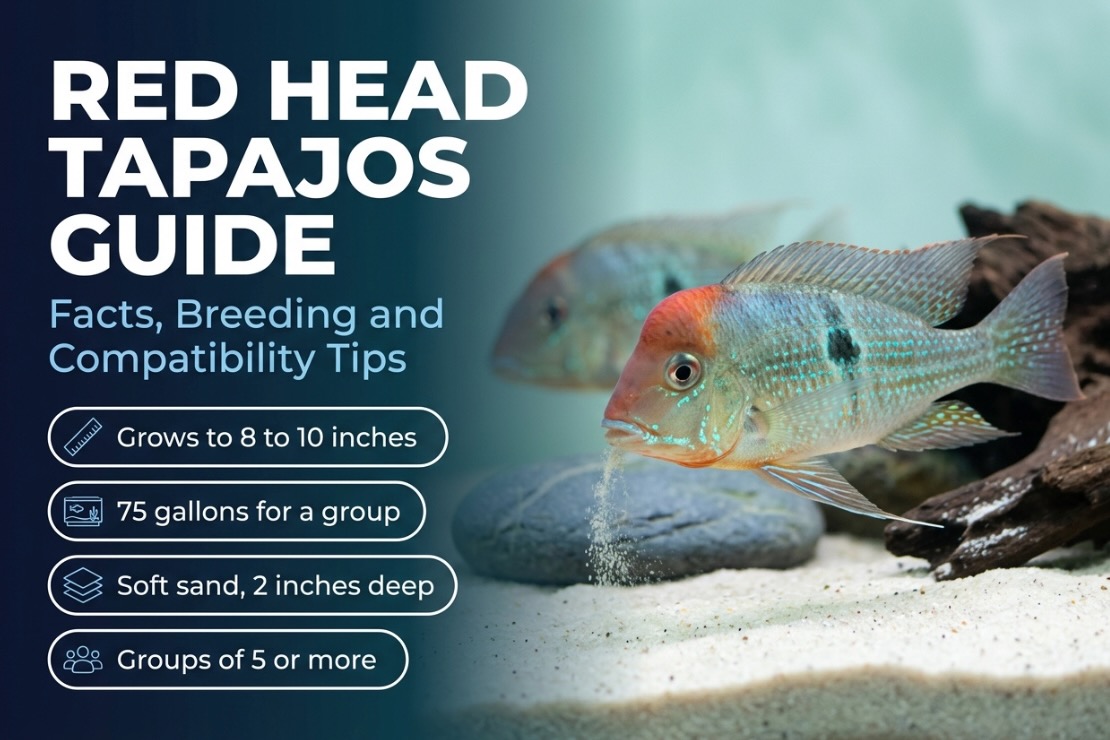
For many, the word “cichlid” conjures images of aggressive, boisterous fish that tear apart aquascapes and bully their tank mates. For a long time, that was my perception too. But then I saw my first group of Geophagus. They weren’t fighting or posturing; they were working. A small school of them moved across the sandy bottom of the tank, each one methodically taking a mouthful of sand, gently sifting it through its gills, and releasing it in a clean little cloud. They were engineers, tiny excavators constantly curating their environment. It was in that moment I truly understood their name: Geophagus, the “eartheaters.” The Red Head Tapajos, with its developing crimson crown and peaceful demeanor, is the jewel of this group, a fish that taught me that cichlids could be not just beautiful, but profoundly elegant and fascinatingly purposeful.
The Red Head Tapajos (Geophagus sp. ‘red head tapajos’) is a South American cichlid that brings a unique combination of grace, color, and behavior to the home aquarium. Providing for their specific needs is a joy that rewards the keeper with a truly spectacular display.
What is the scientifically accurate tank setup for a group of Red Head Tapajos?
The Red Head Tapajos is a social, sand sifting cichlid that requires a specialized environment to manifest its natural behaviors. Specifically, a 75 gallon aquarium with a 4 foot footprint is the analytical minimum for a group of five to six individuals. Furthermore, you must provide a substrate consisting of fine, soft sand at least two inches deep. Consequently, I reject the assumption that gravel is an acceptable alternative for this genus. Therefore, the fish must be able to pass sand through their gills without the risk of mechanical injury. In fact, a lack of proper sifting material leads directly to stress and suppressed immune function.
How do you manage the delicate water parameters of the Tapajós river system?
Replicating the soft, acidic waters of the Brazilian Amazon is essential for the long term health of the Red Head Tapajos. Specifically, the water temperature should remain stable between 80–86∘F (27–30∘C). Furthermore, you must maintain a pH level between 6.0 and 7.5 to prevent physiological distress. Consequently, these fish are hyper sensitive to nitrogenous waste and require a rigorous maintenance schedule. Therefore, I prioritize 50% weekly water changes to keep nitrate levels below 20ppm. As a result, you prevent the onset of lateral line erosion and other water-quality-related illnesses.
What is a scientifically balanced diet for Red Head Tapajos?
The Red Head Tapajos is an opportunistic omnivore that requires a diet capable of being consumed during its constant sifting process. Specifically, you should provide high-quality sinking pellets or crumbles that settle into the sand bed. Furthermore, you must supplement their intake with frozen foods like bloodworms, daphnia, and brine shrimp to provide essential proteins. Consequently, the inclusion of carotenoids such as astaxanthin is necessary to enhance the vibrant red coloration of the nuchal hump. Therefore, I prioritize frequent, smaller feedings over one large daily meal. In fact, their metabolism is designed for continuous foraging throughout the day.

Which tank mates are analytically compatible with Red Head Tapajos?
Selecting tank mates for the Red Head Tapajos requires a focus on peaceful species that occupy different strata of the aquarium. Specifically, larger tetras and deep bodied characins make excellent dither fish that encourage the cichlids to stay active. Furthermore, other non aggressive South American species like Severums or Angelfish can coexist provided there is sufficient space. Consequently, I strictly avoid housing them with hyper aggressive Central American cichlids that would easily outcompete them. Therefore, I prioritize a community that respects the gentle nature of the “Earth-eater” group. As a result, the entire tank remains harmonious and low-stress.
Why is the social hierarchy critical for the behavior of Red Head Tapajos?
The Red Head Tapajos functions best when kept in a group of five or more to allow for natural social interactions. Specifically, a lone individual will often become shy, lethargic, and lose its characteristic color intensity. Furthermore, a larger group helps to distribute minor territorial aggression across several fish rather than focusing it on one victim. Consequently, the dominant males will display the most impressive red coloration and fin extensions to maintain their rank. Therefore, I reject the idea that these are “centerpiece” fish to be kept in pairs only. In fact, their social complexity is the most rewarding aspect of their care.
What are the fascinating mechanics of delayed mouthbrooding?
The reproductive cycle of the Red Head Tapajos is a masterclass in parental dedication and evolutionary strategy. Specifically, the pair will meticulously clean a flat surface before the female deposits her eggs. Furthermore, after the eggs hatch, the parents take the “wigglers” into their mouths for protection against predators. Consequently, this delayed mouthbrooding allows the fry to develop in a highly secure environment during their most vulnerable stage. Therefore, I prioritize providing smooth river rocks or slate to facilitate this natural spawning behavior. As a result, you can witness some of the most complex parental care in the fish world.
How do you distinguish between the sexes in a mature colony?
Distinguishing between male and female Red Head Tapajos becomes easier as the fish reach their full adult size of eight to ten inches. Specifically, males typically develop a more pronounced red nuchal hump on their forehead and longer dorsal fin filaments. Furthermore, the males often exhibit more intense iridescence along their flanks compared to the slightly smaller females. Consequently, observing the fish during spawning is the only 100% accurate way to vent or identify the pair. Therefore, I recommend raising a juvenile group and allowing them to pair off naturally. In fact, forcing a pair often leads to failed spawns and aggression.
Red Head Tapajos FAQ
No — they are one of the most peaceful cichlids available. They are social, gentle sand-sifters that function best in groups of five or more. The only aggression observed is minor territorial behaviour between males competing for dominance, which a large group distributes naturally. Avoid housing them with aggressive Central American cichlids that would easily outcompete them.
Fine, soft sand at least two inches deep is mandatory — gravel is not an acceptable alternative. Red Head Tapajos are earth-eaters that continuously pass sand through their gills as part of their natural foraging behaviour. Without proper sifting material they cannot express this instinct, leading directly to chronic stress and suppressed immunity.
A minimum group of five to six individuals in a 75-gallon tank is the standard recommendation. A lone fish will become shy, lethargic, and lose its characteristic red colouration. The social hierarchy within a group produces the most impressive colour displays and allows minor aggression to be spread across multiple fish rather than targeting one individual.
Yes — they are delayed mouthbrooders with complex and fascinating parental behaviour. The pair cleans a flat surface, the female deposits eggs, and after hatching the parents take the fry into their mouths for protection. Providing smooth river rocks or slate encourages natural spawning. The recommended method is raising a juvenile group and allowing natural pair formation.
At full adult size of 8–10 inches, males develop a more pronounced red nuchal hump on the forehead and longer dorsal fin filaments. Males also show more intense iridescence along their flanks than the slightly smaller females. Observing the fish during spawning is the only fully reliable sexing method.
Sources
- Seriously Fish
https://www.seriouslyfish.com/species/geophagus-sp-red-head-tapajos/ - FishBase
https://www.fishbase.se/summary/Geophagus-sp..html - Tropical Fish Hobbyist Magazine
https://www.tfhmagazine.com/articles/freshwater/the-earth-eaters-geophagus - Aquarium Glazer
https://www.aquariumglaser.de/en/fish-archives/geophagus-sp-tapajos-red-head-2/ - Cichlid-Forum
https://www.cichlid-forum.com/profiles/species.php?id=468 - MonsterFishKeepers
https://www.monsterfishkeepers.com/forums/threads/geophagus-red-head-tapajos-care.502341/
Leave a Reply
You must be logged in to post a comment.