
للغة العربية اضغط هنا
With a stately, disc-shaped body, the Severum exudes intelligence through their expressive eyes. Consequently, it is one of the most beloved and personable cichlids in the freshwater hobby. They offer the majestic presence of a Discus; however, they have a hardier nature. This makes them a fantastic centerpiece for a medium-to-large South American community tank. Therefore, this guide will answer all your questions about what it takes to care for these gentle giants.
The water dogs of My Community
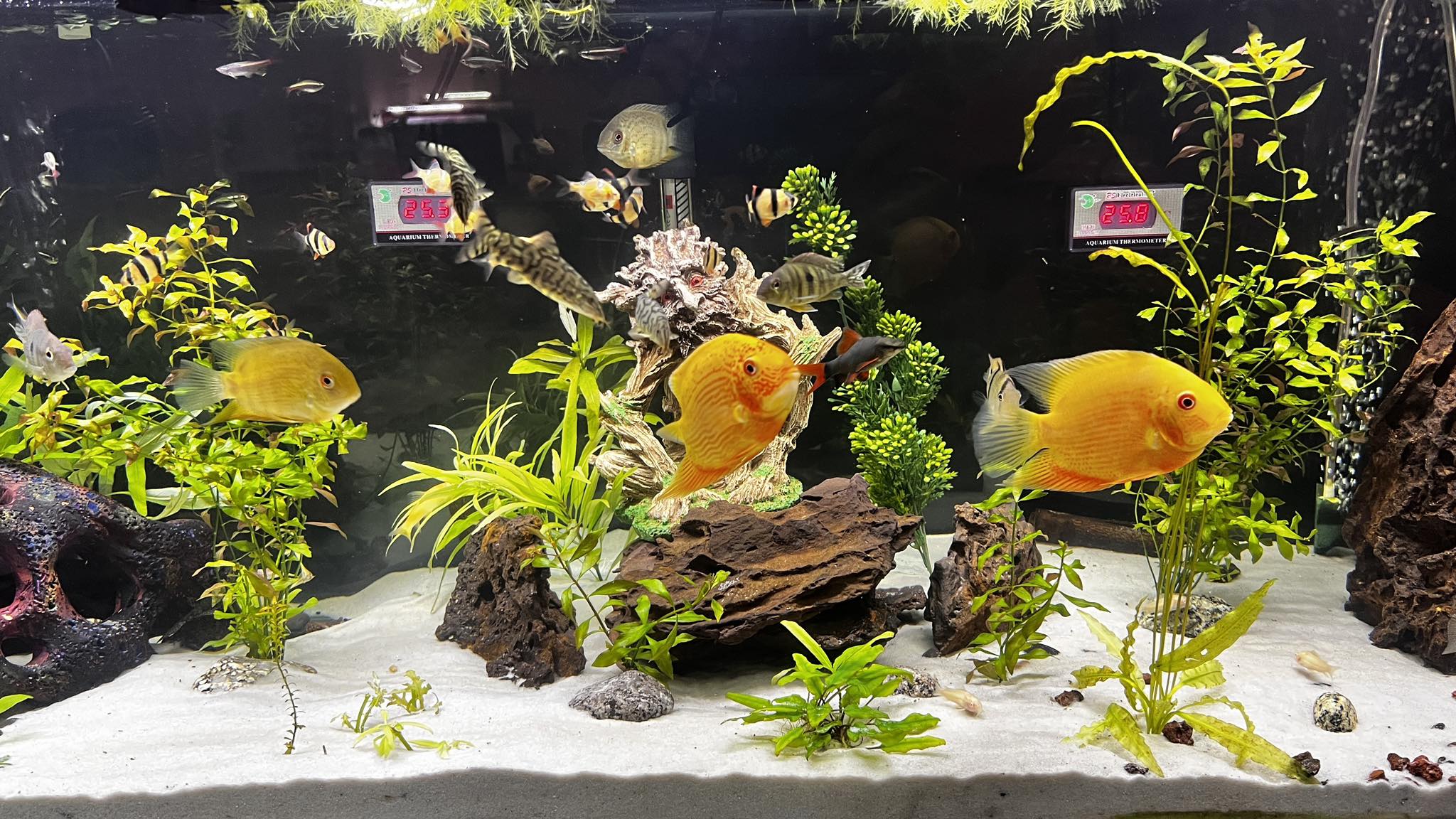
My large South American tank was my pride and joy, a bustling community of vibrant Red Head Tapajos and my quiet, confident Guianacara. However, the undisputed kings and queens of that world were my Red Spotted Severums. They weren’t bullies or aggressors; instead, they were the calm, majestic centerpiece that brought a sense of established grace to the entire aquarium.
From them, I learned that their “aggression” was a language of subtle displays, not a desire for chaos. In fact, watching them interact with each other and their tank mates taught me a valuable lesson, a cichlid tank doesn’t have to be a war zone. Rather, it can be a complex, fascinating, and surprisingly peaceful society.
What Tank Size is Needed for Severums?
A common mistake new keepers make is buying a fish based on its juvenile size. Specifically, they do this without planning for the majestic adult it will become. Severums are a perfect example. That charming, 3-inch (7.5 cm) young fish at the store will grow into a large, stately, 8-inch (20 cm) adult with a significant presence.
Therefore, providing the right size tank from the beginning is the single most important factor for their long-term health. Ultimately, it ensures a low-stress life and peaceful temperament.
The Absolute Minimum: The 55-Gallon Tank
While a 55-gallon (approx. 208 liters) tank is often cited as the absolute minimum, it’s crucial to understand what “minimum” truly means. Specifically, this size provides the bare essentials for a single Severum or a single, confirmed bonded pair.
Consequently, it gives them enough space to live, but it offers very little room for error or for a thriving community. Furthermore, in a 55-gallon tank, territorial disputes can be more frequent. Stress levels can be higher. In addition, your options for suitable tank mates are severely limited.
The Highly Recommended Size: The 75-Gallon Tank (and Larger)
This is the size where your Severums will truly begin to thrive, not just survive. A 75-gallon (approx. 284 liters) tank or larger is highly recommended for keeping Severums, especially in a community setting. The benefits of this larger volume of water are immense:
- Dilutes Aggression: Severums are cichlids, and territorial behavior is in their nature. A larger tank provides significantly more space for each fish. This space allows each fish to claim its own territory. It helps them establish hiding spots and escape the line of sight of a pushy tank mate. This dramatically reduces stress and the potential for bullying.
- Creates Stable Water Parameters: As large fish, Severums have a considerable bio-load, meaning they produce a significant amount of waste. A larger volume of water is far more forgiving of minor mistakes. It dilutes toxins like ammonia and nitrate more effectively, creating a more stable and healthier environment.
- Unlocks a Wider Range of Tank Mates: A 75-gallon tank or larger provides space to keep Severums. You can house them with other suitable medium-to-large cichlids. You can also include dither fish. This allows you to create a dynamic and balanced community.
Why Tank Shape Matters as Much as Volume
Don’t just look at the gallons or liters; look at the tank’s dimensions. Severums have a unique body shape that makes the tank’s height and footprint critical.
Height is Essential: Severums have a tall, disc-shaped body. They need a tank with adequate vertical space to swim and turn comfortably. Look for a tank that is at least 18 inches (approx. 45 cm) tall, with 21 inches or more being even better.
A Larger Footprint is Better: A “long” or “breeder” style tank with a larger footprint (length x width) is far superior. This type of tank design is preferable to a tall, narrow tank of the same volume. The larger footprint provides more horizontal swimming room and more ground space for territories.
When choosing a tank for a Severum, you are not buying a home for the 3-inch juvenile you see today. You are investing in a forever home for the 8-inch, majestic adult it is destined to become.
How Should I Aquascape a Severum Tank?
Creating the right environment for your Severum goes far beyond simply adding water. Instead, the substrate, decorations, and plants you choose are the building blocks of their world. In fact, they directly influence their behavior, health, and sense of security. Therefore, here’s a detailed breakdown of how to create the perfect Severum habitat.
The Substrate:
Choosing the right substrate isn’t just a decorative choice; it’s a critical provision for your Severum’s natural foraging instincts.
Why Soft Sand is the Best Choice: While Severums (Heros) and Earth-eaters (Geophagus) are both South American Cichlids, they belong to different tribes. Severums are Heroini, while Earth-eaters are Geophagini. Specifically, they sift it through their gills to find tiny food particles, and then they spit out the clean sand. Crucially, this is a vital part of their enrichment. While Severums will pick at the substrate and move sand, they do not possess the specialized gill rakers or the constant sifting behavior of a true Geophagus. They are “pickers,” not “sifters.” Therefore, a soft sand substrate (like play sand or pool filter sand) is gentle on their delicate mouths and gills, allowing them to perform this fascinating, natural behavior safely.
The Problem with Gravel: While fine gravel is a possible alternative, it comes with risks. First, the sharp edges can potentially injure your Severum’s mouth as it tries to sift. More dangerously, a piece of gravel that is just the right size can be accidentally swallowed, which can lead to a fatal intestinal blockage or impaction. For all these reasons, a soft sand substrate is overwhelmingly the best and safest choice to allow them to thrive.
The Hardscape:
The Goal: Break Up Lines of Sight
The primary purpose of your hardscape is to create visual barriers and distinct territories. In fact, in a bare tank, fish are constantly exposed, which leads to stress: a dominant Severum can see and intimidate a more submissive one from across the tank. Therefore, by using large pieces of driftwood and strategically placed rockwork, you create a complex environment where fish can easily escape each other’s line of sight. This, in turn, is the single most effective way to reduce stress and prevent bullying.
Driftwood
Large, branching pieces of driftwood are perfect for this. Not only do they create a natural, Amazonian feel, but they alsoprovide cover and can serve as a surface for spawning. Furthermore, many types of wood release beneficial tannins. These tannins soften the water and create a more natural “blackwater” feel, which Severums love.
Rockwork and Caves
Use smooth river stones or slate to build caves and overhangs. However, it’s crucial to provide multiple hiding spots so that no single fish can monopolize all the best real estate.
A CRITICAL SAFETY NOTE
Remember that Severums are diggers. Therefore, you must place all heavy rockwork directly on the bottom glass of the aquarium. Do this before you add the sand. Otherwise, if you place heavy rocks on top of the sand, your Severums can burrow underneath them, causing the structure to collapse and crush the fish or crack the tank.
The Plant Dilemma:
Severums are omnivores with a healthy appetite for greens, which makes a traditional, lushly planted tank a significant challenge.
The Reality: To a Severum, many delicate aquarium plants look like a free, all-you-can-eat salad bar. They will nibble on, uproot, and often completely devour soft-leaved plants.
Your Best Bet (The “Severum-Proof” Plants): Your best chance for success lies with tough, unpalatable plants that can be attached to the hardscape where they can’t be uprooted. The two best candidates are:
- Anubias (e.g., Anubias barteri, Anubias nana): They have thick, waxy, and tough leaves that most Severums find unappealing.
- Java Fern (Microsorum pteropus): This plant is famous for its bitter taste. This taste acts as a natural deterrent for most plant-eating fish.
- How to Plant Them: Use super glue to attach the rhizome. Alternatively, you can use cotton thread. The rhizome is the thick green stem. Attach it directly to your driftwood or rocks. Do not bury the rhizome in the substrate, or it will rot.
- A Worthy Gamble: If you are determined to have rooted plants, choose very tough species. Fast-growing varieties like Amazon Swords or Vallisneria provide your best chance. Success is not guaranteed, but their robust nature gives them a fighting chance.
- The Zero-Risk Option: If you want a green look without the frustration, choose high-quality artificial silk plants. They are a perfectly acceptable alternative.

What are the Ideal Water Parameters?
- Temperature: They are tropical fish and require a stable temperature between 74-84°F (23-29°C).
- pH: They are adaptable but prefer soft, slightly acidic water with a pH of 6.0-7.0.
- Water Quality: Like all large cichlids, they are sensitive to poor water quality. Consistent weekly water changes of 25-50% are essential to keep nitrates low.
What Should I Feed My Severum?
Severums are omnivores with a significant need for vegetable matter.
- Staple Diet: A high-quality cichlid pellet should be the foundation of their diet.
- Vegetable Matter: This is crucial for their health. Offer blanched vegetables like zucchini, spinach, and shelled peas.
- Meaty Foods: Supplement their diet with frozen foods like bloodworms, brine shrimp, and krill.
- Why is my Severus not eating its vegetables? This is common. They can be picky. Be persistent and continue to offer vegetables. Sometimes, withholding their favorite pellet food for a day can encourage them to try the greens.
Are Severums Aggressive?
This is the most important—and most nuanced—question to ask before bringing a Severum home. Although they can reach 8 inches or more, they are remarkably peaceful. This trait has rightfully earned them the nickname “gentle giant.” However, it is crucial to understand this term in context. “Gentle” for a large cichlid is a world away from “gentle” for a Neon Tetra. They are still intelligent, territorial cichlids with a complex social structure and distinct personalities.
The Cichlid Contradiction
A Severum’s “aggression” is less about malice and more about communication and establishing social order. They live in a world of subtle cues, displays of dominance, and territorial boundaries. In a well-structured aquarium, this rarely results in serious physical harm to other fish. Instead, you will observe a fascinating range of behaviors:
Establishing the Pecking Order
When you keep a group of Severums, they will create a social hierarchy. This is a natural and healthy process that involves a lot of posturing. You will see them engage in behaviors like:
- Flaring: Spreading their gills and fins to appear larger and more intimidating.
- Head Shaking & Tail Slapping: Quick, deliberate movements to signal dominance.
- Lip-Locking: Two Severums may briefly lock mouths in a test of strength. While this looks alarming, it is a highly ritualized behavior that rarely causes injury.
Territorial Disputes
A Severum will often claim a specific area of the tank. This could be a favorite cave or a section of driftwood. They consider it their own. Their “aggression” will be focused on gently pushing other fish out of this personal space. This is why a complex aquascape with plenty of visual barriers is crucial. It allows a submissive fish to easily retreat. Breaking the line of sight will end the confrontation.
Breeding Aggression
Everything changes when a pair decides to breed. The “gentle” part of their nature temporarily vanishes, andthey become a united team of ferocious guardians. Consequently, their focus shifts from the general pecking order to protecting their chosen spawning site and, later, their eggs and fry. At this time, they will terrorize any and all tank mates, no matter their size, that venture too close. This, therefore, is the most aggressive you will ever see them.
Why is My Severum Bullying other fish?
If the behavior in your tank has moved beyond minor squabbles to persistent bullying, it is a sign that something is wrong in the environment. You need to identify the issue and make adjustments. Here are the most common causes:
- The Tank is Too Small: This is the number one cause of excessive aggression. In a cramped space, fish are in constant forced proximity. There are no distinct territories and no room to escape. A submissive fish cannot get away from a dominant one, turning minor displays into relentless, stress-inducing harassment.
- Incompatible Tank Mates: Housing a Severum with the wrong fish will always lead to trouble.
- Fish That are Too Small: A Severum is an opportunistic omnivore. While they are not aggressive hunters, if a fish (like a Neon Tetra) is small enough to be seen as a potential snack, it will likely disappear one day.
- Fish That are Too Timid: Very shy fish can become “targets” for a bored or territorial Severum. Slow-moving fish can also attract this behavior. The Severum will constantly harass them.
- Fish That are Too Aggressive: Housing them with hyper-aggressive cichlids (like a Jaguar Cichlid) is also a mistake. The “gentle giant” will be the one that gets bullied and stressed.
- A Pair Has Formed and is Preparing to Breed: As mentioned above, a breeding pair will become the tyrants of the tank. If you notice two Severums working together, they are preparing to spawn. They work to clear a space and chase everyone else away. Their behavior is completely normal for breeding pairs. This is stressful for the other fish.
- Individual Personality: It’s a simple but crucial fact: fish have individual personalities. Just like any other animal, some Severums are naturally more placid and easy-going, while others are simply grumpier and more territorial. You may just have a particularly assertive individual.
The Most Recommended Severums Tank Mates
South American Fish
- Geophagus Species (Earth-eaters): This is a premier choice. Species like the Red Head Tapajos (Geophagus sp. ‘red head tapajos’) or the Threadfin Acara (Acarichthys heckelii) are perfect. They are peaceful and occupy the middle-to-lower levels of the tank. They are constantly sifting sand. This behavior creates a dynamic and interesting environment without directly competing with the Severums for territory.
- Other Severums: Keeping a group of Severums together is one of the most rewarding options. In a large enough tank (90 gallons+), a group of 5-6 individuals can form a complex social hierarchy that is fascinating to watch.
- Guianacara Species (“Bandit Cichlids”): As in my own successful experience, these are fantastic companions. They are peaceful, intelligent, and tend to stick to their own territories near the substrate, leaving the mid-water column to the Severums.
- Blue Acaras (Andinoacara pulcher): These cichlids are a classic choice. They are beautiful, hardy, and have a very similar semi-aggressive but manageable temperament.
- Festivums (Mesonauta festivus): A wonderfully unique and peaceful cichlid. It shares the same body shape and graceful swimming style as the Severum.
Dither and Bottom-Dwelling Fish
These are non-cichlid tank mates that add activity, clean the substrate, and help make the Severums feel more secure. For example, a large school of robust, mid-to-large sized characins can create a stunning display and act as “dither fish.” Crucially, their calm, schooling presence signals to the Severums that the environment is safe, thereby reducing shyness. Great choices include:
- Silver Dollars (Metynnis argenteus)
- Bleeding Heart Tetras (Hyphessobrycon erythrostigma)
- Congo Tetras (Phenacogrammus interruptus) (Note: An African species, but thrives in similar water parameters).
- Plecos (Catfish): A peaceful species of Pleco is an essential part of the cleanup crew. The Bristlenose Pleco (Ancistrus sp.) is a perfect choice as it stays a manageable size. Larger, more impressive species like the Royal Pleco (Panaque nigrolineatus) also make stunning tank mates in a large enough tank.
- Corydoras Catfish: For a truly peaceful tank, a large shoal of a robust Corydorasspecies (like C. aeneus or C. sterbai) can work well, but ensure the Severums are not overly territorial near the bottom.
Fish to Avoid:
- Hyper-Aggressive Cichlids: Do not house them with aggressive Central American cichlids like Jack Dempseys or Jaguar Cichlids. The “gentle giant” will be bullied, stressed, and will likely die.
- Small, Delicate Fish: As mentioned, tiny schooling fish like Neon Tetras, Ember Tetras, and Guppies are simply too small. They will likely be eaten once the Severum matures.
- Fin Nippers: Avoid notorious fin nippers like Tiger Barbs, which will harass your Severum and shred its beautiful, flowing fins.
- African Cichlids: Do not mix them. African Cichlids from lakes like Malawi and Tanganyika have specific water requirements. They need very hard, alkaline water. These fish are generally far more aggressive.
What Are the Different Types of Severums?
All the most common color morphs. These are selectively bred variations of the same species: the Common Severum, Heros efasciatus.
1. The Classic: The Green Severum
Appearance: This is the “wild type” Severum and the genetic foundation for many other morphs. Specifically, it has a stunning base color. This ranges from a beautiful olive-green to a golden-yellowish hue. Additionally, there is often shimmering blue and gold spangling on its cheeks and fins. However, the most defining feature is a series of eight or nine faint, dark vertical bars running down its body. Crucially, these bars can appear or disappear almost instantly depending on the fish’s mood. Conversely, they become extremely bold and pronounced during spawning, territorial disputes, or periods of stress.
Size and Temperament: As the standard for the species, they typically reach 6 to 8 inches. They exhibit the classic “gentle giant” semi-aggressive cichlid temperament.
2. The Star of the Show: The Red Spotted Severum (or “Red Tiger”)
Appearance: This is arguably the most popular and sought-after color morph. The Red Spotted Severum has the same greenish-gold base body. However, it is covered in a spectacular pattern of brilliant red to orange dots and squiggles. Specifically, this pattern is often most intense on the face and gill plates before spreading across the body. Ultimately, the intensity of the red coloration is a sign of maturity and excellent health.
Making the Red Spots More Vibrant: The vibrancy of the red spots is directly influenced by diet. To that end, to bring out their most stunning colors, you must feed a diet rich in carotenoids. These are natural color-enhancing pigments found in high-quality cichlid pellets and in meaty foods like krill and shrimp.
Temperament: As they are the same species as the Green Severum, their temperament is identical.
3. The Golden Severum
Appearance: A beautiful leucistic morph, the Golden Severum lacks the dark pigments of its green cousin. Instead, it has a solid, creamy golden-yellow to orange body. However, this body often has very faint, ghost-like vertical barring, which is only visible when the fish is stressed. Furthermore, many specimens retain the beautiful iridescent spangling on their cheeks, and they typically have striking, bright red eyes.
Important Note: The Golden Severum is a leucistic variety. This means it has reduced pigment, but not a complete absence of it.
4. The Turquoise Severum
Appearance: A less common but absolutely stunning variety, the Turquoise Severum is sometimes called a Blue Severum. Consequently, it displays a high degree of iridescent blue coloration over its body. The base color is often still greenish, but it is overlaid with an intense blue sheen, especially on the face and fins.
5. The Red Shoulder Severum (A Different Species!)
Scientific Name: Heros sp. ‘Rotkeil’ (meaning “Red Shoulder” in German).
Appearance: This is not a color morph but likely a distinct, yet-to-be-officially-described species. It is easily identifiable by the intense, deep red-orange patch of color on its “shoulder.” This patch develops right behind the gill plate. This red patch stands out dramatically against their greenish-gold body.
Temperament and Care: Their care is virtually identical to the Common Severum. They share the same semi-aggressive temperament, which is manageable. They are a true showstopper for enthusiasts looking for something a little different.
What Health Problems Do Severums Get?
What is “Hole-in-the-Head” Disease?
This is a common ailment in cichlids, appearing as small pits or lesions on the head. Generally, it’s often linked to poor water quality, a lack of vitamins (especially Vitamin C), and stress.
Bloat
Do severums get bloated easily? Yes. Due to their herbivorous nature, they have a long intestinal tract. Consequently, a diet too low in fiber and too high in protein can cause digestive issues and bloat.
Swim Bladder Issues
Why is my severum swimming head-down? This can indicate a swim bladder disorder, often caused by constipation from their diet. Therefore, feeding them shelled peas and maintaining a high-fiber diet can help prevent this.
Is Breeding Severums Difficult?
How do I get a pair to form?
You cannot simply choose a male and a female and expect them to become a breeding pair. This is because Severums, like many intelligent cichlids, form deep, long-lasting pair bonds and are very particular about their chosen mate.
The Best Method:
The most reliable and recommended method is to start with a group of 6 to 8 healthy, unrelated juveniles. Then, raise this group together in a large, species-appropriate tank. As they grow and mature over the next year or two, their natural social hierarchy will develop. Eventually, you will notice a dominant male and female starting to separate from the group.
Signs a Pair Has Formed:
Constant Association: They will swim together, eat together, and claim a specific territory, almost always at each other’s side.
Displays of Affection: You may see them gently nudging each other or shaking their heads in a courtship display.
Territorial Defense: They will begin to work as a team, gently but firmly pushing all other fish away from their chosen corner or cave.
Once you have a confirmed pair, it is often best to move them to their own dedicated breeding tank. A 55-gallon tank is a good size. This provides them the security and space they need.
What Does the Breeding Process Look Like?
- Site Preparation: The first sign that spawning is imminent is meticulous cleaning. The pair will select a flat, vertical or slightly angled surface. This surface can be a piece of slate. It can also be a large, smooth rock. Another option is a wide Amazon Sword leaf or even the glass of the aquarium. Both male and female will use their mouths to scrub this surface for hours, removing every trace of algae or debris. It is worth noting that there is a species, Heros severus (the true, rare Severum), that is a mouthbrooder.
- The Spawning Dance: The female’s breeding tube (papilla) will become visible. She will then make several slow, deliberate “passes” over the cleaned surface, depositing a line of adhesive, amber-colored eggs. The male will follow directly behind her, making his own passes to fertilize them. This process can last for over an hour and result in a clutch of 200 to 800 eggs.
- Dedicated Biparental Care: The moment the last egg is laid, both parents transform into a hyper-vigilant security team. They will take turns fanning the eggs with their pectoral fins to provide oxygen. This action also helps prevent fungus. They will ferociously guard the perimeter and chase away any intruders.
Why do the parents eat the eggs or fry?
This is an incredibly common, and often heartbreaking, experience for first-time Severum breeders. Do not be discouraged; it is a normal part of their learning process.
Inexperience and Stress: Most often, a young, first-time pair simply doesn’t know what to do yet. This is because they are driven by a confusing mix of instinct to spawn and instinct to eat. Furthermore, any external stress—a sudden movement outside the tank, the presence of other threatening fish, or a sudden change in water parameters can be enough to trigger them to eat the clutch in a panic.
An Unviable Clutch: The parents are adept at recognizing a bad batch of eggs. If, for instance, a large percentage of the eggs are unfertilized, they will turn a fuzzy, opaque white. Consequently, the parents will often eat the entire clutch to absorb the protein and energy back. Ultimately, this prepares them for the next, and hopefully more successful, attempt.
“Practice Makes Perfect”: In almost all cases, a healthy, bonded pair eats their first one or two clutches. However, they will get it right on the third or fourth try. As they become more mature and confident, their parental instincts will fully kick in. Therefore, the best approach is to remain patient. Specifically, keep their environment stable and stress-free, and let them learn from their mistakes. The reward of watching them successfully raise a cloud of tiny fry is well worth the wait.
Sources
- Cichlidae (Tribe Heroini)
https://www.cichlidae.com/tribe.php?id=17 - Seriously Fish (Heros efasciatus)
https://www.seriouslyfish.com/species/heros-efasciatus/ - Aquarium Co-Op
https://www.aquariumcoop.com/blogs/aquarium/severum-care-guide - Keeping Tropical Fish (Rotkeil Severum)
https://keepingtropicalfish.co.uk/fish-database/red-shoulder-severum/ - American Cichlid Association
https://cichlid.org/articles/heros-efasciatus/ - The Spruce Pets (Hole in the Head)
https://www.thesprucepets.com/hole-in-the-head-disease-1378481


Leave a Reply