You look into your beautiful aquarium, and your heart sinks. There, on the fin of your favorite fish, is a single, tiny white spot, like a grain of salt. The next day, there are three more. You are officially in a battle with Ich, the most common and persistent parasite in the freshwater hobby. But don’t panic. While it is serious, Ich is a well-understood and treatable disease. Therefore, this guide will be your battle plan, explaining the enemy’s life cycle, the best treatment methods, and how to prevent this plague from ever returning.
The Aquatic Glitter of Death
I will never forget my first, and hopefully last, major Ich outbreak. I skipped quarantine on a new fish—a rookie mistake I paid for dearly. It started with one innocent-looking spot on my Red Spotted Severum. However, within a week, my entire tank looked like it had been sprinkled with the aquatic glitter of death.
Consequently, I became a frantic, overly suspicious pharmacist, turning my living room into a fishy emergency room. The entire tank ended up stained a haunting shade of blue from the medication. It was a stressful, expensive, and completely avoidable disaster. That outbreak was, ultimately, the final, brutal lesson that taught me the non-negotiable importance of a quarantine tank. This guide is the wisdom I earned in the trenches of that glittery, blue-stained war.
What is Ich, and What Do the Spots Look Like?
Ich (pronounced “ick”) is the common name for the disease caused by a protozoan parasite called Ichthyophthirius multifiliis.
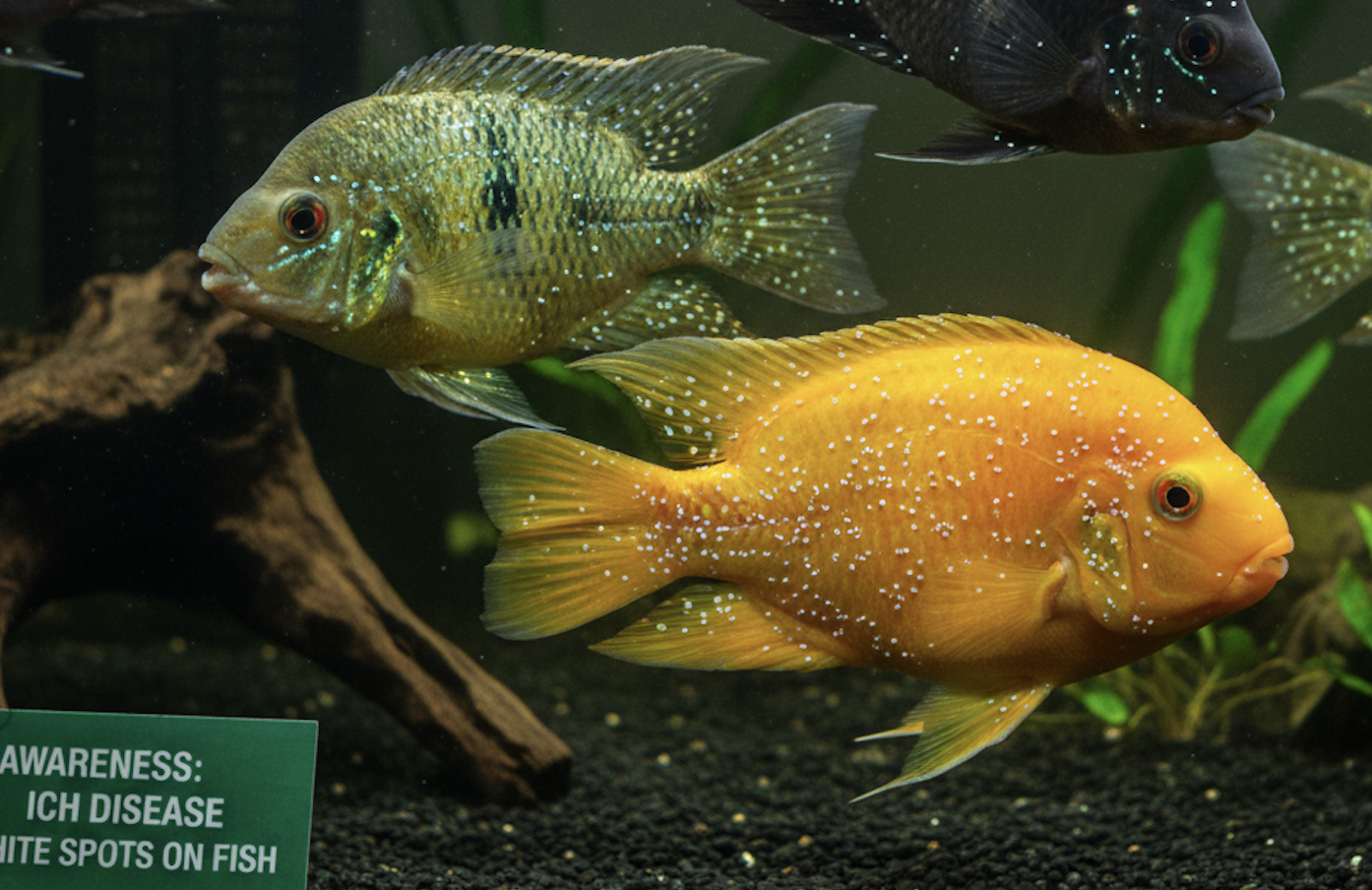
What are the symptoms? The most obvious sign is the appearance of small, distinct white spots on the body, fins, and gills of the fish. They look exactly like individual grains of salt have been sprinkled on your fish.
Is it Ich or Fungus? To differentiate, a fungal infection (like Saprolegnia) usually appears as larger, cottony, or fuzzy white patches, whereas Ich spots are small, hard-edged, and uniform in size.
Other Symptoms: In addition to the spots, an infected fish will often show signs of irritation like “flashing” (rubbing or scratching its body against decor), clamped fins, lethargy, and difficulty breathing (gasping) as the parasites invade its gills.
Why is Understanding the Ich Life Cycle So Important?
To defeat your enemy, you must know its strategy. The Ich parasite has a three-stage life cycle, but it can only be killed in one of those stages.
The Feeding Stage: This is the white spot you see on the fish. The parasite has burrowed into the skin and is feeding, protected by the fish’s own slime coat. Significantly, medication cannot kill the parasite in this stage.
The Reproductive Stage: Next, after feeding, the parasite detaches from the fish, falls to the substrate, and forms a cyst. Inside this cyst, it reproduces, creating hundreds to thousands of new baby parasites. Again, medication also cannot penetrate this cyst.
The Infective Stage: Finally, the cyst bursts, releasing a horde of free-swimming “swarmers” into the water column. They must find a new fish host within 48 hours, otherwise, they will die. Crucially, this is the only stage where medication can kill the parasite.
This cycle is why you must treat the entire tank and continue treatment for long after the last spot has disappeared from your fish.
What Causes Ich in an Aquarium?
The primary cause of Ich is its introduction into a tank by new, un-quarantined fish, plants, or even a wet net from another tank. Alternatively, the parasite can lie dormant in a tank in very low numbers, but it will only cause a full-blown outbreak if the fish’s immune systems are weakened by stress from poor water quality, temperature fluctuations, or bullying.
How Do I Treat Ich? A Step-by-Step Battle Plan
You have two primary methods of attack. Whichever you choose, the key is to be consistent and complete the full course of treatment.
Method 1: The Heat and Salt Treatment (Medication-Free)
This is a classic, effective, and less invasive method, but it has its risks.
Increase Water Agitation: Add an air stone. The Ich parasite attacks the gills, making it harder for fish to breathe. Increased oxygenation is crucial.
Slowly Raise the Temperature: Increase your aquarium’s temperature by 1-2 degrees Fahrenheit per hour until it reaches 86°F (30°C). This dramatically speeds up the Ich life cycle, forcing the parasites into the vulnerable free-swimming stage much faster. Historically, this was sufficient to stop Ich reproduction. However, in recent years, heat-resistant strains found in commercial aquaculture have been documented surviving up to 90°F (32°C). While heat does speed up the life cycle (making meds work faster), relying solely on heat is no longer guaranteed to cure the infection.
Slowly Add Aquarium Salt: Dissolve aquarium salt (NOT table salt) in a separate container of water and slowly add it to the tank over several hours. The target dose is 1 tablespoon of salt for every 3-5 gallons of water. The salt helps to dehydrate and kill the free-swimming theronts.
Perform Gravel Vacuums: Every few days, do a gravel vacuum to remove as many of the reproductive cysts (tomonts) as possible from the substrate.
Maintain the Treatment: Keep the heat and salt levels stable for at least 10 days.
CRITICAL WARNING: Many scaleless fish (like Kuhli Loaches), some catfish, and some tetras are very sensitive to salt and high heat. This method may not be safe for all tanks.
Method 2: Commercial Ich Medication
This is often the faster and more surefire method.
Choose a Medication: Use a reputable medication that contains malachite green, formalin, or a combination of both.
Remove Chemical Filtration: Before dosing, you must remove any activated carbon from your filter, as it will absorb the medication and render it useless.
Follow the Instructions Precisely: Dose the medication according to the manufacturer’s instructions.
How long do I treat? You must treat for the full recommended course, even if the spots disappear after a few days. Remember, you are not treating the spots on the fish; instead, you are treating the invisible swarmers in the water. Therefore, it’s often recommended to continue treatment for 3-5 days after the last visible spot has vanished.
How Do I Prevent Ich from Ever Coming Back?
Prevention is the ultimate cure.
- QUARANTINE. QUARANTINE. QUARANTINE. This is the golden rule. A simple 10-gallon tank where all new fish are observed for 4-6 weeks is the vaccine that will make your main tank immune to this plague.
- Maintain Stable, High-Quality Water: Perform regular water changes and keep your parameters pristine.
- Feed a High-Quality Diet: A healthy diet boosts your fish’s immune system.
Ice Treatment In Aquariums FAQ
Ich appears as small, hard-edged white spots uniformly scattered across a fish’s body, fins, and gills, resembling individual grains of salt. A fungal infection, by contrast, produces larger cottony patches rather than distinct pinpoint dots. Affected fish also scratch against surfaces, clamp their fins, and may gasp near the water surface.
The Ich parasite has three stages, but medication kills it only during the free-swimming phase in open water. The feeding and cyst stages offer full protection from any chemical treatment. Full tank treatment must continue well past the disappearance of visible spots to eliminate all cycling parasites.
Ich most commonly enters through un-quarantined fish, plants, or shared equipment from another tank. It can also lie dormant at harmless levels until fish immunity is lowered by stress or poor water quality. A strict quarantine protocol removes the primary route through which new infections are introduced.
Raise the temperature slowly to 86°F (30°C) to accelerate the Ich life cycle and push parasites into the killable free-swimming phase. Add dissolved aquarium salt at one tablespoon per three to five gallons to dehydrate exposed parasites. Maintain both conditions consistently for at least ten days while vacuuming the substrate regularly.
No — Kuhli Loaches, many catfish species, and some tetras are highly sensitive to both elevated temperatures and aquarium salt. Commercial Ich medication containing malachite green or formalin is a safer and more reliable option for tanks containing these vulnerable species. Always research salt and heat tolerance before choosing a treatment method.
Remove all activated carbon from the filter before dosing, as it absorbs medication and renders treatment completely useless. Follow the manufacturer’s dosage precisely and complete the full course even after spots have disappeared from the fish. The treatment targets invisible free-swimming parasites in the water, not the spots visible on the fish.
Quarantining every new fish, plant, and piece of equipment for a minimum of four weeks is the single most effective prevention. Stable water quality and a high-quality diet keep fish immune systems strong against dormant parasites already in the system. Avoiding shared wet equipment between tanks closes the remaining entry route entirely.
Sources
- University of Florida IFAS (Ichthyophthirius multifiliis)
https://edis.ifas.ufl.edu/publication/FA006 - Fish Pathology (Life Cycle of Ich)
https://fishpathogens.net/pathogen/ichthyophthirius-multifiliis - Aquarium Co-Op (Treating Ich)
https://www.aquariumcoop.com/blogs/aquarium/how-to-treat-ich - Heiko Bleher / Practical Fishkeeping (Salt Treatments)
https://www.practicalfishkeeping.co.uk/features/frequently-asked-questions-on-using-salt/ - Microbe-Wiki (Malachite Green Mechanism)
https://microbewiki.kenyon.edu/index.php/Malachite_Green - ResearchGate (Stress and Fish Immune System)
https://www.researchgate.net/publication/222566767_Stress_and_the_immune_system_in_fish
Leave a Reply
You must be logged in to post a comment.