
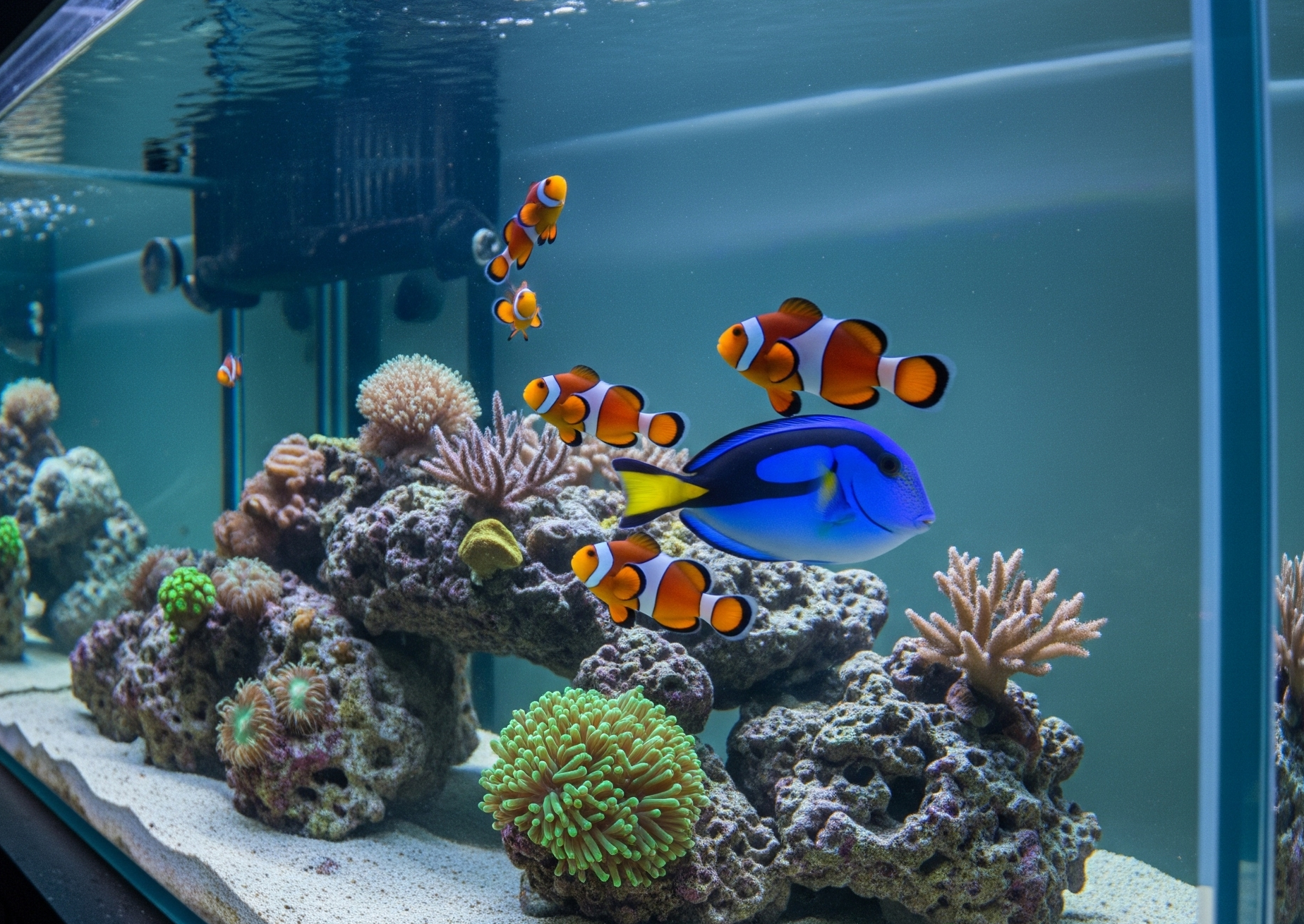
Fresh vs. Salt Water Aquariums. Alright, fellow aquatic world lovers, let’s dive deeper into the fascinating world of keeping fish, specifically the two major paths you can take: Freshwater vs. Saltwater Aquariums. It’s a choice that shapes your entire journey into this wonderful hobby, and understanding the nuances is key to a thriving aquatic environment.
Fresh water Aquariums:
Often seen as the gentle entry point for aspiring aquarists, and for good reason. They are generally perceived as more forgiving and less demanding for beginners, offering a relatively straightforward setup and maintenance routine. The core reason lies in the water itself. You’ll primarily be working with conditioned tap water, which, after dechlorinating, is typically ready for use. This simplifies the initial setup significantly as you don’t need to create the water’s chemical composition from scratch. Equipment-wise, a basic fresh water setup usually involves a filter, a heater (depending on the fish species), and lighting, all of which are generally more affordable and widely available.
Fresh water fish species like guppies, mollies, angelfish, tetras, or even the classic goldfish, are often hardier and more adaptable to slight variations in water parameters. They tend to have a broader tolerance for pH levels and temperature fluctuations, making minor errors less catastrophic. Furthermore, the cost of freshwater fish and aquatic plants is typically lower, allowing beginners to stock their tanks without a hefty initial investment. This allows for a more relaxed learning curve, letting you focus on the basics of fish health, feeding, and tank cleanliness without the added complexity of precise chemistry.
Is it hard to start a salt water aquarium?
Stepping into the realm of saltwater aquariums is transitioning from a casual gardener to an orchid specialist. These tanks are undeniably breathtaking, offering a kaleidoscope of colors from vibrant fish like the clownfish, regal tangs, and delicate gobies, to the living jewels of coral reefs. However, this unparalleled beauty demands a significantly higher level of commitment, and often, financial investment.
Fresh vs. Salt Water
The fundamental difference is the need to recreate ocean water. This means using highly purified water, typically achieved through a Reverse Osmosis/Deionization (RO/DI) unit, and then carefully mixing it with a specialized marine salt mix. Achieving and maintaining the correct salinity (salt concentration) is very important, needing accurate hydrometers or refractometers. Beyond salinity, you become an amateur chemist, constantly monitoring a wider array of parameters such as pH, alkalinity, calcium, magnesium, nitrates, and phosphates. Each of these plays a critical role in the health of marine fish and, especially, corals.
The equipment list for a saltwater tank expands considerably. You’ll likely need a protein skimmer to remove organic waste, powerheads or wave makers to simulate ocean currents and often powerful lighting systems(especially for coral reefs) that mimic the sun’s spectrum. These components, alongside live rock and specialized substrates, contribute to a significantly higher initial and ongoing cost. Salt water creatures themselves, while stunning, are generally more sensitive to changes in their environment and are often more expensive to purchase. This means that mistakes can be costly, both in terms of livestock and equipment. Success in saltwater aquariums often comes with a deep understanding of marine biology and water chemistry.
Navigating Your Aquatic Journey: Fresh vs. Salt Water

The decision between a fresh vs. salt water aquarium boils down to several personal factors: your experience level, your budget, the time you can dedicate to maintenance and learning, and your tolerance for technical detail.
Choose Freshwater if: You’re new to the hobby. You may prefer a more straightforward setup. You might be working with a limited budget. You want to enjoy beautiful fish without delving too deeply into complex water chemistry. It’s an excellent way to build confidence and understand the basics of aquarium keeping.
Opt for Saltwater if: You’re an experienced aquarist seeking a new challenge. You are fascinated by marine ecosystems. You are prepared for a higher financial and time commitment. You enjoy the technical aspects of water quality management. It’s a truly rewarding experience for those ready for the dedication.
Regardless of your choice, both freshwater and saltwater aquariums offer an incredibly rewarding and mesmerizing glimpse into the aquatic world. They provide a unique opportunity to observe living ecosystems in your own home, bringing a sense of peace and wonder. Just be ready to spend hours mesmerized by your underwater companions, possibly developing a new appreciation for plumbing and chemistry!
Author’s Note
I’ll admit, the first time I saw a real reef tank, I was completely mesmerized. Immediately, I was convinced I was going to dive headfirst into the saltwater world. However, I remembered my journey—my first bettas and the hard-won battle to understand the nitrogen cycle. Ultimately, I realized my passion was about understanding the world I was responsible for. Mastering the freshwater world isn’t a lesser step; it’s the bedrock of being a good keeper. Therefore, choose the path that lets you learn and grow with joy, not stress.
Fresh Water And Salt Water Aquariums FAQ
A freshwater aquarium is better for beginners because of simpler water chemistry, more forgiving fish, and lower equipment costs. Freshwater fish like tetras, guppies, and corydoras tolerate minor parameter fluctuations that would stress or kill most saltwater species. Mastering the fundamentals of freshwater keeping first provides the experience base that saltwater success is built on.
A saltwater aquarium costs three to five times more than a comparable freshwater setup due to specialized equipment and more expensive livestock. RO/DI filtration, protein skimmers, marine salt, and live rock add significant startup costs before any livestock is purchased. Ongoing water chemistry management also requires more time and precision than any freshwater equivalent.
A saltwater aquarium requires equipment freshwater tanks do not: an RO/DI unit, protein skimmer, powerheads, refractometer, and specialized coral lighting. Live rock replaces much of the biological filtration media used in freshwater setups. Each additional component increases both the initial investment and the technical knowledge required to maintain the system correctly.
Freshwater fish cannot survive in a saltwater aquarium — the osmotic difference causes rapid dehydration that kills fish within hours. The physiology of freshwater and saltwater fish is fundamentally different, with each adapted exclusively to their respective water chemistry. No acclimation process exists that can transfer a freshwater fish to saltwater successfully.
The hardest part of maintaining a saltwater aquarium is keeping salinity, pH, alkalinity, calcium, magnesium, nitrates, and phosphates stable simultaneously. A change in any one parameter affects the others in interconnected ways, requiring constant monitoring that freshwater setups do not demand. Corals are especially sensitive and react visibly to even minor chemistry changes within hours.
Saltwater aquariums require management of salinity, alkalinity, calcium, and magnesium — parameters freshwater tanks do not need to track. Freshwater systems only require monitoring ammonia, nitrite, nitrate, and pH — a significantly simpler parameter list. The chemical complexity of saltwater chemistry is the primary reason experienced aquarists recommend mastering freshwater first.
A reef tank is the most demanding form of saltwater aquarium and is unsuitable for beginners without prior saltwater experience. Corals require stable lighting spectrums, precise calcium and alkalinity dosing, and water quality that tolerates no significant fluctuation. Most reefers recommend starting with a fish-only saltwater system for at least a year before attempting coral.


Leave a Reply