
You’ve mastered the freshwater world. Your tanks are stable, your fish are thriving, and the nitrogen cycle is your old, predictable friend. But now, you see it at a public aquarium or a local fish store: a true saltwaterx tank. A dazzling, impossible world of vibrant corals and fish that look like living jewels. Inevitably, the thought lodges in your brain: “Could I do that?”
Welcome to the ultimate “level up” in the aquarium hobby. Making the leap from freshwater to saltwater is a challenging, expensive, and incredibly rewarding journey. This being the case, this guide is your roadmap, breaking down the myths, the gear, and the science you’ll need to turn that dream into a reality.
A Whole New Level of Obsession
Let’s be clear: graduating from a freshwater tank to a reef tank is like graduating from a fun college course to a PhD program in applied rocket science. For instance, I look at my beautiful, complicated-enough freshwater tanks, and then I look at the requirements for a reef tank, and I realize I’m not nearly ready to sell a kidney for the right kind of lighting.
This hobby is a beautiful rabbit hole, but the saltwater side is a whole different level of glorious, color-coded madness. It’s not just a hobby, it’s a world of new equipment with scary names, a whole new set of chemical parameters to obsess over, and creatures that can die if you look at them the wrong way. I admire it immensely from afar, and consequently, this guide is the product of my obsessive research into the beautiful insanity I hope to join someday.
How is a Saltwater Tank Different from a Freshwater Tank?
The core principles are the same, but the precision and complexity are magnified tenfold.
Water Chemistry
This is the biggest difference. While in freshwater, you manage the nitrogen cycle, in saltwater, you must manage that plus a host of new, critical parameters:
- Salinity: First, you must constantly mix synthetic salt to a precise level and monitor it with a hydrometer or refractometer.
- Alkalinity, Calcium, Magnesium: Second, these are the building blocks of coral skeletons. Consequently, they must be kept at stable, specific levels, which is a constant balancing act.
Essential Equipment
You will need new, specialized gear. This includes:
- A Protein Skimmer: A device that removes organic waste before it breaks down into nitrates.
- Powerheads: Water pumps that create the strong, chaotic flow that corals and fish need.
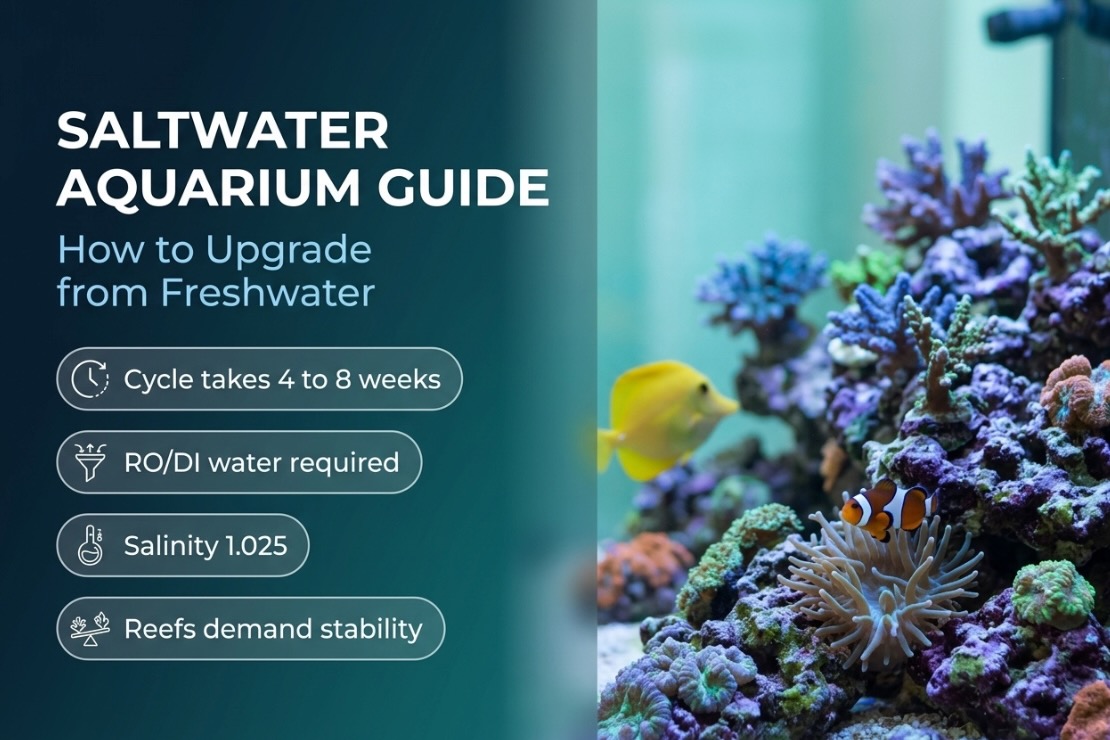
- RO/DI System: A Reverse Osmosis/Deionized water filter is practically mandatory to create pure water, as tap water contains too many impurities for a sensitive saltwater system.
The Cycle
The saltwater nitrogen cycle can take much longer to establish (often 1-2 months) and is usually done using “live rock.”

What Are the Steps to Upgrade to a Saltwater Tank?
1. Research, Research, Research: Do not buy anything yet. First, spend at least a month learning. Decide if you want a simple Fish-Only-With-Live-Rock tank or the much more complex Reef Aquarium.
2. Assemble ALL Your Equipment: Crucially, unlike a freshwater tank, you cannot “add it later.” Buy your tank, sump (if using), protein skimmer, powerheads, heater, and RO/DI unit first.
3. Set Up the Tank: Once equipment is acquired, place your tank, hardscape (live rock or dry rock), and a deep sand bed.
4. Mix Your Saltwater: Next, use your RO/DI system to produce pure water and mix it with a high-quality reef salt to the correct salinity (usually 1.025 specific gravity).
5. Start the Cycle: Let the tank run with all equipment on. Add a source of ammonia (like a piece of shrimp or bottled ammonia) and then wait for the long, slow process of the nitrogen cycle to complete.
6. Add a Cleanup Crew: After the cycle is stable, your first inhabitants should be a hardy crew of snails and hermit crabs to manage algae.
7. Add Your First Fish (Slowly!): Finally, after the cycle is complete and stable, you can add your first, most peaceful fish. Only add one or two fish at a time, weeks apart, to allow your biological filter to catch up.
What is a Reef Aquarium, and Why is it So Advanced?
A reef aquarium is a saltwater tank where the primary focus is not on the fish, but on growing live corals. As such, this is the pinnacle of the hobby and requires an expert level of care and stability. Ultimately, the needs of the corals are paramount.
The “Holy Trinity” of Reef Keeping
Powerful, Specific Lighting: Corals are photosynthetic animals. Therefore, they don’t just need “bright” light; they need light of a specific spectrum and intensity (PAR). Consequently, high-quality, controllable LED reef lights are expensive but essential.
Chaotic Water Flow: Similarly, in the ocean, corals are hit with powerful, unpredictable currents. To mimic this, you must replicate this with multiple, strategically placed powerheads to deliver nutrients, remove waste, and prevent dead spots.
Unwavering Stability: Above all, this is the key. A sudden swing in temperature or a small drop in alkalinity can stress or kill your entire coral collection overnight. Achieving this stability requires:
- Constant Testing: Daily or weekly testing of Calcium, Alkalinity, and Magnesium.
- Dosing: The use of automated dosing pumps to drip-feed essential elements back into the tank as the corals consume them.
- Massive Filtration: For instance, many reefers use a “sump”—a separate tank below the main one that houses the skimmer, heaters, and other equipment, adding to the total water volume and stability.
How Do I Maintain a Saltwater Tank?
Water Changes: You still need to do regular water changes (10−20% weekly is common), but you must pre-mix, heat, and aerate your new saltwater 24 hours in advance. While this is safe for standard salts (like Instant Ocean), some modern “Pro” salts (high alkalinity/calcium mixes like Red Sea Coral Pro) specifically instruct users NOT to mix for more than 2–4 hours. Prolonged mixing/heating of these high-concentration salts causes precipitation (the minerals turn into white dust and fall out of solution), ruining the batch.
Top-Offs: Water evaporates, yet the salt stays behind, which makes the water more saline. Therefore, you must “top-off” the evaporated water daily with fresh, unsalted RO/DI water. An Automatic Top-Off (ATO) system is a lifesaver.
Equipment Maintenance: In addition to water care, protein skimmers need to be emptied and cleaned regularly, and powerheads need to be kept free of algae.
Overall, the journey to a successful saltwater or reef aquarium is a true marathon, not a sprint. It is a deeply rewarding, beautiful, and endlessly fascinating challenge for the dedicated hobbyist who is ready for the next level.
Upgrading To A Saltwater Aquarium FAQ
A saltwater aquarium requires specialized equipment not needed in freshwater: a protein skimmer to remove organic waste, powerheads to create strong water flow, and an RO/DI filtration unit to produce pure water. All equipment must be purchased and fully operational before adding any saltwater or livestock to the tank.
Saltwater aquariums require weekly water changes of 10–20% to maintain water quality. New saltwater must be pre-mixed using RO/DI water and reef salt, then aerated and heated for 24 hours before use. Some high-concentration “Pro” salts, however, must not be mixed for more than 2–4 hours to prevent mineral precipitation that ruins the batch.
A reef aquarium prioritizes living corals as the primary inhabitants, requiring precise control of lighting spectrum, intensity, and three additional chemical parameters. Alkalinity, Calcium, and Magnesium, that a fish-only tank does not demand. A fish-only saltwater tank focuses on marine fish in a simpler, more forgiving system that is significantly more accessible to beginners.
Tap water contains chlorine, chloramine, phosphates, and dissolved solids harmful to the sensitive inhabitants of a saltwater aquarium. An RO/DI filtration system removes these impurities to produce the pure water a marine system requires. Using tap water directly fuels uncontrollable algae growth and disrupts the precise water chemistry a reef demands.
Standard reef salts are safe to mix, aerate, and heat for 24 hours before use in a saltwater aquarium. High-concentration “Pro” salts, however, must not be mixed for more than 2–4 hours. Prolonged mixing causes elevated calcium and alkalinity minerals to precipitate out of solution, turning the entire batch into unusable white sediment.
A saltwater aquarium nitrogen cycle typically takes 4–8 weeks to complete, significantly longer than a freshwater cycle. Live rock is the traditional method for introducing beneficial bacteria and seeding the process. The cycle is only complete when ammonia and nitrite have spiked and returned to zero on consecutive tests.
Sudden coral death in a saltwater aquarium is almost always caused by a rapid swing in Alkalinity, Calcium, or Magnesium, or an unexpected temperature spike. Corals require unwavering stability above all else, and even a minor overnight drop in Alkalinity can kill an entire collection. Daily testing and automated dosing pumps are essential reef maintenance.
Sources
- Bulk Reef Supply (Why You Need RO/DI)
https://www.bulkreefsupply.com/content/post/md-2015-06-why-use-ro-di-water-for-your-saltwater-aquarium - EcoTech Marine (Coral Lab – Lighting & Flow)
https://ecotechmarine.com/wp-content/uploads/2016/07/ReefWholesale_CoralLab_Booklet_Web.pdf - SaltwaterAquarium.com (ATO Guide)
https://www.saltwateraquarium.com/content/the-importance-of-an-auto-top-off-ato-system/ - Red Sea (Coral Pro Mixing Instructions)
https://www.redseafish.com/reef-care-program/reef-salt-program/coral-pro-salt/
Leave a Reply
You must be logged in to post a comment.