
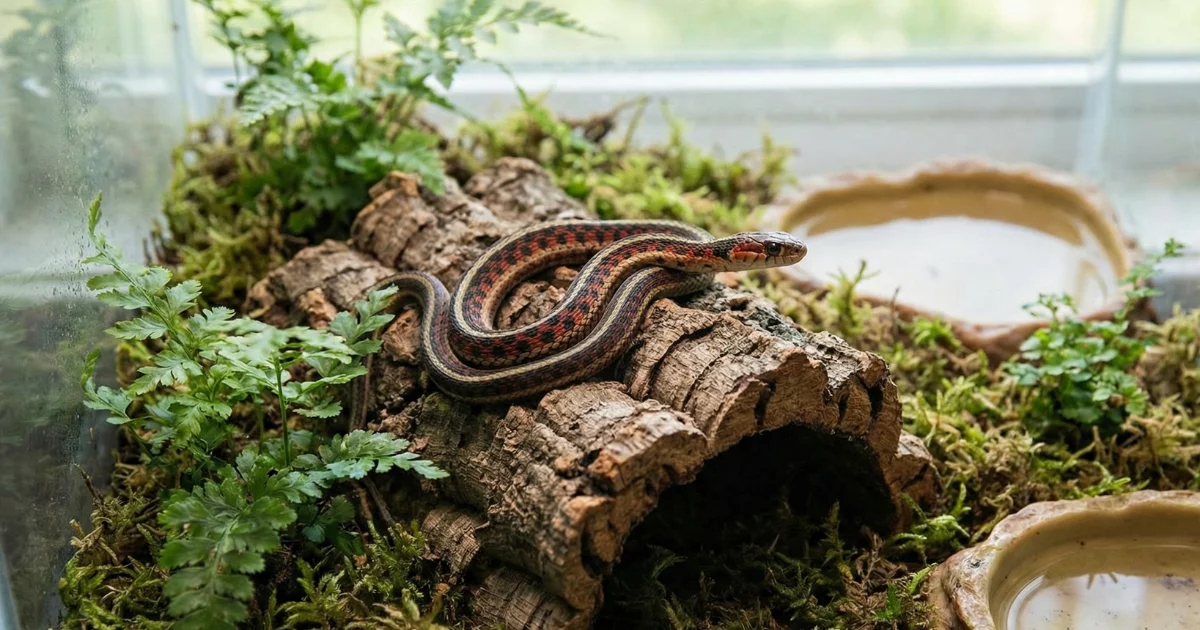
The Garter Snake (Thamnophis spp.) is a diverse group of North American colubrids. Far from being a boring “garden snake,” they are active, intelligent, and one of the few snake species that can and should be kept socially, making them a uniquely rewarding pet.
Is the Garter Snake a suitable choice for a beginning keeper?
The Garter Snake is a fantastic choice for a beginner who seeks an active and visible pet. Specifically, they lack the sedentary nature of many heavy-bodied pythons and spend much of their day exploring. Furthermore, their resilient biology makes them forgiving of minor husbandry fluctuations. Consequently, they serve as an excellent introduction to the complexities of reptilian care. Therefore, I frequently recommend this genus for those who prioritize observation over occasional handling. In fact, their high metabolism ensures they remain one of the most engaging species in the hobby.
What are the realistic growth and longevity expectations for a Garter Snake?
A Garter Snake represents a ten to twenty year commitment to a slender and highly mobile animal. Specifically, most common species reach an adult length of two to three feet. Furthermore, females typically exhibit a heavier build and greater length than males. Consequently, you must prepare for a decade or more of consistent feeding and habitat maintenance. Therefore, I reject the assumption that these are “disposable” short-lived pets. As a result, providing a stable environment from the start is critical for their long-term physiological health.
Why is the communal nature of the Garter Snake so unique in the hobby?
Unlike the vast majority of snakes, the Garter Snake is a naturally social animal that thrives in groups. Specifically, wild populations often hibernate in massive aggregations to conserve heat and ensure mating success. Furthermore, captive studies show that solitary individuals display higher stress markers and reduced activity levels. Consequently, you should prioritize housing them in pairs or small groups of the same sex. Therefore, I recommend providing a larger enclosure to accommodate the social dynamics of the colony. In fact, watching them interact during feeding or basking is a highlight of the keeping experience.
What are the essential habitat requirements for a “Communal Playground”?
Creating a habitat for a Garter Snake requires a focus on security and environmental complexity. Specifically, for a group of adults, a 4×2×2 foot enclosure provides the necessary space for lateral stretching and exercise. Furthermore, you must provide a large, heavy water dish because these snakes are semi-aquatic and love to soak. Consequently, a cluttered environment with branches, cork bark, and artificial plants reduces stress by providing multiple hiding spots. Therefore, I prioritize the use of bioactive substrates to manage waste effectively. As a result, a well-designed tank becomes a miniature ecosystem for your social group.
How do you manage the “Varied Menu” to prevent nutritional disease?
The Garter Snake requires a highly varied diet to prevent the onset of fatty liver disease and vitamin deficiencies. Specifically, a diet consisting only of rodents is nutritionally inappropriate for this genus. Furthermore, you must ensure that any fish offered is strictly thiaminase-free to avoid fatal Vitamin B1 depletion. Consequently, chopped nightcrawlers and silversides serve as excellent staples for a healthy metabolism. Therefore, you should rotate prey items to ensure a complete profile of vitamins and minerals. In fact, their fast metabolism necessitates feeding adults once or twice per week.
What is the biological significance of “musking” as a defense mechanism?
When a Garter Snake feels threatened, it employs a chemical defense known as musking. Specifically, the snake releases a foul smelling fluid from its cloaca to deter potential predators. Furthermore, while the scent is pungent, it is entirely harmless to humans and serves as a non-aggressive bluff. Consequently, regular and gentle handling typically reduces this behavior as the snake acclimates to your presence. Therefore, you should never interpret musking as a sign of malice or aggression. In fact, it is a purely defensive reaction born from the animal’s natural survival instincts.
How does the reproductive cycle of livebearers differ from egg-laying species?
One of the most remarkable aspects of Garter Snake biology is that they give birth to live young. Specifically, they are ovoviviparous, meaning the eggs develop and hatch inside the mother’s body. Furthermore, a single female can produce a large litter of independent, miniature snakes that are ready to hunt immediately. Consequently, this eliminates the need for an external incubator and makes breeding a unique experience for the hobbyist. Therefore, I find their reproductive strategy to be one of the most fascinating topics in herpetological research. As a result, they remain a staple of scientific study regarding reptilian social structures.
Garter Snake Care FAQ
Garter snakes will bite when startled or mishandled, more readily than many beginner species. The bite itself is minor and causes little beyond surface irritation. However, their saliva contains a mild anticoagulant that may cause slight localized swelling in sensitive individuals. Consequently, calm, consistent handling significantly reduces biting incidents over time.
Musk frequency decreases naturally with regular, low-stress handling sessions. Specifically, keep early sessions short — five minutes maximum — and always support the snake’s full body. Furthermore, wash hands before handling to eliminate food scents that trigger a defensive response. Consistency across several weeks produces a noticeably calmer animal.
Only thiaminase-free fish species are safe for regular feeding. Suitable options include silversides, salmon, and trout. Specifically, avoid goldfish, rosy reds, and smelt entirely, as they deplete Vitamin B1 rapidly. Furthermore, thiamine deficiency causes fatal neurological damage, making fish selection one of the most critical dietary decisions for this genus.
Mixed-sex cohabitation will inevitably result in breeding. A gravid female requires significantly more food and space, and repeated pregnancies shorten her lifespan considerably. Therefore, same-sex groupings are the strongly recommended standard for social housing. Consequently, research your animals’ sexes thoroughly before establishing any communal enclosure.
Common species such as the Eastern or Plains Garter Snake typically range from twenty to fifty USD. Furthermore, rarer locality-specific or selectively bred individuals can reach one hundred to two hundred dollars. Always prioritize captive-bred specimens from reputable breeders over wild-caught animals. Wild-caught individuals carry heavy parasite loads and acclimate poorly to captive conditions.
Sources
- Scientific Reports
https://www.nature.com/articles/s41598-020-63668-2 - Smithsonian’s National Zoo
https://nationalzoo.si.edu/animals/garter-snake - Veterinary Partner
https://veterinarypartner.vin.com/default.aspx?pid=19239&id=4952014 - National Geographic
https://www.nationalgeographic.com/animals/reptiles/facts/garter-snakes - ReptiFiles
https://reptifiles.com/garter-snake-care-guide/ - Advancing Herpetological Husbandry
https://www.facebook.com/groups/AdvancingHerpetologicalHusbandry/ - Animal Diversity Web
https://animaldiversity.org/accounts/Thamnophis_sirtalis/
Leave a Reply
You must be logged in to post a comment.