
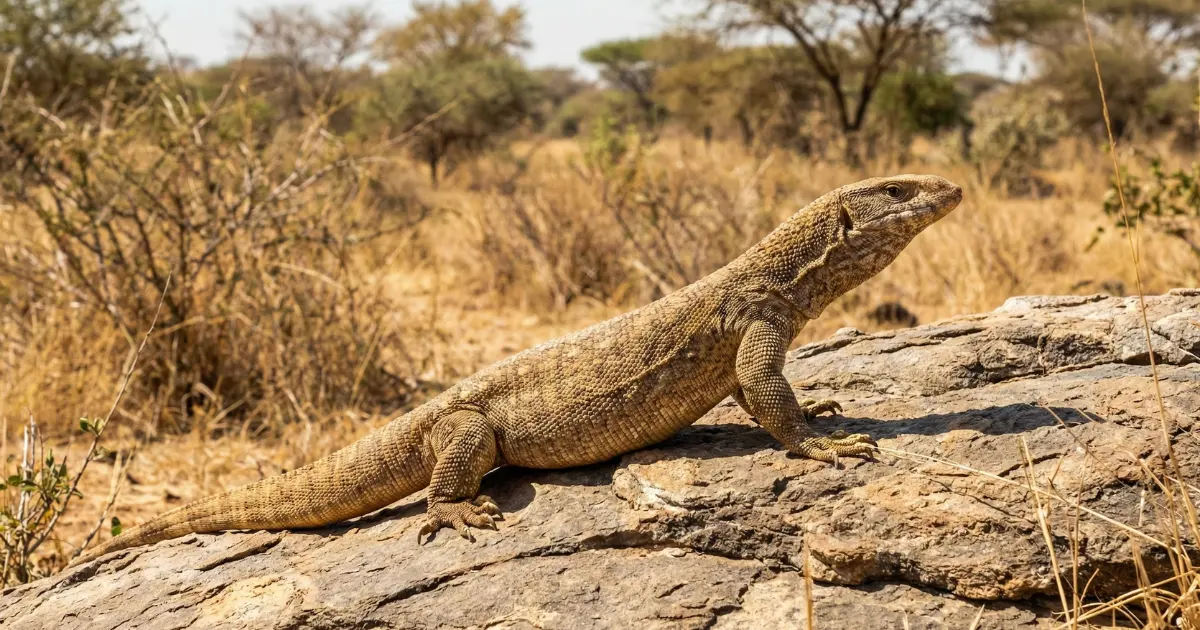
The Savannah Monitor (Varanus exanthematicus) is not a disposable pet. It is a highly intelligent, powerful, and fascinating creature with incredibly specific needs that are a world away from what the pet store tag might tell you. This guide is an attempt to right that wrong.
Is the Savannah Monitor a suitable choice for a beginning reptile keeper?
The Savannah Monitor is definitively an intermediate to expert level species that should never be a first pet. Specifically, their massive enclosure requirements and high utility costs make them financially overwhelming for most novices. Furthermore, retail pet stores frequently misunderstand their highly specialized diet. Consequently, foundational husbandry failures kill a majority of these monitors prematurely in captivity. Therefore, I reject the assumption that these animals are “starter” monitors. In fact, providing the necessary environmental complexity requires a deep understanding of Sahelian ecology.
What are the realistic growth and lifespan expectations for the Savannah Monitor?
A healthy Savannah Monitor represents a fifteen to twenty-year commitment to an incredibly powerful predator. Specifically, adults reach a length of three to four feet and possess a thick, muscular build. Furthermore, they are long-term residents that require consistent social interaction and enrichment. Consequently, you must confront the logistical challenge of housing a lizard that outgrows a standard room. Therefore, I prioritize the “brutal honesty” of their size over their initial low purchase price. As a result, the animal’s physical prime overwhelms many ill-equipped keepers.
Why is the “Rodent Myth” the leading cause of mortality in captivity?
The most fatal misconception regarding the Savannah Monitor involves the belief that they should eat mice or rats. Specifically, wild data proves their digestive systems evolve to process chitin-rich invertebrates like roaches and crickets. Furthermore, a diet high in mammalian fat causes obesity, gout, and fatal fatty liver disease. Consequently, you must view rodents as an extremely rare treat rather than a staple food source. Therefore, you must provide gut-loaded insects for 90% of their nutritional intake. In fact, a “fat” monitor is a dying monitor.
What are the non-negotiable standards for a “Mini-Savannah” habitat?
Housing a Savannah Monitor requires building a dedicated room rather than simply purchasing a glass aquarium. Specifically, the absolute minimum enclosure footprint is 8 feet long by 4 feet wide. Furthermore, you must provide 18 to 24 inches of soil based substrate to facilitate natural burrowing behaviors. Consequently, a shallow substrate leads to chronic stress and respiratory issues due to a lack of humidity. Therefore, your enclosure must be constructed from materials that can withstand high moisture and heavy digging. As a result, the physical infrastructure is the most expensive part of ownership.
How do you replicate the intense solar radiation of the African Sahel?
Replicating the African sun requires a high-energy array of halogen flood lamps and T5 UVB bulbs. Specifically, the basking surface must reach 130–150∘F (54–65∘C) to activate the monitor’s metabolism. Furthermore, you must use a cluster of bulbs to ensure the animal’s entire body is heated evenly. Consequently, a single small bulb creates “hot spots” that can cause localized thermal burns. Therefore, a high-output 12% or 14% UVB tube is mandatory to prevent the onset of Metabolic Bone Disease. In fact, these animals are essentially “solar-powered” biological machines.
Can a Savannah Monitor be successfully socialized for handling?
While often defensive as juveniles, a Savannah Monitor can become an inquisitive and calm resident through patient interaction. Specifically, trust must be earned by respecting their space and approaching them from the side rather than above. Furthermore, you should never attempt to grab or restrain a monitor, as this triggers a defensive flight response. Consequently, allowing the animal to associate your presence with food and positive exploration is the best strategy. Therefore, I prioritize target training as a way to safely interact with these powerful lizards. As a result, you develop a relationship based on mutual respect.
Why is solitary housing mandatory for all monitor lizard species?
The Savannah Monitor is a strictly solitary animal that views other lizards as either competition or potential prey. Specifically, housing multiple individuals together leads to violent territorial disputes and severe injury. Furthermore, even if they appear to “cuddle,” this is actually a competitive behavior for the best basking spot. Consequently, you must provide each animal with its own massive, independent enclosure to ensure its safety. Therefore, I reject the assumption that these animals benefit from companionship. In fact, the stress of a cage mate will significantly shorten their lifespan.
Savannah Monitor Care FAQ
Savannah Monitors are not beginner pets despite frequent pet store marketing claims. Their 8×4 foot minimum enclosure, 150°F basking temperatures, and insect-based diet exceed novice capabilities. Most retail purchases die within three years from improper husbandry rooted in pet trade misinformation.
Adult Savannah Monitors reach 3 to 4 feet in total length with thick muscular bodies. Females tend to stay slightly smaller than males but both sexes possess significant power. Their compact build hides remarkable strength capable of moving heavy enclosure furniture and damaging cage walls.
Wild Savannah Monitors eat almost exclusively insects, snails, and other invertebrates throughout their natural range. Stomach content studies repeatedly confirm chitin-rich prey forms over 90% of their diet. Captive specimens require gut-loaded roaches and crickets, never the rodent-heavy diets sold by pet stores.
Most Savannah Monitors die prematurely from obesity, fatty liver disease, and gout caused by rodent feeding. Pet shops routinely recommend mice as a staple, which directly kills the lizard. Inadequate enclosure size and shallow substrate compound these dietary mistakes within two to three years.
Savannah Monitors live 15 to 20 years under proper husbandry conditions. Captives fed correct insect-based diets in large enclosures regularly reach the upper end of this range. Pet store specimens fed rodents in small tanks rarely survive past their fourth or fifth birthday.
Keeping a Savannah Monitor costs $3,000 to $6,000 in the first year before utility bills. Custom 8×4 foot enclosures alone run $1,500 to $3,000 in materials. Halogen lamp clusters, T5 UVB fixtures, and deep substrate add another $800 to $1,200.
Savannah Monitors must live alone because they view other lizards as competition or food. Group housing causes territorial fights, severe injuries, and chronic stress. Behaviors that look like cuddling are actually competitive jostling for the best basking position, not affection.
Sources
- San Diego Zoo Wildlife Alliance
https://animals.sandiegozoo.org/animals/savannah-monitor - National Geographic
https://www.nationalgeographic.com/animals/reptiles/facts/savannah-monitor - Reptiles Magazine
https://reptilesmagazine.com/savannah-monitor-care-sheet/ - Advancing Herpetological Husbandry
https://www.facebook.com/groups/AdvancingHerpetologicalHusbandry/ - ReptiFiles
https://reptifiles.com/savannah-monitor-care/ - Smithsonian’s National Zoo
https://nationalzoo.si.edu/animals/savannah-monitor - The Bio Dude
https://www.thebiodude.com/blogs/reptile-and-amphibian-caresheets-with-the-bio-dude/savannah-monitor-care-and-bioactive-maintenance
Leave a Reply
You must be logged in to post a comment.