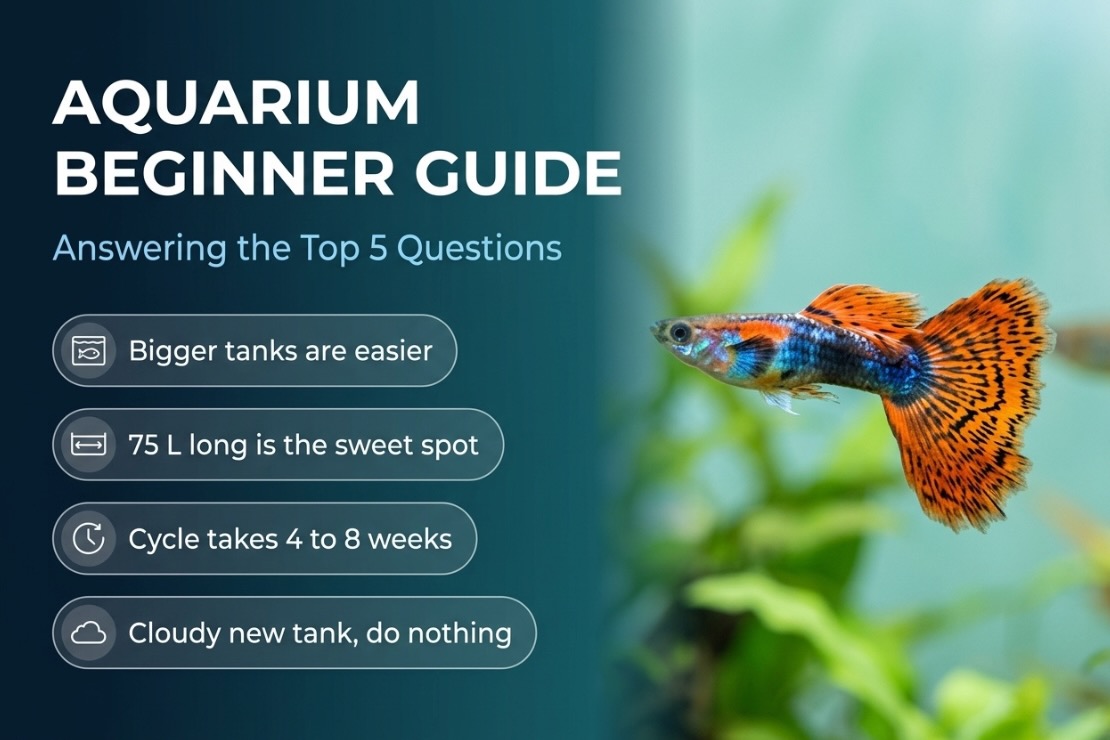
Diving into the aquarium hobby for the first time is an incredible feeling. It brings about a mix of excitement at the thought of building a beautiful underwater world and sheer, sweat-inducing panic because you realize you’re now responsible for keeping tiny, fragile creatures alive in a glass box. As a result, every new hobbyist is flooded with the same big questions: What size tank do I get? What is this “cycling” thing everyone is talking about? Furthermore, why did my crystal-clear water suddenly turn into a cloudy mess? Therefore, this guide is here to be your calm, clear voice in the storm, providing simple, direct answers to the most common questions every beginner asks.
The IKEA Instructions for a Living World
My brain is now a walking, talking encyclopedia of strange and specific animal facts. That is to say, I can tell you the ideal humidity for an African Chameleon as well as the complex social structure of a Severum cichlid. Nevertheless, I vividly, and with a slight shudder, remember the day I brought home my very first 10-gallon tank kit.
I unboxed the pile of gear. It included the filter with its weird charcoal bag, the mysterious gravel vacuum, and the tiny heater. I was instantly staring at it all and felt completely bewildered. In effect, it felt like I had been tasked with assembling a space shuttle using only a set of vague, hieroglyphic instructions. The panic, furthermore, was real.
Therefore, this guide is the cheat sheet I wish I’d had back then. It serves as the simple, no-nonsense answer sheet to the big, scary questions that stand between you and a beautiful, thriving aquarium.
1. What is the Best Tank Size for a Beginner?
This is the most important decision you will make, and the answer is surprisingly counter-intuitive: bigger is easier.
While a small 5 or 10-gallon (20 to 40 liters) nano tank seems less intimidating, it is, in reality, far more difficult to manage. Think of it like a glass of water versus a swimming pool. A single drop of dye will instantly change the color of the glass of water, but it will have almost no effect on the pool. Your aquarium’s water chemistry works the same way.
Why are bigger aquariums more stable? A larger volume of water provides a massive buffer against mistakes.
- Toxin Dilution: Fish waste produces ammonia. In a small tank, this ammonia becomes concentrated and toxic very quickly. In a larger tank, it is much more diluted, giving you more time to correct the problem.
- Temperature Stability: A larger body of water heats and cools much more slowly, providing a stable, stress-free temperature for your fish.
- More Stocking Options: It gives you a wider and more forgiving range of fish you can keep successfully.
The Sweet Spot: The best all-around starting size for a new hobbyist is a 20-gallon long (75-liter) aquarium. It’s large enough to be stable and forgiving, but not so large that it becomes overly expensive or difficult to maintain.
2. How Do I Start My First Aquarium? A Simple Checklist
Setting up is easy if you follow a logical order.
- Choose Your Location: First, place your aquarium stand in its final position, away from direct sunlight (which causes algae) and heating/cooling vents (which cause temperature swings).
- Rinse Everything: Next, thoroughly rinse your substrate (sand or gravel) in a bucket until the water runs clear. You should also rinse any new decorations.
- Install Equipment: Then, place your heater and filter in the tank. Crucially, do not plug them in yet.
- Add Substrate and Decor: Afterward, add your rinsed substrate and arrange your rocks, driftwood, and decorations.
- Add Water and Conditioner: Now, fill the tank with water. To avoid messing up your aquascape, place a clean bowl on the substrate and pour the water into it. Once full, add a high-quality water conditioner to neutralize the chlorine and chloramine in your tap water.
- Turn Everything On: Finally, plug in your filter and heater and let them run.
- Begin the Nitrogen Cycle! This is the most important step.
3. How Do I “Cycle” My New Tank? (The Nitrogen Cycle Explained)
“Cycling” is the process of growing a colony of invisible, beneficial bacteria inside your aquarium’s filter. These bacteria are the life-support system of your tank. Without them, your fish will die. The process works in three stages:
- Ammonia: Fish produce waste, which creates toxic Ammonia.
- Nitrite: The first type of beneficial bacteria consumes this Ammonia and converts it into a still-toxic compound called Nitrite.
- Nitrate: A second type of bacteria consumes the Nitrite and converts it into a much less harmful compound called Nitrate, which is then removed through regular water changes.
The safest and most humane way to cycle your tank is the Fishless Cycle:
- Set up your tank as described above.
- “Feed” the empty tank a source of ammonia. You can do this by dropping in a few fish flakes every day or by adding a few drops of pure bottled ammonia.
- Wait and Test. Over the next several weeks, use a liquid test kit (like the API Master Test Kit) to monitor the water. You will see the ammonia level rise and then fall. Then you will see the nitrite level rise and then fall.
4. How Long Do I Wait Before Adding Fish to the Aquarium?
The answer is simple: you wait until the nitrogen cycle is complete. This process typically takes 4 to 8 weeks. It requires patience, but it is the only way to ensure your tank is safe for fish.
How do you know it’s complete? The cycle is complete when you can add a dose of ammonia, and within 24 hours, your test kit reads 0 ppm Ammonia, 0 ppm Nitrite, and some level of Nitrate. This is the definitive green light that proves your bacteria colony is fully established and ready to handle fish waste.
5. How Do I Clear Up the Cloudy Water of a New Aquarium?
Don’t panic! That milky, grayish-white haze that appears in your new tank a few days after setup is called a bacterial bloom. It is a population explosion of a different kind of free-floating bacteria that is feeding on the excess nutrients in your new, sterile environment. It is not directly harmful to fish and is a normal, healthy sign that your aquarium is starting to come to life.
What should I do? Nothing. This is the most important advice. Do not perform a huge water change, do not change your filter cartridge, and do not add any chemicals. The bloom will go away on its own in a few days to a week as your main filter bacteria become established and out-compete the cloudy-water bacteria for food. Just be patient.
Beginner Aquarium FAQ
A 20-gallon long tank (75 liters) is the ideal starting size. Bigger tanks are actually easier to manage — they dilute toxins more effectively, hold temperature more stably, and forgive beginner mistakes better. Avoid nano tanks under 10 gallons as small water volumes are far harder to keep chemically stable.
It is the process of establishing beneficial bacteria in your filter. Fish waste creates toxic ammonia. First bacteria convert ammonia into nitrite, still toxic. Second bacteria convert nitrite into nitrate, which is far less harmful and removed through water changes. Without this cycle completing, fish cannot survive in a new tank.
Add a small daily ammonia source to your empty, fully set up tank — either fish flakes or a few drops of pure bottled ammonia. Test the water weekly with a liquid test kit. The cycle is complete when ammonia and nitrite both read zero within 24 hours of adding ammonia.
Wait 4 to 8 weeks for the nitrogen cycle to complete. The tank is ready when your test kit reads 0 ppm ammonia, 0 ppm nitrite, and a measurable nitrate level within 24 hours of adding ammonia. Adding fish before this point almost always leads to preventable deaths.
This is a bacterial bloom — a harmless population explosion of free-floating bacteria in a new tank. It is a normal and healthy part of the startup process. Do not change the filter, do not do large water changes, and do not add chemicals. It clears naturally within a few days to a week.
Yes, always. Tap water contains chlorine and chloramine which are toxic to fish and kill the beneficial bacteria your filter needs. Add water conditioner immediately after filling the tank and with every water change afterwards. This step is non-negotiable for any aquarium setup regardless of tank size or fish species.
Sources
- University of Florida (Water Quality)
https://edis.ifas.ufl.edu/publication/FA016 - Aquarium Co-Op (Nitrogen Cycle Guide)
https://www.aquariumcoop.com/blogs/aquarium/the-nitrogen-cycle - Practical Fishkeeping (Fishless Cycling)
https://www.practicalfishkeeping.co.uk/features/the-best-way-to-cycle-an-aquarium/ - FishLab (Cloudy Aquarium Water)
https://fishlab.com/cloudy-aquarium-water/ - Sera (Aquarium Setup Guide)
https://www.sera.de/en/service/info/the-setup-of-an-aquarium/
Leave a Reply
You must be logged in to post a comment.