
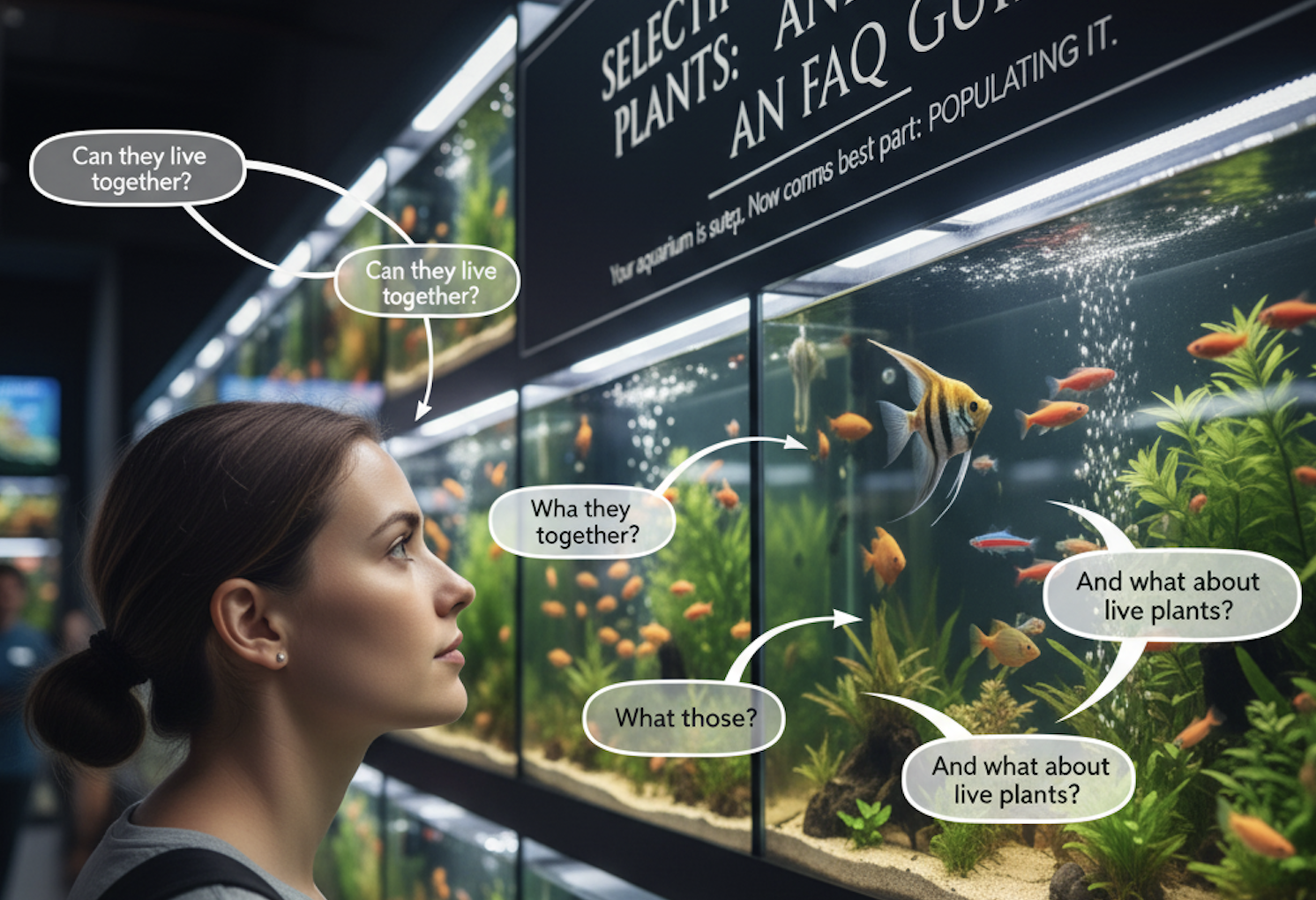
Your aquarium is set up, the water is crystal clear, and the filter is humming along. The world is built. Next, comes the best part: populating it. Walking into a fish store for the first time is a magical experience—a kaleidoscope of moving color and life. However, it can also be a paralyzing one. What are those? Can they live together? How many can I get? Moreover, what about live plants? For this reason, this guide is here to be your confident shopping companion, answering the most common questions about stocking your first beautiful, and most importantly, peaceful aquarium.
The Fish Store Choice Paralysis
I know the feeling well. You walk into the fish store with a clear, noble vision. “I shall create a serene, minimalist aquascape with a single, elegant school of fish.” But ten minutes later, your plan has completely derailed. You’re standing between a tank of hyperactive, flashy guppies that look like a rave party and a tank of majestic angelfish that look like a royal court, and you want both. You might even consider those weird noodle fish hiding in the back.
This situation is a classic case of what I call “Fish Store Choice Paralysis.” In fact, my Multiple Tank Syndrome is a direct result of this. However, for your first tank, making the right choices is the key to success. Therefore, this guide is here to help you navigate that beautiful, chaotic store.
A good “beginner” fish isn’t just one that looks cool; instead, it’s one that is hardy and forgiving of the small mistakes every new hobbyist makes. Therefore, the best choices are peaceful, adaptable, and readily available as captive-bred.
Livebearers (Guppies, Platys, Swordtails)

They are incredibly hardy, active, and furthermore, come in countless colors. Just be prepared, however, for their prolific breeding!
Corydoras Catfish

The charming cleanup crew. These are peaceful, shoaling bottom-dwellers that are essential for any community tank. They are, in fact, constantly sifting the sand and are, therefore, incredibly fun to watch.
Zebra Danios

The indestructible athletes. These are super active, hardy fish and are, therefore, great for beginners. They are also a perfect “dither fish,” as their constant, confident swimming makes other, shyer fish feel safe.
Betta Fish (with a big caveat)

A Betta can be a wonderful beginner fish if kept alone in a proper, heated, and filtered tank of at least 5 gallons. They are not a good choice for a beginner’s first community tank.
What Fish Can I Keep Together? The Art of Compatibility
Creating a peaceful community tank is a puzzle, but the rules are simple.
- The Golden Rule (The Mouth Size Test): If Fish A can fit into Fish B’s mouth, Fish B will eventually eat Fish A. It’s not a question of “if,” but “when.” Therefore, always research the full adult size of your fish.
- Temperament: Next, you must match their personalities. A peaceful fish like a Corydora will be stressed to death by an aggressive cichlid. Always read about whether a fish is “Peaceful,” “Semi-Aggressive,” or “Aggressive” before you buy.
- Tank Level: Finally, a well-balanced tank has fish that occupy different levels. To achieve this, choose some top-dwellers (like Guppies or Danios), some mid-dwellers (like most Tetras), and some bottom-dwellers (like Corydoras or Kuhli Loaches). This practice ensures everyone has their own space.
How Many Fish Can I Safely Put in My Tank?
This is where the most dangerous myth in the hobby lives. You may have heard the “one-inch-per-gallon” rule. Please ignore it completely. It is a terrible and misleading guideline. The real factor to consider is bio-load.
What is Bio-load? In simple terms, bio-load is the total amount of waste produced by the inhabitants of your tank. For example, a single, messy 3-inch Goldfish has a much higher bio-load than ten 1-inch Neon Tetras.
The Better Rule: Stock your tank slowly. Start with one small school of fish (like 6 Corydoras). Afterward, wait a couple of weeks, test your water to make sure the filter is handling the waste, and only then can you add your next small school. A properly stocked tank is built over months, not in a single afternoon. A good starting point for a 20-gallontank (approx. 70 to 80 liters) would be a school of 6 bottom-dwellers (like Corys) and a school of 8-10 mid-dwellers (like a hardy Tetra).
Can I Keep Live Plants in My Fish Tank?
Yes, and you absolutely should! For many beginners, live plants seem like a scary, complicated step, but they are actually one of the most beneficial things you can add to your aquarium.
The Benefits
- They are a natural filter: Plants consume ammonia and nitrates, helping to keep your water clean and stable.
- They provide shelter: Plants give fish a place to hide and feel secure, which dramatically reduces stress.
- They look beautiful: Live plants are the key to creating a truly natural and breathtaking underwater world.
What Are Easy Plants for Beginners?
You don’t need CO2 injection or fancy lights to have a beautiful planted tank. **Start with these “**bulletproof,” low-light beginner plants:
- Java Fern & Anubias: These are the two hardiest plants in the hobby. The most important rule is to never bury their rhizome (the thick green stem) in the substrate. Rather, attach them to driftwood or rocks with super glue or thread.
- Java Moss: In addition, there is Java Moss. A versatile, fast-growing moss that you can attach to any surface. It offers incredible cover for fry and shrimp.
- Cryptocoryne: Last but not least, Cryptocoryne are beautiful, hardy root-feeding plants. Since they are root-feeders, you plant them directly into your substrate. Therefore, they will benefit greatly from a “root tab” fertilizer placed underneath them.
Aquarium Fish And Plants FAQ
Hardy livebearers like guppies and platys pair naturally with Java Fern and Anubias. Both categories tolerate minor water fluctuations that beginners inevitably cause. These plant species need no CO2 injection, no specialized lighting, and forgive the neglect every new aquarist experiences.
Live plants absorb ammonia and nitrates from the water, reducing toxic waste loads between changes. Fish benefit from reduced chemical stress, improved daytime oxygen, and the natural shelter that plant growth provides. A planted tank is measurably more stable than a bare one under identical maintenance conditions.
Stock tanks slowly, adding one small school at a time rather than filling everything at once. A 20-gallon planted tank typically supports six bottom-dwellers alongside eight to ten mid-level fish. Test water parameters after each addition before introducing the next group to the tank.
The one-inch-per-gallon rule is inaccurate and should be discarded by every aquarist. Bio-load, the total waste output of all inhabitants, determines safe stocking far more reliably than body length. A 3-inch goldfish produces far more waste than ten 1-inch neon tetras of equivalent combined length.
Large cichlids and goldfish are the most destructive species for any planted community aquarium. Goldfish consume soft-leafed plants rapidly and uproot rooted species through constant, relentless substrate digging. Cichlids excavate substrate, rearrange décor, and systematically destroy aquascaping layouts that took weeks to establish.
Most beginner-friendly plant species grow successfully under standard aquarium lighting without any CO2 injection. Java Fern, Anubias, Java Moss, and Cryptocoryne tolerate low light and modest nutrients by design. CO2 systems and high-powered lighting belong to intermediate and advanced planted tank setups, not beginner tanks.
A Betta fish thrives in a planted tank only when paired with appropriate, carefully chosen companions. Small, non-colorful, non-fin-nipping species like Corydoras, Otocinclus, and small rasboras are the only safe options. Any fish with long fins or bright colors risks triggering the Betta’s territorial aggression instantly.
Sources
- Aquarium Co-Op (Top 10 Beginner Fish)
https://www.aquariumcoop.com/blogs/aquarium/top-10-beginner-fish - The Spruce Pets (The One Inch Per Gallon Myth)
https://www.thesprucepets.com/the-inch-per-gallon-rule-1381244 - Fishkeeping World (How to Stock an Aquarium)
https://www.fishkeepingworld.com/how-to-stock-a-fish-tank/ - Tropica (Anubias barteri var. nana)
https://tropica.com/en/plants/plantdetails/Anubiasbarterivar.nana(101)/4549 - Buce Plant (Cryptocoryne Care Guide)
https://buceplant.com/blogs/aquascaping-guides-and-tips/cryptocoryne-care-guide
Leave a Reply
You must be logged in to post a comment.