
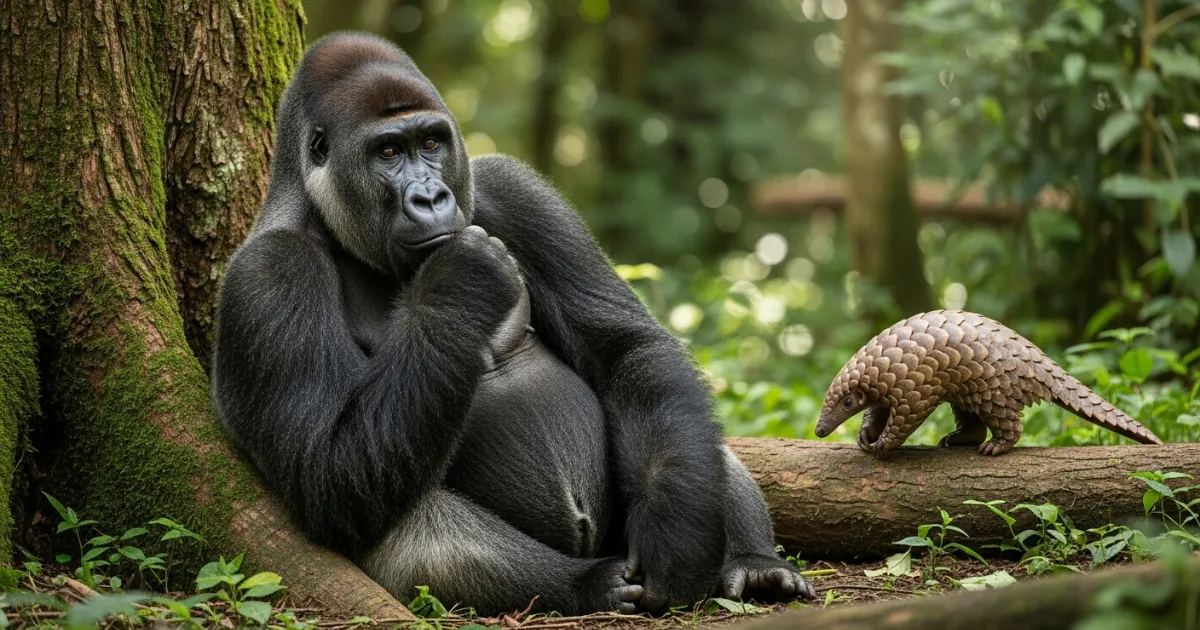
Sometimes, you look at an animal and see a reflection of yourself. For instance, to look into the deep, thoughtful eyes of a silverback gorilla is to feel an immediate, profound connection. You see the gentle strength of a family protector and a powerful mirror of our own capacity for love. Because of this, their peril feels deeply personal, highlighting the importance of endangered species conservation.
And then there are moments when you see a creature so unique, it feels like a being from a world of myth. To see a pangolin, for example, a walking, solitary artichoke, is to witness a masterpiece of evolution.
One is our mirror, and the other a mystery. However, both are disappearing at an alarming rate, pushed to the brink of extinction. While their stories are different, their fight for survival is one and the same—a fight that defines modern endangered species conservation.
Part 1: Endangered Species Conservation
The Gorilla – Our Gentle Giant in Peril
Species and Subspecies: The Gorilla Family
There are two species of gorilla, both living in the forests of central sub-Saharan Africa.
- Eastern Gorilla: Mountain Gorilla and Eastern Lowland Gorilla.
- Western Gorilla: Cross River Gorilla and Western Lowland Gorilla.
What is their conservation status?
The situation is challenging for many subspecies, but there is hope. Indeed, both the Eastern and Western Gorillaspecies are currently classified as Critically Endangered, which highlights the urgent need for conservation efforts. However, the Mountain Gorilla serves as an inspiring exception, because a successful endangered species conservation initiative upgraded it to Endangered—this demonstrates what we can achieve.
Threats to the Gorilla
What are the main threats facing them today?
The primary threats are poaching for the illegal bushmeat trade, habitat loss, and disease transmission from humans.
- The Illegal Bushmeat Trade: As human populations expand, the demand for wild meat increases. Consequently, gorillas have become an easy target for poachers.
- Disease Transmission: Because gorillas share approximately 98% of our DNA, they are extremely susceptible to human respiratory viruses. Indeed, a common cold can be lethal to a gorilla.
- Political Instability: Gorilla habitats are often in regions with a history of civil unrest. This conflict, in turn, disrupts conservation efforts and leads to an increase in poaching.
Biology, Ecology, and Gorilla Conservation
Gorillas live in stable, peaceful family groups called “troops.” The troop is led by a dominant silverback male, who is the chief protector and decision-maker. Moreover, gorilla mothers are dedicated. But with females giving birth only once every 4-6 years, their populations are incredibly slow to recover.
How does tourism affect gorillas?
When managed responsibly, “ecotourism” is one of the most powerful tools for this type of endangered species conservation. For example, the revenue from tourist permits provides a direct economic incentive for communities to protect the gorillas.
Part 2: Endangered Species Conservation
The Pangolin – The World’s Most Hunted Ghost
Species and Conservation Status: The Pangolin Family
There are eight pangolin species. In total, four inhabit Asia, and four live in Africa. All eight species face threats, withstatuses ranging from Vulnerable to Critically Endangered.
Threats Driving Pangolin Extinction
Why are pangolins critically endangered?
They are the most illegally trafficked mammal on Earth. Ultimately, an insatiable black-market demand for their scales and meat has decimated their populations.
- Pangolin Scales: Despite being made of harmless keratin (the same as your fingernails), people falsely believe the scales have curative properties in traditional Asian medicine.
- Vulnerability: A pangolin’s only defense is to roll into a tight ball. While this is effective against a lion, it makes them tragically easy for a human poacher to simply pick up.
Biology, Ecology, and Pangolin Conservation
Are pangolins reptiles or mammals?
Despite their scaly appearance, pangolins are mammals. They are specialist insectivores, and in fact,a single pangolin can consume up to 70 million insects a year, making them vital for pest control. They are shy, solitary, and primarily nocturnal, which makes their role in endangered species conservationand research very difficult.
Efforts in Pangolin Conservation
(Endangered Species Conservation)
What is being done to combat the illegal trade?
Currently, all eight species are protected under CITES, making all international commercial trade illegal. Efforts focus on strengthening law enforcement and running massive public awareness campaigns to reduce demand.
How can individuals help pangolin conservation efforts?
Donate: Support organizations focused on this specific area of endangered species conservation.
Reduce Demand: Above all, never purchase any product made from pangolin and educate others that their scales have no medicinal value.
Raise Your Voice: Ultimately, the more people who know about this shy, unique animal, the more pressure there will be to stop the trade.
The future of both the gorilla and the pangolin rests on our ability to fight these threats.
Sources
- Gorilla Organization
https://gorillas.org/gorillas-stay-stable-but-remain-critically-endangered/ - Rwanda Eco Company
https://rwandaecocompany.com/gorilla-reproduction-cycle/ - IUCN Pangolin Specialist Group
https://pangolinsg.org/2025/09/14/pangolins-still-at-risk-new-pangolin-specialist-group-report-calls-for-stronger-global-action/


Leave a Reply