
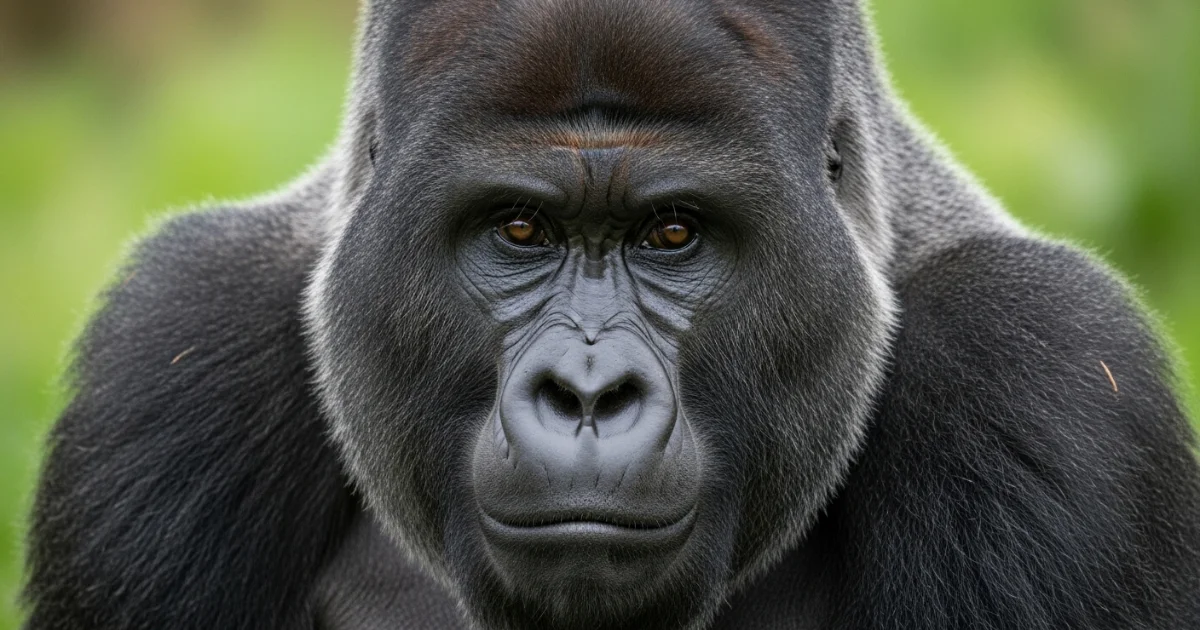
There are exceptionally few wild animals. When you look into their eyes, you feel they are looking right back into you. They do this with a depth of understanding that transcends the species barrier. The Mountain Gorilla is unequivocally one of those animals. In fact, the late, legendary Dian Fossey, who ultimately gave her life to protect them, called them “the greatest of the great apes.” To witness a silverback calmly watching over his family is to witness a profound and peaceful intelligence.
Seeing a baby gorilla play with its caring mother shows its intelligence. Years ago, this amazing animal was on the brink of extinction due to war, poaching, and disease. However, a strong and united conservation effort changed their future. Their story is not just about recovery; it teaches us what can happen when we value a species. It is a true Mountain Gorilla conservation success.
A Personal Reflection on Hope
When I first learned about the plight of the mountain gorillas, it felt like reading a foregone conclusion. The forces against them—human conflict, poverty, habitat loss—seemed insurmountable. Yet, following their story over the years has been a profound lesson in resilience, not just for the gorillas, but for humanity. It shows that when compassion is fused with strategy, situations can be turned around. Empowering rather than sidelining communities is crucial. This isn’t just a story about saving an ape. It shows we are capable of healing the wounds we inflict on our planet. The reflection in the gorilla’s eyes is, in many ways, a reflection of the best version of ourselves.
What Is the Current Status of the Mountain Gorilla Population?
Today, the Mountain Gorilla is listed as Endangered on the IUCN Red List, which is a significant achievement for conservation. In 2018, their status improved from “Critically Endangered,” the most at-risk category. This change resulted from years of intense conservation efforts, along with a steady increase in their population. These factors justified the reclassification and showed that conservation efforts were effective.
The recovery has been, frankly, remarkable. For instance, in the early 1980s, the population in the Virunga Massif had crashed to a terrifying low of just 250 individuals. Today, as a result of tireless work, the total global population across both of its habitats numbers more than 1,063 individuals and, importantly, continues its steady growth. These magnificent apes live in two completely isolated populations, which means conservationists must manage two distinct groups.
Firstly, there is the Virunga Massif, a stunning volcanic mountain range that straddles the borders of Rwanda, Uganda, and the Democratic Republic of Congo (DRC), which is home to approximately 604 gorillas. Secondly, there is Uganda’s Bwindi Impenetrable Forest, a separate and unique ecosystem that is consequently home to the remaining 459 gorillas, highlighting a truly significant Mountain Gorilla conservation success.
What Were the Primary Threats That Nearly Wiped Mountain Gorillas Out?
The main threats that pushed mountain gorillas to the brink were a devastating combination of uncontrolled poaching, pervasive civil war and conflict, and relentless habitat loss for agriculture and human settlement. The Virunga region, for example, has been a center of intense human conflict for decades, most notably the Rwandan genocide in 1994. This turmoil led to a complete breakdown of law and order, which in turn caused a surge in refugees needing land and resources. Furthermore, the presence of armed militias in the forests was catastrophic for the gorillas, as rangers were often unable to conduct patrols safely.
Beyond direct conflict, the risk of disease transmission from humans remains a major and ongoing threat. Because we share approximately 98% of our DNA, gorillas are highly susceptible to human diseases. Consequently, a common cold, influenza, or even measles could be fatal to a gorilla. For this reason, tourist interactions are strictly controlled with rules about distance and health. In addition, snares set by poachers for other animals like antelope present a huge problem. Gorillas, especially curious youngsters, can easily get their hands or feet caught in these crude wire traps. While not the intended target, these snares can subsequently cause horrific injuries, leading to infection, loss of a limb, and even death.
What Makes Their Biology and Social Structure So Unique?
Mountain gorillas are perfectly adapted to their high-altitude, cold environment. For instance, they have much thicker and longer fur than their lowland cousins, which provides essential insulation. They are also slightly larger and more robust. The undisputed leader and protector of every gorilla family is the silverback. He is a mature male whose role is absolutely central to the troop’s survival. Specifically, he dictates the group’s movements, finds food, mediates internal disputes, and will ferociously defend his family to the death against any threat. Ultimately, his calm, confident leadership is the glue that holds the entire social structure together.
Interestingly, these powerful animals cannot survive in captivity. They have a very specialized diet of mountain vegetation and are extremely sensitive to the stresses and diseases found in lowland, captive environments. In fact, no mountain gorilla has ever survived for long in a zoo. This biological reality means that in-situ conservation—that is, protecting them directly in their wild habitat—is the only viable option.
How Was the Mountain Gorilla Conservation Success Achieved?
The success is built on a multi-faceted model of “extreme conservation,” a strategy initially pioneered by Dian Fossey and subsequently scaled up by a powerful coalition of governments and non-governmental organizations (NGOs). The key pillars of this Mountain Gorilla conservation success are, firstly, dedicated on-the-ground protection through daily monitoring and anti-poaching patrols. Secondly, ensuring that local communities benefit financially from the gorillas’ survival. Thirdly, providing direct veterinary intervention to sick and injured gorillas in the wild. And finally, fostering incredible transboundary cooperation between the three nations of Rwanda, Uganda, and the DRC.
Responsible eco-tourism, in particular, has become the economic engine of their survival. A small, controlled number of tourists pay a high fee (currently up to $1,500 per person in Rwanda) for a permit to spend just one hour with a habituated gorilla family. This revenue is substantial and directly funds the salaries of rangers, trackers, and veterinarians, as well as broader conservation programs. Moreover, dedicated teams of “Gorilla Doctors” monitor every single habituated gorilla family every day. They can consequently intervene to remove snares, administer antibiotics for respiratory infections, or treat other life-threatening illnesses.
This unparalleled level of direct care has been crucial for boosting infant survival rates. Above all, a significant portion of the revenue generated from tourism permits is shared with the local communities living around the parks. This money builds schools, clinics, and clean water infrastructure, thereby transforming the gorillas from a resource competitor into a hugely valuable asset worth protecting. In short, this community partnership has been perhaps the single most important factor in reducing poaching.
What Challenges Remain for Their Future Survival?
Despite this incredible Mountain Gorilla conservation success, their future is still fragile. The primary threats have shifted but remain serious. For example, the ever-present risk of a catastrophic disease outbreak is a major concern for conservationists. In addition, habitat encroachment poses a significant challenge. As the human population around the parks continues to grow, and the gorilla population inside the parks also grows, they are quite literally running out of space. This leads to increased instances of gorillas venturing onto farmland, which can create conflict with local people.
Nevertheless, the mountain gorilla recovery serves as the gold standard for conservation. It proves that a critically endangered species can be saved when its survival is made economically beneficial to local people. Indeed, the combination of total government commitment, robust community partnerships, and science-driven, intensive daily protection offers a blueprint for how to save other endangered great apes. The story of the Mountain Gorilla is, therefore, a powerful testament to the fact that extinction is a choice, and we can, if we truly commit, choose survival.
Check our article on
Giant African Millipede
Mountain Gorilla FAQ
The total global mountain gorilla population currently exceeds 1,063 individuals across two isolated habitats — approximately 604 in the Virunga Massif spanning Rwanda, Uganda, and the DRC, and 459 in Uganda’s Bwindi Impenetrable Forest. The population continues to grow steadily as a result of ongoing conservation efforts.
Mountain gorillas are currently listed as Endangered on the IUCN Red List — a significant improvement from their previous Critically Endangered status, which was updated in 2018. This positive reclassification reflects decades of successful conservation work and a steady, measurable increase in their global population.
The primary threats are poaching, civil war and armed conflict in the Virunga region, habitat loss from agricultural expansion, and disease transmission from humans. Because gorillas share approximately 98% of human DNA, a common cold or influenza can be fatal. Wire snares set for other animals also cause serious injuries and death.
No. Mountain gorillas cannot survive in captivity. They have a highly specialized diet of mountain vegetation and are extremely sensitive to the stresses and diseases of lowland environments. No mountain gorilla has ever survived long in a zoo, making direct in-habitat protection the only viable conservation strategy.
A gorilla trekking permit in Rwanda currently costs up to $1,500 per person for one hour with a habituated gorilla family. This revenue directly funds ranger salaries, anti-poaching patrols, veterinary teams, and broader conservation programs — making responsible ecotourism the primary economic engine of the gorillas’ survival.
The silverback is the undisputed leader and protector of his family group. He controls the troop’s movements, locates food sources, mediates internal conflicts, and will defend his family against any threat. His calm, confident leadership is the central organizing force that holds the entire gorilla social structure together.
Sources
- IUCN Red List
https://www.iucnredlist.org/species/39999/17623296 - World Wildlife Fund (WWF)
https://www.worldwildlife.org/species/mountain-gorilla - Gorilla Doctors
https://www.gorilladoctors.org/about-us/why-we-do-what-we-do/ - African Wildlife Foundation
https://www.awf.org/wildlife-conservation/mountain-gorilla - International Gorilla Conservation Programme
https://igcp.org/our-work/communities-and-tourism/


Leave a Reply