
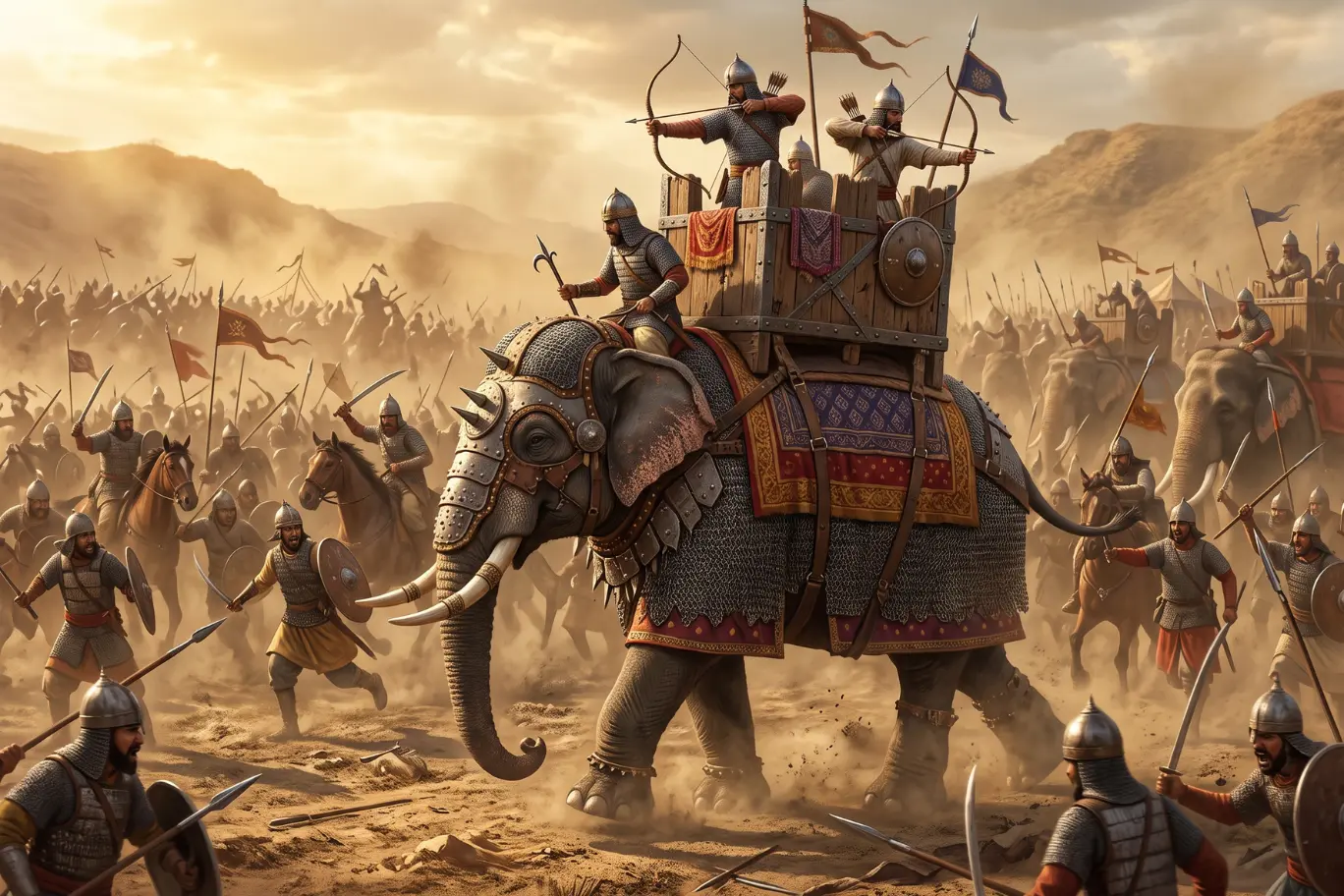
Elephants in human history are not the gentle giants documentaries make them out to be. Ancient Indian kings turned them into living tanks, capable of shattering entire infantry lines on impact. Centuries later, Hannibal marched dozens of them across the Alps, betting an entire war on their endurance. Along the way, popular culture invented details that never actually happened, including one persistent myth about a god. This article separates the documented facts from the legend, correcting a few mistakes most sources still repeat.
How Did Ancient India Turn Elephants Into Weapons of War?

Ancient India developed war elephant use gradually, not from one single starting date. The Rigveda, composed roughly 1500–1000 BCE, mentions them only for transport. However, the Mahabharata and Ramayana, composed around the 4th century BCE, describe elephants fighting in battle. Consequently, historians place the true rise of elephant warfare somewhere in that gap. By the Maurya Empire (c. 321–185 BCE), elephant corps had become fully systematized war units. Indian kings valued them so highly that one saying claimed an army without elephants was as weak as a kingdom without a king.
What Happened When Alexander the Great Faced India’s Elephant Corps?

At the Battle of Hydaspes in 326 BCE, King Porus deployed them directly against Alexander’s advancing army. Ancient sources disagree on the exact number, citing anywhere from 85 to 200 animals. They caused real chaos at first, trampling Macedonian formations and terrifying soldiers who had never faced anything like them. Alexander, however, ordered his javelin throwers to target the mahouts and the elephants’ vulnerable flanks. As a result, the wounded elephants panicked and trampled Porus’s own troops instead. Porus lost the battle, yet Alexander respected him enough to reinstate him as a regional ruler.
Why Did Chandragupta Maurya Trade 500 Elephants for an Empire?

Chandragupta Maurya used his elephant corps as leverage, not just as a battlefield weapon. In 305 BCE, Seleucus I Nicator invaded Mauryan territory and lost the resulting war. Therefore, the two rulers negotiated a treaty instead of continuing to fight. Seleucus ceded large territories, including parts of modern Afghanistan, to Chandragupta. In exchange, Chandragupta gifted Seleucus 500 trained war elephants. Those very elephants later helped Seleucus win the Battle of Ipsus in 301 BCE, reshaping the entire Hellenistic world.
Is Ganesha Really an Ancient Symbol From the Same Era?

No, and this is where a lot of popular content gets it wrong. Ganesha did not emerge as a distinct, recognizable deity until the 4th to 5th century CE, during the Gupta period. Some scholars trace loose textual precursors back to the 1st century BCE, but that still falls over a thousand years after the earliest Vedic elephant references. In other words, Ganesha is a genuinely important figure in Hinduism, but he is not an artifact of the same 1000 BCE war-elephant era. Conflating the two eras is a common mistake, and I would rather correct it than repeat it.
Why Did Hannibal March Elephants Across the Alps?

Hannibal needed a shock advantage to invade Italy from a direction Rome never expected. In 218 BCE, he led roughly 38,000 soldiers, thousands of cavalry, and 37 war elephants over the Alps. The crossing took about 15 to 16 days through snow, ice, and hostile mountain tribes. Notably, recent research using energy-expenditure modeling points to the Col de la Traversette as the likely route. The animals’ fat reserves and stable footing may have made the climb genuinely easier for them than for the men.
Did Hannibal’s Elephants Actually Die Crossing the Alps?

Mostly, no, and this myth needs busting directly. Historical evidence suggests that most of the 37 survived the mountain crossing itself with minimal losses. The real damage came afterward, during the unusually harsh winter of 218–217 BCE and the fighting that followed. Nearly all of them died from cold and combat conditions in Italy, not from the Alps themselves. Only one elephant, named Surus, survived long enough to become a lasting figure in the campaign. Therefore, the popular image of elephants tumbling off Alpine cliffs is largely Hollywood invention, not documented history.
My Experience: What Keeping Large, Slow-Growing Animals Taught Me About This History
I do not keep elephants, obviously, but I understand animals that outgrow every plan you make for them. Mike and Frida, my red-eared sliders, arrived coin-sized and are now genuinely large, food-driven animals with real personalities. Watching Frida dominate Mike over two years gave me a small, honest window into what it means to manage a powerful animal long-term. Scale that up to a multi-ton elephant, trained for war and marched over a mountain range, and the logistics become almost unimaginable. In fact, that is exactly why the Hannibal story fascinates me. It is not really about elephants dying dramatically. It is about the sheer, grinding difficulty of keeping large animals alive under extreme pressure, which is something any exotic keeper can respect on a much smaller scale.
Elephants FAQs
Hannibal brought 37 across the Alps in 218 BCE, according to ancient sources like Polybius and Livy. Most survived the actual mountain crossing. The animals died later, mostly from the harsh Italian winter and ongoing battles, not from the climb itself.
Nearly all of Hannibal’s elephants died during the winter of 218–217 BCE following the crossing. Only one elephant, Surus, survived long enough to become individually documented in later accounts. This makes the animals’ post-crossing survival rate extremely low despite surviving the Alps.
Ganesha emerged as a clearly recognizable, distinct deity during the Gupta period, roughly the 4th to 5th century CE. Some scholars trace looser textual precursors to the 1st century BCE. Either way, he postdates early Vedic-era elephant references by centuries.
Ancient Indian kings valued war elephants as mobile shock units capable of breaking enemy infantry and cavalry lines instantly. A large corps also signaled wealth and military strength to rival kingdoms. This made elephants both a battlefield weapon and a political status symbol.
Yes, this is accurate and well documented. Following the Seleucid-Mauryan War in 305 BCE, Chandragupta gifted Seleucus I Nicator 500 trained war elephants. In return, Seleucus ceded significant eastern territories to the Mauryan Empire.
Yes, ancient accounts describe genuine panic among Macedonian troops facing them for the first time at Hydaspes in 326 BCE. Alexander countered this by training his javelin throwers to target mahouts and vulnerable flanks specifically. This tactic ultimately turned the elephants against Porus’s own army.
Sources
- World History Encyclopedia
https://www.worldhistory.org/article/1241/elephants-in-ancient-indian-warfare/ - Encyclopedia Britannica (Ganesha)
https://www.britannica.com/topic/Ganesha - Warfare History Network
https://warfarehistorynetwork.com/article/battle-of-the-hydaspes-vanguard-of-elephants/ - The History Herald
https://thehistoryherald.com/articles/ancient-history-civilisation/hannibal-and-the-punic-wars/a-note-on-hannibal-s-losses-during-the-crossing-of-the-alps/ - Lumen Learning, Early World Civilizations (Seleucid-Mauryan treaty)
https://courses.lumenlearning.com/atd-herkimer-worldcivilization/chapter/expansion-of-the-maurya-empire/ - Discover Magazine (Hannibal’s Alps route study)
https://www.discovermagazine.com/hannibal-s-war-elephants-may-hold-the-key-to-a-2-000-year-old-alpine-mystery-and-why-they-outlasted-his-men-49337

Leave a Reply
You must be logged in to post a comment.