
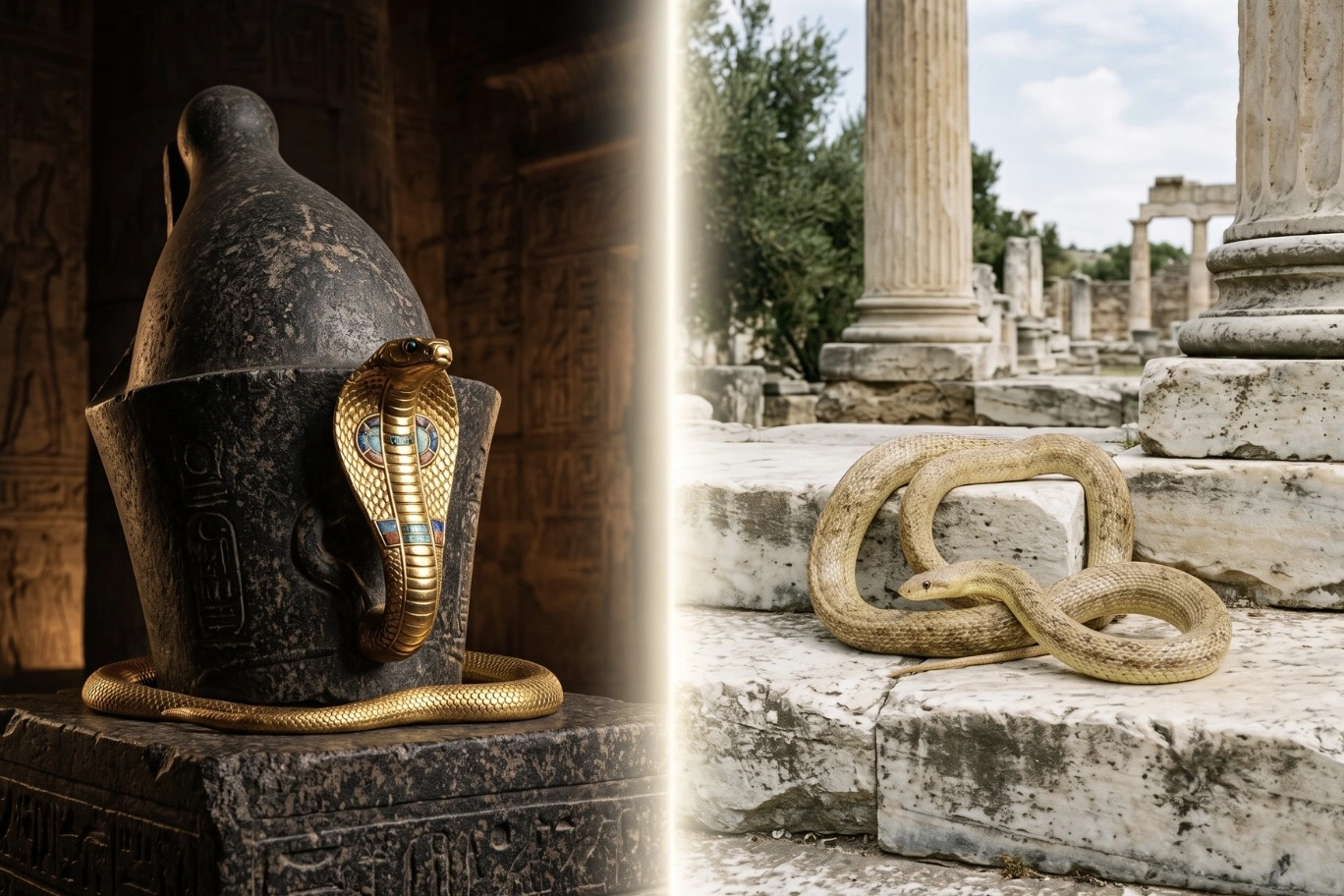
Snakes in ancient history rarely played a single role. Egyptians feared the cobra’s venom, yet they placed it directly on the pharaoh’s forehead. Greeks avoided venomous species entirely, yet they let snakes crawl freely across the floors where sick people slept. Therefore, one animal carried two completely opposite reputations at once. This article breaks down exactly how that happened, one civilization at a time.
Why Did Egyptian Pharaohs Put Cobra Snakes on Their Crown?

Pharaohs wore the cobra because it represented Wadjet, an ancient protector goddess of Lower Egypt. The rearing cobra, known as the uraeus, sat on the royal brow as a warning to enemies. In fact, Egyptians believed the uraeus could spit fire at threats facing the king. Consequently, the symbol functioned as both a religious statement and an active line of defense.
What Was the Uraeus Snakes, and Why a Cobra Specifically?

The uraeus depicted an Egyptian cobra raised upright with its hood flared open. Notably, this posture is a real defensive display cobras still perform today. Egyptians chose it precisely because live cobras look genuinely threatening in this stance. As a result, the image needed no exaggeration to communicate danger to anyone who saw it.
Did Ancient Egyptians Actually Worship Snakes?
Egyptians did not worship every snake equally, and the distinction mattered. Wadjet’s cobra protected the pharaoh and represented order. However, a separate serpent named Apophis represented chaos and attacked the sun god in Egyptian mythology. Specifically, priests performed rituals to symbolically destroy Apophis and preserve cosmic balance. Therefore, ancient Egypt reserved reverence for one snake and hostility for another, based entirely on symbolic role rather than species.
Why Did Ancient Greeks Turn to Snakes for Healing?

Greeks associated snakes with renewal because a snake sheds its skin and emerges looking new. This visual cue linked the animal directly to recovery and rebirth. Asclepius, the Greek god of medicine, carried a staff with a single snake wound around it. Consequently, that image became permanently tied to the healing arts across the ancient world.
What Really Happened Inside the Temples of Asclepius?

Healing temples called Asclepeia let non-venomous snakes move freely through patient sleeping areas. Priests specifically used a calm, yellow species now known as the Aesculapian snake, Zamenis longissimus. Specifically, patients slept in a chamber called the abaton. There, they hoped for a dream-based cure or a direct visit from the god. In fact, new Asclepeia typically imported a live snake from an established temple during their founding ceremony. Priests treated the animal’s arrival as the god himself taking up residence in the building. Major sanctuaries stood at Epidaurus, Kos, Pergamon, Trikala, and Gortys, and pilgrims travelled real distances to reach them. This detail suggests the snake itself, not just its image, mattered to the ritual. The priests were not simply decorating a temple wall with a nice symbol. Consequently, they were curating one specific, low-risk species and trusting it near sick, sleeping strangers.
Why Does A Single Snake Still Represent Medicine Today?

Modern medicine uses the Rod of Asclepius, a staff with one snake and no wings. However, many organizations mistakenly use the caduceus instead, a two-snake staff belonging to Hermes. The U.S. Army Medical Corps adopted the caduceus in 1902, and the mix-up has persisted ever since. As a result, two distinct Greek symbols now compete for the same modern meaning. Only one of them, in fact, was ever actually about healing.
How Did the Ancient Split Between Reverence and Fear Survive to Today?

Ancient Egypt and Greece never expected the whole population to handle snakes. Access stayed narrow on purpose. A pharaoh wore the cobra. A priest managed the temple snake. Everyone else kept a respectful, unbothered distance, and that arrangement was not considered strange. Modern research suggests the same split still runs through us today. Estimates of snake fear vary widely by study. Clinical phobia rates sit around 3 percent, yet nearly a third of adults report real, intense unease. Meanwhile, specific phobias in general affect about one in ten adults in the United States, according to the Cleveland Clinic. Therefore, the numbers disagree on the exact size of the fearful majority, but every study agrees a majority exists. What has genuinely changed is who gets close. Access shifted from a royal or priestly role to a personal choice. Anyone willing to learn the animal properly can now claim it.
Are Reptile Keepers the Modern Descendants of the Asclepius Priests?

In a real sense, yes, and the parallel runs deeper than it first appears. Asclepius’s priests did not grab just any snake off the street for their temple floor. They deliberately chose one calm, well-understood, non-venomous species and left the dangerous ones alone. Modern herpetoculture runs on the same exact logic, just with better documentation. The Reverend Gregory Bateman published The Vivarium in 1897, one of the first English-language guides to keeping reptiles properly. The hobby then exploded from the 1970s onward. Care sheets, reptile expos, and captive-breeding programs replaced guesswork with real husbandry knowledge. Consequently, today’s keepers select species for temperament and manageability. That same deliberate care once guided a temple priest choosing his one trusted snake. The setting changed from a marble sanctuary to a glass enclosure in a spare room. However, the underlying decision, choosing informed closeness over blind avoidance, has not changed at all.
My Experience: Standing With the Minority Who Lean In

My mother loved animals. She was never scared to pick up a snake. Still, I did not inherit a pet snake from her. Instead, I inherited the instinct behind that curiosity, and it eventually pulled me toward Mike, Frida my RES turtles, and Cosmo my African chameleon. Writing this article clarified something I had already learned the slow way with my own reptiles. Trust from an animal that cannot fake affection means more than trust from one that can. Frida, my red-eared slider, took two full years to swim toward my hand instead of away from it. She never rushed that process to make me feel better about myself. She never faked calm she did not actually feel.
Cosmo works the exact same way. He only climbs toward the feeding tweezers when he is genuinely comfortable, never a moment before. So, I understand precisely why ancient priests let a snake move freely through a room full of frightened, sleeping people. A creature that cannot pretend is, oddly enough, one of the least threatening things near someone vulnerable. I have not added a snake to my own collection yet. However, tracing this history, I recognize a familiar pull in myself. It is the same pull that once put a cobra on a crown. It is respect, not recklessness, and it is exactly what keeps a keeper coming back.
Why This FAQ Block Qualifies
Pharaohs wore a rearing cobra called the uraeus to represent Wadjet, a protector goddess. The image signaled royal authority and threatened divine punishment against enemies. Egyptians believed the cobra could spit fire at threats facing the throne. This made the uraeus both a religious symbol and a warning.
Egyptians did both, depending on which snake was involved. Wadjet’s cobra represented protection and earned genuine reverence on royal crowns. Apophis, a separate mythological serpent, represented chaos and required nightly ritual defeat. Species mattered less than symbolic role in shaping the reaction.
Priests used a calm, non-venomous species now called the Aesculapian snake, Zamenis longissimus. This snake moved freely through patient sleeping chambers during healing rituals. Its mild temperament made it safe to have around vulnerable, sick visitors. The species still exists across parts of Europe today.
Yes, patients slept in a chamber called the abaton inside Asclepius’s temples. Priests hoped patients would dream of the god or receive a symbolic cure. Non-venomous snakes moved through this space as part of the healing ritual. Ancient sources describe this practice consistently across multiple temple sites.
The Rod of Asclepius shows one snake wound around a plain staff, with no wings. The caduceus shows two snakes and a pair of wings, and belongs to Hermes. Only the Rod of Asclepius has any real historical link to medicine. The caduceus became associated with healthcare through a documented 1902 U.S. Army error.
A snake can kill with venom and still appear to renew itself by shedding its skin. Ancient cultures noticed both traits and built entirely different symbols around each one. Egypt leaned into the threat with the protective uraeus cobra. Greece leaned into the renewal with the healing Rod of Asclepius.
Sources
- The Metropolitan Museum of Art
https://www.metmuseum.org/art/collection/search/546039 - Michael C. Carlos Museum, Emory University
https://carlos.emory.edu/slithering-through-egypt - Postgraduate Medical Journal, Oxford Academic
https://academic.oup.com/pmj/article/100/1186/613/7301419 - Snakebite Foundation
https://www.snakebitefoundation.org/blog/asclepius-and-snakes-symbols-of-medicine-and-healing
Leave a Reply
You must be logged in to post a comment.