
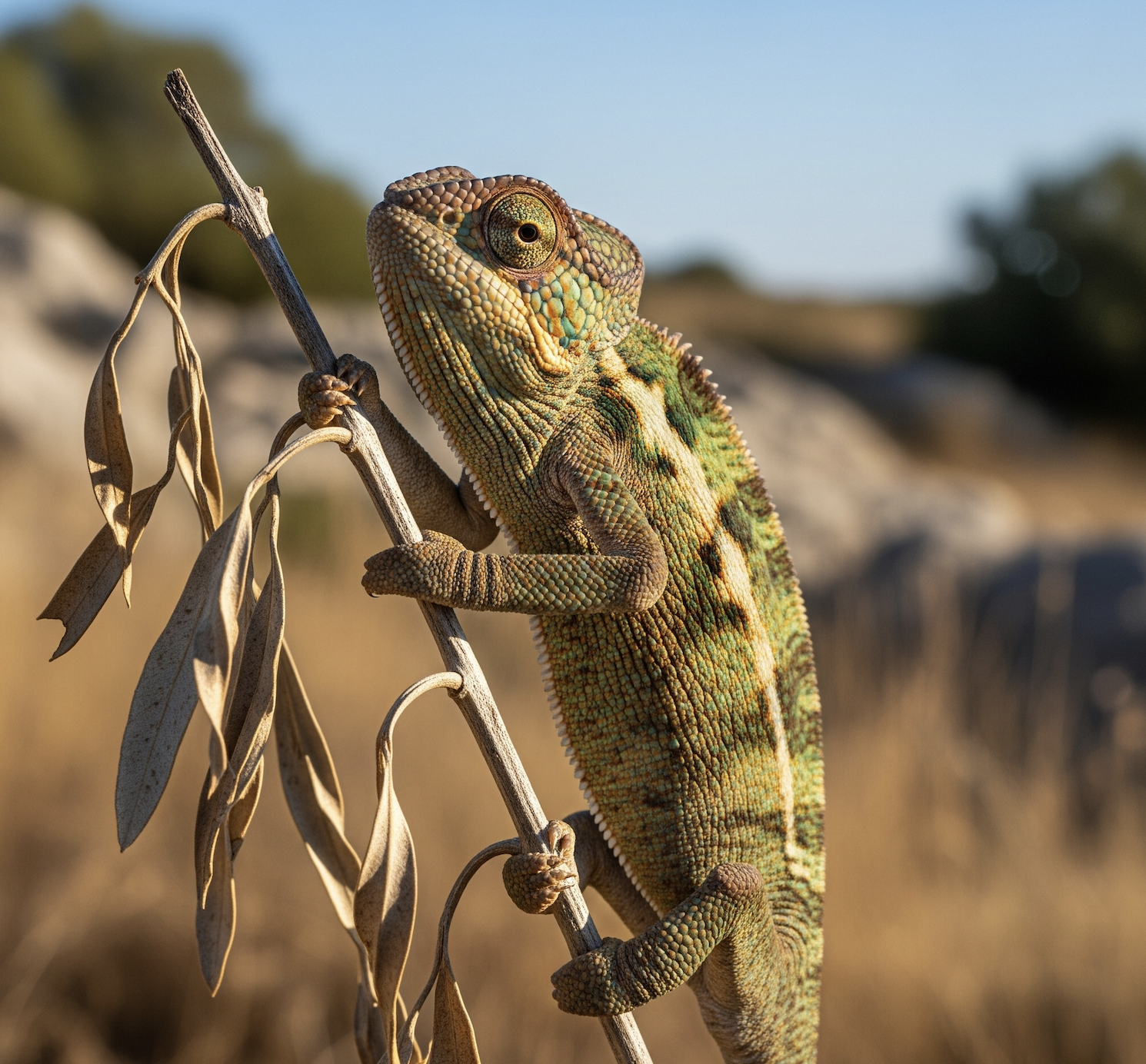
Chameleons, which belong to the family Chamaeleonidae, are a group of World lizards known for their unique adaptations and vibrant colors. With over 200 species, these reptiles show a remarkable range of characteristics, making them fascinating subjects for herpetologists and reptile enthusiasts alike.
Why have a chameleon as a pet?
Well.. Forget fetch! You get a living mood ring that changes colors, though mostly they’re just judging you. They’re like tiny, leafy dragons with a built-in fly swatter tongue. Plus, they come with their own climbing gym, just add plants! A chameleon is your high-weirdness friend. Just don’t expect them to play hide and seek, they’re already experts. But, They are not for beginners, previous reptile keeping experience is recommended.
Types of Chameleons
The chameleon family is incredibly diverse, with numerous species found across Africa, Madagascar, Asia, and even parts of Europe. Some well-known types include:
Panther Chameleon (Furcifer pardalis): Native to Madagascar, known for its vibrant colors and large size.

Veiled Chameleon (Chamaeleo calyptratus): Found in Yemen and Saudi Arabia, easily identified by the casque on its head.

Jackson’s Chameleon (Trioceros jacksonii): Native to East Africa, notable for its three horns.

Common Chameleon (Chamaeleo chamaeleon): Also known as the European chameleon, found in parts of Southern Europe and North Africa.

African Chameleon: This is a broad term that encompasses many species found in Africa.

How to tell if it is happy or stressed?
Chameleons are generally solitary creatures and do not like much handling. They can become stressed quite easily, which makes them unsuitable pets for beginners.
What’s on the Menu: Diet
Most chameleons are primarily insectivores, meaning their diet consists mainly of various insects. Specifically, they feast on items like crickets, locusts, mealworms, waxworms, flies, and cockroaches. Furthermore, some larger species might even consume small birds or other lizards. It’s also worth noting that a few species, such as the Veiled chameleon, will include vegetation in their diet. Consequently, providing a varied diet is crucial, and supplementing their food with calcium and vitamins is essential for their health.
Basic Needs: What do I need to know before getting a chameleon?
Providing proper care for chameleons demands attention to their specific requirements. First, a tall, well-ventilated enclosure is essential, with screen cages often preferred for good airflow. Second, UVB and UVA lighting are absolutely crucial for their health, helping them produce vitamin D3 and maintain proper body temperature. Third, temperature and humidity needs vary by species, but generally, they require a basking spot and a gradient within their habitat, with humidity levels carefully monitored. Inside their home, they need plenty of branches, vines, and live plants for climbing and hiding. Finally, for hydration, they typically drink water droplets from leaves, so a misting system or drip system is a must.
A Glimpse into History
Chameleons boast a long evolutionary history. The oldest known fossil, Anqingosaurus brevicephalus, was found in China and dates back to the Middle Paleocene, roughly 58.7–61.7 million years ago. However, it’s believed their lineage is much older, possibly sharing a common ancestor with iguanids and agamids over 100 million years ago. Anqingosaurus is cited as one of the earliest “chameleon-like” fossils. However, some paleontologists debate if it is a true member of Chamaeleonidae or a stem-group lizard. The timeline of 60–100 million years for the lineage’s origin aligns with modern DNA “molecular clock” studies that place their divergence from other iguanids near the Cretaceous-Paleogene boundary. DNA analysis suggests that chameleons likely originated in Africa before spreading to Madagascar. Subsequently, over millions of years, they diversified significantly, adapting to various habitats and evolving the unique traits we see today.
Author’s Note
People always ask me if my grumpy African Chameleon, Cosmo, changes color to match my furniture. The honest answer is that he couldn’t care less about my decor. Instead, Cosmo changes color to match his opinions, and he has a lot of them. His “you have interrupted my very important basking time” color is a dull, unimpressed green. His “I am deeply offended by that worm you just offered me” is a slightly darker, more judgmental green and showing more patterns. But then there’s the magic.
The brilliant, vibrant green that erupts across his skin the moment he sees his favorite snack. Or, the calm, content teal he wears when he’s perched on my head, pretending he doesn’t actually enjoy the attention. Living with Cosmo has taught me that the real magic of a chameleon isn’t the myth of disguise; rather, it’s learning to have a silent, colorful conversation. You just have to pay attention to what they’re saying.
Sources
- Nature
https://www.nature.com/articles/ncomms3477 - Scientific American
https://www.scientificamerican.com/article/how-a-chameleons-tongue-really-works/ - Chameleon Academy
https://chameleonacademy.com/veiled-chameleon-care-sheet/ - Journal of Herpetological Medicine and Surgery
https://herpmed.org/doi/abs/10.5811/westjem.2011.5.2273 - National Geographic
https://www.nationalgeographic.com/animals/article/chameleons-color-change-nanocrystals


Leave a Reply