
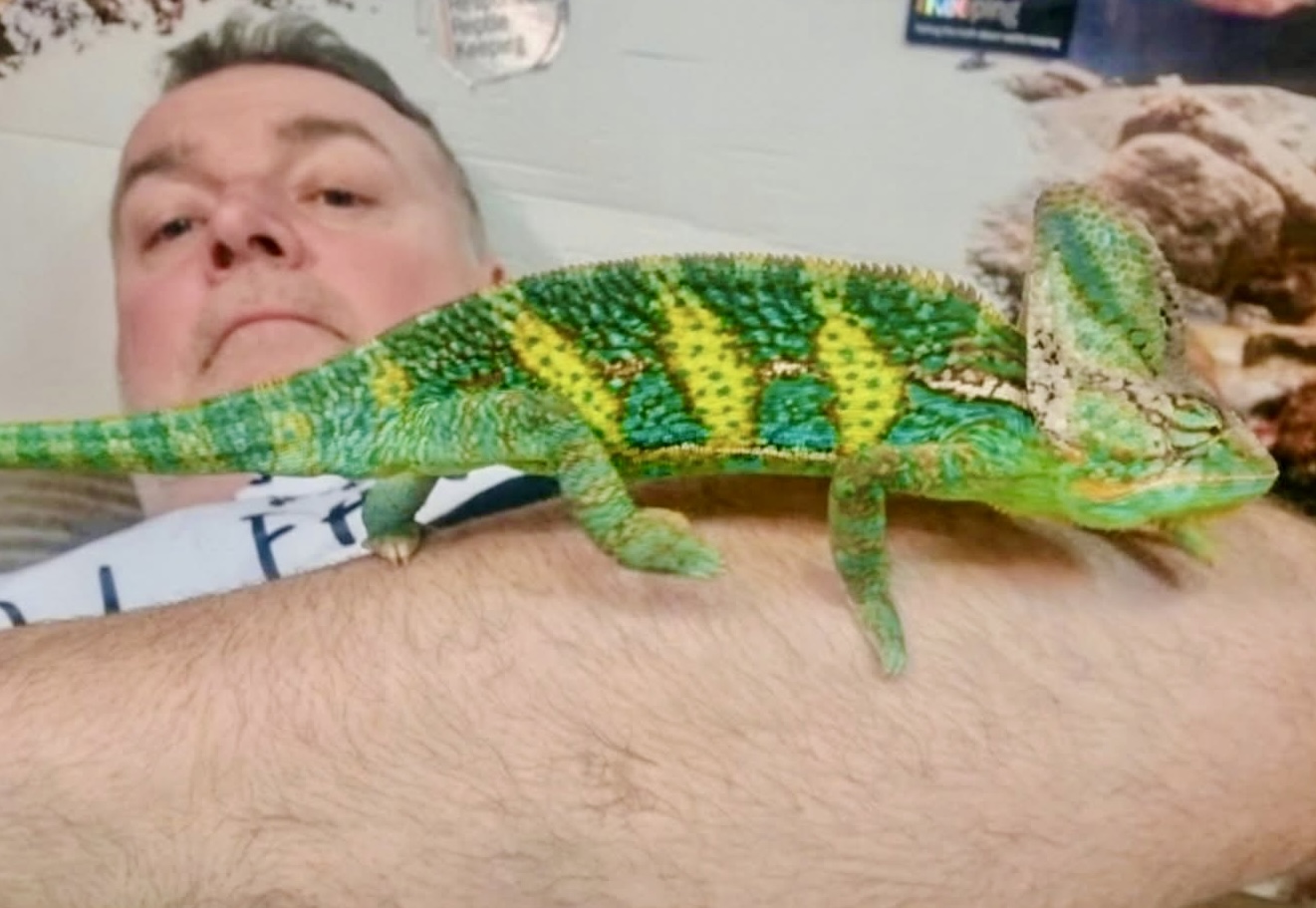
People often tell me that Veiled Chameleons are the “hardy” or “easy” chameleon. This always makes me laugh. To me, that’s like saying a rattlesnake is the “cuddly” kind of venomous snake.
My African Chameleon, Cosmo, has a respectable little bump on his head and a Ph.D. in the art of the judgmental side-eye. His care is a delicate, daily dance of precise hydration and temperature. The Veiled Chameleon has what can only be described as a full bicycle helmet on its head and a reputation for being slightly more forgiving of mistakes. But “more forgiving” for a chameleon still means it’s a creature that can get sick if you look at it the wrong way. They are a different flavor of glorious, high-maintenance chaos, and this guide is for anyone ready to serve at the pleasure of His Royal Highness.
With a magnificent, towering casque on its head like a royal crown and a personality that is equal parts grumpy and glorious, the Veiled Chameleon (Chamaeleo calyptratus) is one of the most impressive and popular chameleons in the pet trade. They are a true display animal, a living piece of prehistoric art. But their regal appearance comes with a kingdom’s worth of specific care requirements that are absolutely non-negotiable. This guide will be your complete introduction to the care of this demanding and rewarding reptile.
Are Veiled Chameleons Suitable for Beginner Keepers?
Why are these reptiles often incorrectly labeled as easy pets for first-time owners?
No, the Veiled Chameleon is not a suitable pet for beginners. Specifically, they are intermediate-level reptiles that require precise environmental control. While they are hardier than some Malagasy species, they remain extremely sensitive to chronic stress. Furthermore, their specific needs for high ventilation and humidity balance often lead to failure for inexperienced keepers. Consequently, a lack of preparation frequently results in heartbreaking health declines. Therefore, only those dedicated to serving “His Royal Highness” with rigorous data-led care should consider ownership.
What is the Ideal Habitat for a Veiled Chameleon?
What specific dimensions and enclosure types are required to support a healthy adult?
For adult males, the minimum standard is a vertical enclosure measuring 60x60x120 cm. Vertical space is critical because these lizards are strictly arboreal and feel safest at height. Furthermore, females can inhabit a slightly smaller space of 45x45x90 cm. While the article demands full screen, hybrid enclosures often perform better for maintaining humidity. Specifically, glass or PVC back walls can prevent the air from becoming too dry. Consequently, stagnant air must be avoided to prevent fatal respiratory infections.
What are the Necessary Lighting and Temperature Gradients?
How does a keeper replicate the Arabian sun and climate within a captive environment?
A Veiled Chameleon requires a basking spot reaching 29°C to 35°C near the top of the cage. Furthermore, an ambient temperature gradient should drop to approximately 21°C at the bottom. Specifically, a linear T5 HO 5.0 or 6% UVB bulb is a non-negotiable requirement for calcium metabolism. Without this specific light, the lizard will develop Metabolic Bone Disease (MBD). Consequently, the bulb must be replaced every six to twelve months to ensure adequate output. Therefore, lighting is the most critical investment for their long-term survival.
What Should Form the Core of Their Diet?
How does the omnivorous nature of this species influence their nutritional requirements?
These chameleons are primarily insectivores but uniquely consume some vegetation. Specifically, a varied diet should include gut-loaded dubia roaches, crickets, and silkworms. Furthermore, adults benefit from occasional offerings of dandelion greens or soft fruits. Juveniles must eat daily to support their rapid growth phases. However, adults only require feeding every other day with approximately five to seven large insects. Consequently, providing a diverse prey selection prevents nutritional deficiencies and maintains interest in food.

How Do You Monitor Their Health and Biology?
What are the primary signs of illness and the anatomical differences between the sexes?
Health monitoring requires observing color changes and physical posture. Specifically, dark or mottled colors often indicate extreme stress or thermoregulation issues. Furthermore, keepers can distinguish males by the large cranial casque and the tarsal spurs on their rear feet. Females have smaller casques and lack these spurs entirely. Therefore, female care must include a “lay bin” for egg production to prevent fatal egg-binding. Consequently, understanding these biological markers is essential for any researcher or hobbyist.
Veiled Chameleons Care FAQ
No. While they are sometimes labeled as “hardy,” they are actually intermediate-level reptiles that require precise environmental control. Their sensitivity to stress and specific needs for high ventilation and humidity often lead to health failures if the owner is inexperienced or unprepared.
Adult males require a minimum vertical enclosure of 60x60x120 cm. Females require at least 45x45x90 cm. Vertical space is essential as these lizards are arboreal and feel most secure at height. Stagnant air must be avoided, so full-screen or hybrid enclosures are recommended to ensure proper ventilation and prevent respiratory infections.
You must provide a basking spot between 29°C and 35°C, with a downward gradient to 21°C at the bottom. A linear T5 HO 5.0 or 6% UVB bulb is non-negotiable for calcium metabolism and must be replaced every 6–12 months to prevent Metabolic Bone Disease (MBD).
They are primarily insectivores that also consume some vegetation. Provide a varied diet of gut-loaded insects like dubia roaches, crickets, and silkworms. Adults can also be offered dandelion greens or soft fruits. Juveniles need daily feedings, while adults should be fed every other day with 5–7 large insects to prevent nutritional deficiencies.
Males are identifiable by a large, prominent cranial casque (the “crown” on their head) and tarsal spurs on their rear feet. Females have smaller casques and lack these spurs. Female care is uniquely demanding, as they require a “lay bin” for egg production to avoid life-threatening egg-binding.
Sources
- Smithsonian’s National Zoo
https://nationalzoo.si.edu/animals/veiled-chameleon - Animal Diversity Web
https://animaldiversity.org/accounts/Chamaeleo_calyptratus/ - Reptiles Magazine
https://reptilesmagazine.com/veiled-chameleon-care-sheet/ - Wikipedia
https://en.wikipedia.org/wiki/Veiled_chameleon - Chameleon Academy
https://chameleonacademy.com/veiled-chameleon-care - The Bio Dude
https://www.thebiodude.com/blogs/chameleon-caresheets/veiled-chameleon-caresheet - PetSmart Learning Center
https://www.petsmart.com/learning-center/reptile-care/veiled-chameleon-care-guide


Leave a Reply