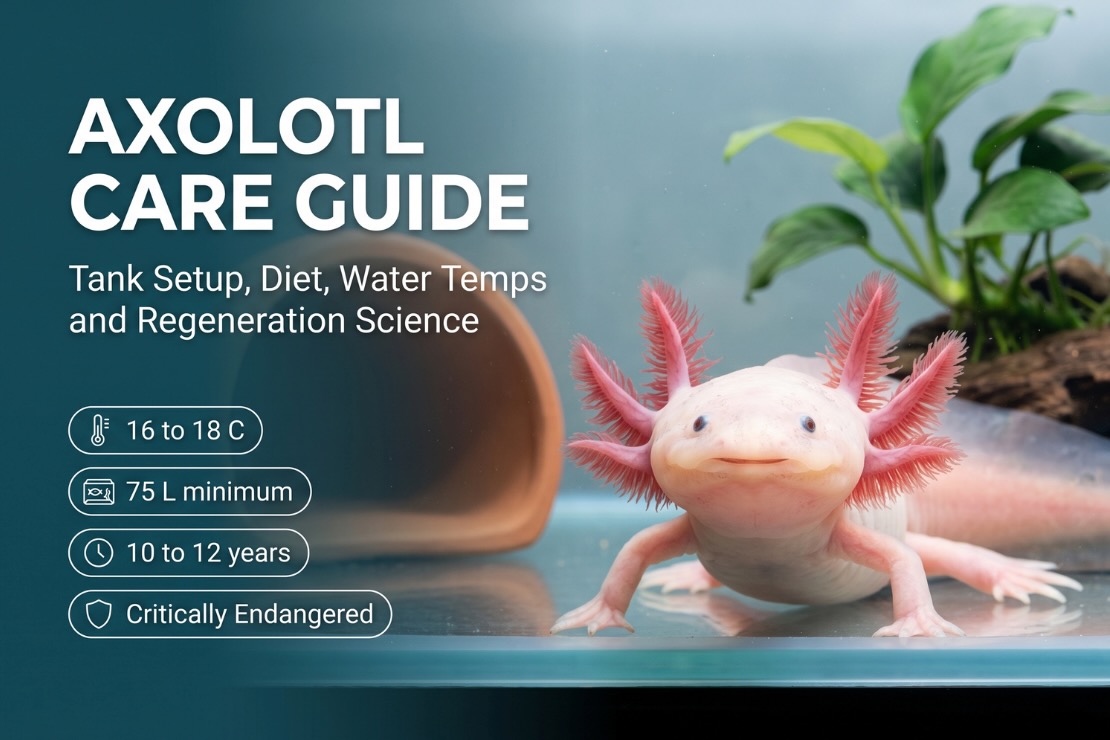
The Axolotl is one of the most alien creatures in the pet world. Specifically, it possesses feathery external gills and a serene smile. It also has the remarkable ability to regenerate lost limbs. Therefore, many people find them incredibly endearing. It is the Peter Pan of the salamander family. In fact, it is a perennial juvenile that never truly grows up. However, this charming exterior hides a delicate animal. They have very specific and non-negotiable needs. Consequently, this guide answers all your questions about their care.
Is it Legal to Own an Axolotl?
It depends on where you live, because rules differ between countries and between US states. Specifically, the species is listed as critically endangered, with an estimated 50 to 1,000 adults left in the wild. It is also listed under CITES Appendix II. Consequently, regulators watch the pet trade closely.

Trackers commonly list California, Maine, New Jersey, and Washington D.C. as places where ownership is illegal, with permits needed in New Mexico and Hawaii. However, these lists disagree with each other. Therefore, confirm the details with your state wildlife agency.
Some rules have changed recently. Virginia made axolotl possession legal on 1 August 2021, and it requires no permit. Arkansas moved the other way. It added axolotls to its prohibited species list on 16 May 2024 and opened a registration window for earlier owners. As a result, an older blog list can be wrong in either direction.
Owners outside the US should check national wildlife and import rules, since I found no single global standard. Finally, never release a pet axolotl. Escaped animals put native amphibians at risk.
The Proper Tank Setup for an Axolotl
What size tank is appropriate for an adult?

An adult needs at least 75 liters (20 US gallons). A long tank beats a tall one. In fact, most adults reach about 23 to 25 cm in length. The Royal Veterinary College advises planning for an adult size of up to 35 cm. Consequently, the tank must give enough room to walk and turn.
Floor space matters more than height, because axolotls are bottom-dwellers. Volume also affects temperature. A large body of water changes temperature slowly, so it rides out a warm afternoon better. In other words, a bigger tank buys you a margin for error.
Sources disagree on how much extra space a second animal needs. Furthermore, the RVC notes that axolotls are best housed alone. Therefore, treat 75 liters as the floor for one animal, not as a goal.
What kind of filter is best?

A gentle sponge filter is the safest choice. Strong water flow is a severe cause of stress in axolotls. Specifically, they come from calm lakes, so turbulence works against them. The RVC also warns that over-filtration causes stress. Consequently, aim for biological capacity without a strong current.
If you use a hang-on-back or canister filter, baffle the outlet. A sponge over the outflow, a spray bar, or a ceramic wall all soften the current. Watch the gills afterwards. Curled gills can signal poor water quality, high temperature, or a harsh flow.
Cycle the tank before the animal arrives. Axolotls produce high levels of ammonia, so a mature biofilter matters. Patience here is cheaper than a vet bill.
Is gravel safe for axolotls?

No, gravel is not safe. Axolotls can swallow it. The RVC states that axolotls can occasionally eat gravel, and this can cause a fatal obstruction. Moreover, they feed by suction. A rapid mouth opening draws in water and prey together. Consequently, anything near the food can go in with it.
Keeper guidance often sets the risk line by size. Gravel larger than 3 mm and smaller than the animal’s head is commonly flagged as swallowable. The safest option is a bare-bottom tank.
Sand is debated. Some keepers use fine sand for larger animals. However, VCA advises avoiding small rocks or sand and using a substrate the axolotl cannot consume. Therefore, a bare bottom is the lowest-risk choice.
Hand feeding with tongs helps. Keepers report that it significantly reduces the gravel an axolotl ingests. Also, a long absence of droppings despite regular feeding can suggest impaction. In that case, contact an exotics vet.
What decorations are safe?

Choose smooth, rounded decor with no sharp edges. Sharp surfaces can scratch delicate skin. Furthermore, every item should be larger than the axolotl’s head. Small objects can be swallowed in the same way as gravel.
Hides are essential for comfort. Terracotta pots, ceramic caves, and smooth PVC pipe sections all work. Check each hide for an opening large enough to exit easily. Rinse new items in plain water, because soap residue has no place in this tank.
Hardy plants such as Anubias are popular additions, as your original text notes. Tie them to wood or rock instead of burying them. Dim lighting also helps. A shady, dark corner of the room helps the water stay cool. In fact, a quiet corner suits an animal that does not enjoy parties.
Ideal Water Parameters and Temperature

This is the most critical aspect of their care. Specifically, axolotls require cold water. Their ideal temperature range is 60 to 68 degrees Fahrenheit. Temperatures above 72 degrees cause stress and fungal infections. Eventually, high heat leads to death. Consequently, most climates require an aquarium chiller.
What water conditioner should I use?

Use a conditioner that removes chlorine and chloramine. Read the label, because some suppliers use chloramine. Most freshwater conditioners remove chlorine, but not all break the chloramine bond. Consequently, standing water alone may not be enough. Your water supplier can tell you what it uses.
Now the aloe question. Some conditioners contain aloe vera. Experienced caudate keepers advise against assuming that a product safe for fish is safe for caudates. However, I found no authoritative source stating that aloe is toxic to amphibians. Therefore, treat avoidance as a sensible precaution, not as a proven rule.
Amphibian-specific conditioners also exist. One manufacturer states its product removes chlorine and chloramine and detoxifies ammonia. Treat new water before it enters the tank. Match its temperature to the tank, too.
A Good Staple Diet for an Axolotl

Earthworms and quality sinking pellets should form the base. The RVC lists earthworms, bloodworms, blackworms, salmon pellets, and brine shrimp for adults. It cautions that some of these items are fatty, so none should become the permanent diet. Therefore, rotate foods.
Avoid wild-caught insects. They may carry pesticides or parasites. Moreover, portion control matters. Offer only what the animal can eat entirely in two to five minutes. Remove leftovers promptly to protect water quality.
How often should you feed them?
Juveniles eat daily, while adults do well with a meal every two to three days, as your original text states. However, adjust to body condition. Feeding too much or too often leads to obesity, which shortens lifespan
Can Axolotls Live With Other Fish?
Generally, no. The RVC states that axolotls are best housed alone and that sharing a tank carries risk. Consequently, a species-only tank remains the safest plan.

Temperature is the first mismatch. Many fish species need water that is too warm for an axolotl to survive comfortably. Furthermore, size creates a second problem. Small fish may be eaten, while larger fish may nip the gills. Fish can also carry parasites.
Axolotls can be rough with each other. Juveniles are known for cannibalism. Young animals can share space only when it is ample, and even then cannibalism is reduced, not removed. Adults of similar size may coexist, but injuries still occur. They regrow bitten limbs. Nevertheless, regeneration does not spare them the stress.
Identifying Stress and Superpowers
What if the gills curl forward?
Forward-curling gills are a clear sign of stress. Water that is too warm is a very common hidden cause, along with floating and loss of appetite. Poor water quality and strong flow also trigger it. Therefore, check temperature, test the water, and soften the current.
Other warning signs include food refusal, lethargy, and pale patches of mucus-like material on the skin. In addition, contact a vet if the animal floats uncontrollably or stops eating. Prompt veterinary attention is advised in those cases.

What is the axolotl’s secret superpower?
Regeneration is the headline act. Axolotls regrow limbs, gills, tails, and parts of the eye and brain. However, the ability declines with age, but it does not disappear. After limb amputation, the missing part regrows without scar formation between the stump and the new structure.
The process is distinctive. Immune cells clean the injury, and instead of scabbing, a cone-shaped cluster of regenerative cells called a blastema forms. Humans, regrettably, prefer scabs.
What has recent research found?
Several 2026 studies move the field forward.
- SP8 gene. A PNAS study compared axolotls, zebrafish, and mice and pointed to SP genes as central to regeneration. Moreover, axolotls lacking SP8, edited with CRISPR, could not properly regenerate limb bones.
- Signaling. An eLife study reports that dorsal and ventral cells use Wnt and FGF2 signals to activate Shh, which drives complete limb patterning.
- Cell behavior. Northeastern researchers are building models of blastema formation to understand the rules cells follow. That work is a preprint.
- Retinoic acid. A 2025 study identified retinoic acid as a key signal telling the animal which limb type to regrow.
Caution is still warranted. No human limb-regrowth therapy exists. Researchers describe near-term payoffs as better wound healing, scar reduction, and tissue repair.
Why Don’t Axolotls Metamorphose?

Axolotls show neoteny, meaning they reach sexual maturity while keeping larval features. The cause is a lack of thyroid-stimulating hormone, which normally signals the thyroid to produce thyroxine. Consequently, they keep their gills and stay aquatic for life.
Metamorphosis is possible, but it is unnatural. Injections of iodine or thyroxine can induce it. The RVC also notes that axolotls can spontaneously metamorphose in rare cases.
The lifespan effect needs honest framing. Reference works state that artificial metamorphosis dramatically shortens lifespan. However, some keepers dispute this, and I found no strong controlled data. Even so, the process is stressful. Therefore, never attempt it deliberately.
What is the lifespan of an axolotl?

Expect a decade or more. The RVC says axolotls commonly live 10 to 12 years in captivity, and some have lived past 20. Meanwhile, VCA cites up to 10 to 15 years. In fact, that outlasts many family pets.
Husbandry decides where an individual lands in that range. Temperature control, clean water, and a safe substrate matter most. Additionally, obesity shortens lifespan. Therefore, portion control is a longevity tool, not just a hygiene rule.
There is an irony here. The species thrives in captivity while its wild population declines. Consequently, responsible keeping and conservation awareness belong together.
Axolotl Care FAQ
Axolotls are cold-water amphibians that require temperatures between 16–18°C (61–64°F). Maintaining this range is critical, as temperatures exceeding 22°C (72°F) cause severe heat stress, secondary infections, and potential death. In warmer climates, an aquarium chiller is often necessary to keep the environment stable and safe.
Fine aquarium sand or a bare-bottom tank are the only safe substrate options. Axolotls use a vacuum-like suction to eat, often accidentally ingesting gravel or small pebbles. These items cannot be digested and frequently cause fatal intestinal impactions, making any substrate smaller than the animal’s head a major hazard.
No, Axolotls require very gentle water flow because they are adapted to stagnant or slow-moving lake environments.Strong currents cause chronic stress, leading to curled gills and a refusal to eat. Use spray bars or sponge filters to diffuse the output and maintain the calm water they need.
Axolotls should be kept in a species-only tank without fish or other aquatic roommates. Fish often nibble on the axolotl’s delicate, feathery external gills, causing injury and stress. Conversely, the axolotl will eventually attempt to eat any fish small enough to fit in its mouth, regardless of species.
Curled gills or a “hooked” tail tip are primary physical indicators of high stress. This is usually caused by poor water quality, high temperatures, or excessive water flow from the filter. If these signs appear, immediate testing of ammonia levels and a review of the tank’s current temperature are mandatory.
Sources
- Virginia Department of Wildlife Resources
- https://dwr.virginia.gov/wildlife/mexican-axolotls-in-virginia/
- Arkansas Game and Fish Commission
- https://www.agfc.com/?p=17830
- Royal Veterinary College, Axolotl Care (2024)
- https://rvc.ac.uk/Media/Default/Beaumont%20Sainsbury%20Animal%20Hospital/EXOTICS/Animal%20Care%20Factsheets/Axolotl%20care%20sheet%202024%20jh.pdf
- VCA Animal Hospitals
- https://vcahospitals.com/know-your-pet/axolotls-as-pets
- Wake Forest University News
- https://news.wfu.edu/2026/07/28/these-salamanders-may-hold-the-key-to-human-tissue-and-limb-regeneration/
- ScienceDaily (SP8 study)
- https://www.sciencedaily.com/releases/2026/05/260508003121.htm
- eLife
- https://elifesciences.org/articles/110316
- Northeastern University News
- https://news.northeastern.edu/2026/07/27/axolotl-regeneration-anti-aging/
- MDI Biological Laboratory
- https://mdibl.org/building-a-regeneration-factory-new-discoveries-in-limb-regrowth/
- Smithsonian Magazine
- https://www.smithsonianmag.com/smart-news/axolotls-may-hold-the-key-to-regrowing-limbs-and-scientists-are-unraveling-their-secrets-to-help-humans-do-the-same-180986781/
- Wikipedia, Axolotl
- https://www.wikipedia.org/wiki/Axolotl
- Caudata Culture forum (conditioner thread)
- https://caudata.org/threads/are-these-products-safe.35784
Leave a Reply
You must be logged in to post a comment.