
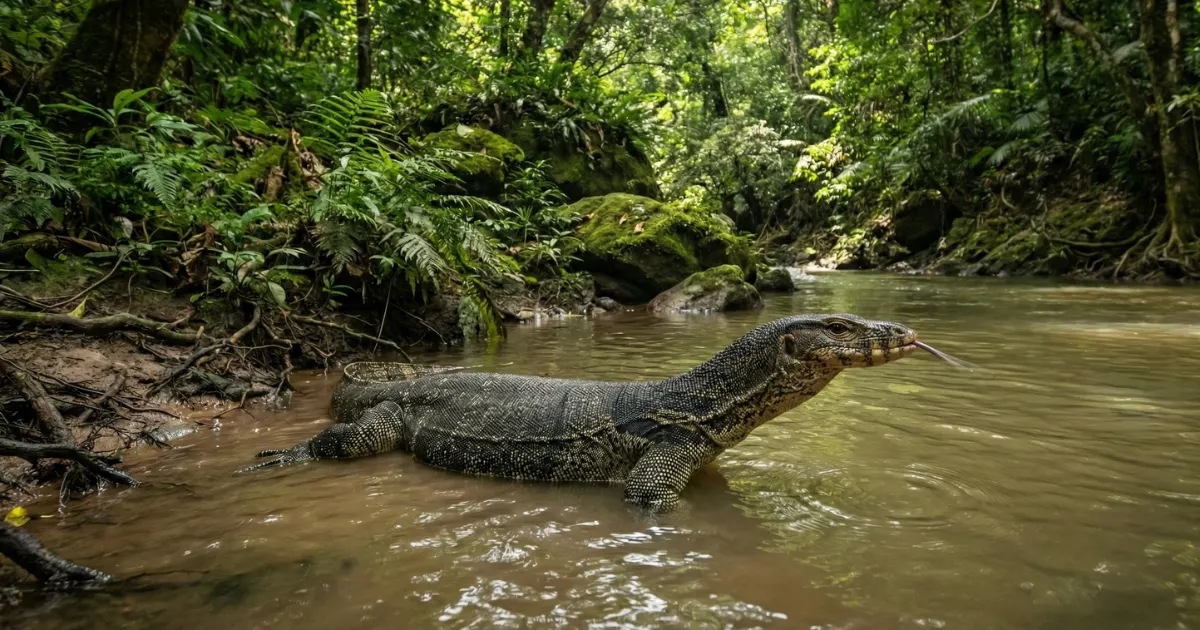
There’s a level of intelligence in some reptiles that forces you to redefine your relationship with The Asian Water Monitor. It moves beyond simple husbandry into a daily cognitive engagement. A Water Monitor is not just having a pet, but to become the full-time enrichment coordinator, habitat engineer, and respectful colleague of a brilliant, ancient mind.
The Asian Water Monitor (Varanus salvator) is one of the largest and most intelligent lizards on Earth. Keeping one is a monumental commitment, a challenge that pushes the boundaries of private reptile husbandry and rewards the dedicated keeper with a relationship unlike any other.
Is the Asian Water Monitor a suitable candidate for a beginning keeper?
The Asian Water Monitor is an expert-only species that demands a level of commitment equivalent to owning a large mammal. Specifically, their massive adult size and high intelligence make them incredibly destructive if they become bored or under stimulated. Furthermore, the logistical challenge of maintaining a room sized, semi aquatic habitat is far beyond the capabilities of a novice. Consequently, I reject the assumption that these are “tame” pets for the average hobbyist. Therefore, only those with extensive experience in varanid behavior and high-level plumbing should consider this giant. In fact, foundational failures in their early care lead directly to dangerous defensive behaviors.
What are the realistic growth and longevity expectations for an Asian Water Monitor?
An Asian Water Monitor represents a twenty to thirty year commitment to one of the most powerful lizards on Earth. Specifically, adult males can easily reach six to eight feet in total length and possess a heavy, muscular build. Furthermore, their growth rate is exceptionally fast, meaning they will outgrow a standard aquarium within months. Consequently, you must be prepared for a multi-decade relationship with an animal that requires specialized, high cost maintenance. Therefore, I prioritize the “brutal honesty” of their size over their initial appeal as small hatchlings. As a result, many ill prepared keepers are forced to rehome these animals once they hit their physical prime.
Why are aquatic features the most expensive hurdle in their care?
Unlike terrestrial monitors, the Asian Water Monitor is an obligate swimmer that requires a heated and filtered indoor pool. Specifically, a simple water bowl is insufficient for an animal that uses water for hunting, hydration, and defecation. Furthermore, the filtration system must be powerful enough to handle the massive organic load produced by a six foot lizard. Consequently, integrating a “hot tub” style feature into a climate controlled room is a non negotiable requirement. Therefore, I prioritize the engineering of the water feature as the most critical part of the habitat build. In fact, poor water quality is a leading cause of systemic infections in this species.
How do you replicate the humid tropical climate of Southeast Asia?
Replicating a Southeast Asian rainforest requires a high-energy array of halogen floods and industrial grade humidification. Specifically, the basking surface must reach 120–140∘F to facilitate the digestion of large whole-prey items. Furthermore, you must maintain ambient humidity levels between 70% and 90% to prevent respiratory failure and shedding issues. Consequently, a T5 high output UVB tube is mandatory to ensure proper calcium metabolism and prevent Metabolic Bone Disease. Therefore, your enclosure must be constructed from waterproof materials like PVC or sealed plywood to withstand constant moisture. As a result, the utility costs for this species are among the highest in the hobby.
What is a scientifically balanced diet for an Asian Water Monitor?
The Asian Water Monitor requires a highly varied diet of whole prey to avoid the fatal effects of obesity and gout. Specifically, a diet consisting only of rodents is far too high in fat for a captive monitor with limited exercise. Furthermore, you should prioritize fish, crayfish, eggs, and vitamin dusted insects to provide a lean nutritional profile. Consequently, I reject the use of canned pet foods as they often contain inappropriate additives and excessive sodium. Therefore, you must provide a rotation of “wild-type” food items to ensure long-term organ health. In fact, an over weight water monitor is a biological ticking clock.
Why is the “Two-Person Rule” mandatory for handling large adults?
Handling an adult Asian Water Monitor requires extreme confidence and the physical support of a second person for safety. Specifically, their whip-like tail can deliver painful strikes that easily break human skin or cause significant welts. Furthermore, their bacteria rich bite and powerful claws can inflict severe injuries during a defensive response. Consequently, trust must be earned through months of positive reinforcement and target training rather than physical force. Therefore, I prioritize “choice based” interaction where the animal chooses to engage with the keeper. As a result, you reduce the risk of a high-stress confrontation with a 60-pound predator.
How do subspecies and “Black Dragon” morphs differ in care?
While the Asian Water Monitor complex includes various island localities like the yellow-headed Cumingi, their care requirements remain identical. Specifically, the “Black Dragon” is a highly coveted melanistic variety that exhibits a stunning all-black appearance. Furthermore, designer morphs like the Albino have become popular but do not change the fundamental biology of the animal. Consequently, a 7-foot Albino still requires the same massive pool and extreme heat as its wild-type counterparts. Therefore, I reject the assumption that “high-end” morphs are somehow more manageable or “tame.” In fact, the genetic color mutation has zero impact on the species’ demanding husbandry needs.
Asian Water Monitor Care FAQ
Asian Water Monitors are not pets in the traditional sense, behaving more like brilliant captive colleagues. Their care matches the demands of a large mammal in space, intelligence, and food cost. Only experienced keepers with custom-built indoor pools should consider this species.
Adult male Asian Water Monitors reach 6 to 8 feet long and weigh up to 60 pounds. Females stay slightly smaller but still develop into massive, powerful animals. The species ranks among the largest lizards on Earth, surpassed only by the Komodo Dragon.
Asian Water Monitors live 20 to 30 years under expert-level husbandry. This longevity rivals many parrot species and demands true generational planning from owners. Younger keepers must consider whether their housing situation, finances, and family will support the lizard for decades.
Asian Water Monitors require heated, filtered indoor pools because they swim, hunt, and defecate in water. A simple bowl fails completely for this semi-aquatic species. Filtration must handle the organic load of a 60-pound lizard, demanding hot tub or koi-pond level equipment.
Asian Water Monitors are genuinely dangerous due to their size, intelligence, and bacteria-rich bite. Adult specimens demand the two-person handling rule for any direct interaction. Their tail delivers welt-causing strikes, and their claws inflict deep wounds during defensive responses or feeding accidents.
Asian Water Monitors eat fish, crayfish, eggs, and vitamin-dusted insects in a varied whole-prey rotation. Rodent-only diets cause obesity, gout, and fatal organ failure within years. Canned reptile foods contain inappropriate sodium and additives, making them unsuitable for this species despite marketing claims.
The Black Dragon variant of the Asian Water Monitor needs identical care to wild-type specimens. Its melanistic coloring affects appearance only, not biology, behavior, or housing requirements. Albino, Cumingi, and other morphs likewise demand the same massive pool, extreme heat, and tropical humidity.
Sources
- Smithsonian’s National Zoo
https://nationalzoo.si.edu/animals/water-monitor - Reptiles Magazine
https://reptilesmagazine.com/asian-water-monitor-care-sheet/ - National Geographic
https://www.nationalgeographic.com/animals/reptiles/facts/water-monitor - Advancing Herpetological Husbandry
https://www.facebook.com/groups/AdvancingHerpetologicalHusbandry/ - ReptiFiles
https://reptifiles.com/asian-water-monitor-care/ - Animal Diversity Web
https://animaldiversity.org/accounts/Varanus_salvator/ - Merck Veterinary Manual
https://www.merckvetmanual.com/exotic-and-laboratory-animals/reptiles/nutritional-diseases-of-reptiles


Leave a Reply
You must be logged in to post a comment.