
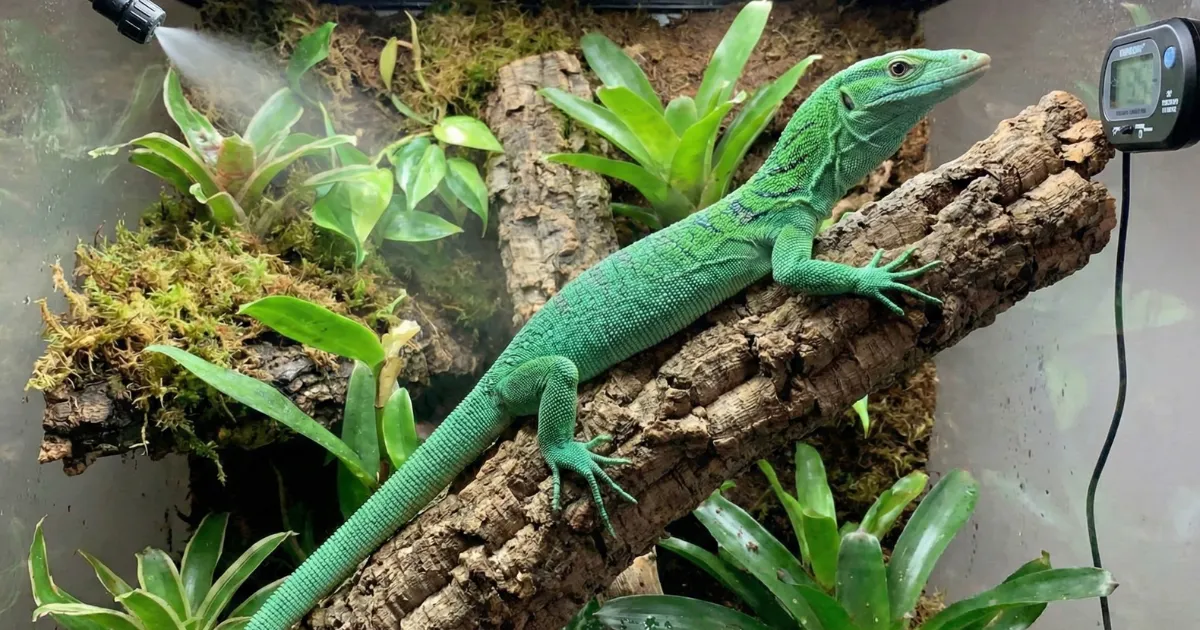
In my many years admiring reptiles, I’ve found there are “pets,” and then there are “subjects of profound admiration.” The Green Tree Monitor falls firmly, and beautifully, into the latter category. The Green Tree Monitor (Varanus prasinus complex) is a small, arboreal lizard from New Guinea and surrounding islands. They are not a pet for handling; they are a stunning display animal, one of the most intelligent and challenging jewels in the entire reptile world.
Are Green Tree Monitors a suitable species for beginning reptile keepers?
The Green Tree Monitor is an expert level species that requires a massive investment in time and high end equipment. Specifically, their extreme sensitivity to environmental fluctuations makes them unforgiving of any beginner mistakes. Furthermore, they are prone to fatal respiratory infections if the humidity and airflow balance is incorrect. Consequently, I reject the assumption that these are manageable “starter” pets for the average person. Therefore, only those with years of monitor experience should attempt to house this brilliant but delicate lizard. In fact, foundational errors in their early care lead directly to chronic stress and premature mortality.
What are the realistic growth and longevity expectations for Green Tree Monitors?
A Green Tree Monitor represents a fifteen to twenty-year commitment to a slender and highly athletic arboreal predator. Specifically, adults reach a total length of approximately three feet, though the tail accounts for two-thirds of that measurement. Furthermore, their lightweight build allows them to navigate thin branches that would break under heavier monitor species. Consequently, you must prepare for a pet that remains exceptionally active and visible throughout its long life. Therefore, I prioritize the “brutal honesty” of their longevity over their initial aesthetic appeal as small hatchlings. As a result, providing a stable environment from the start is critical for their health.
Why is the “Vertical Rainforest” the only ethical housing option?
Housing a Green Tree Monitor requires a sophisticated vertical environment that replicates the density of the New Guinea canopy. Specifically, the absolute minimum height for an adult is five to six feet to allow for natural climbing. Furthermore, you must fill the enclosure with a complex network of branches, vines, and live tropical foliage. Consequently, a lack of environmental complexity leads directly to psychological stress and lethargy. Therefore, I recommend the use of PVC or sealed wood vivariums to trap the required humidity effectively. In fact, a “cluttered” tank is a happy tank for this specific shy genus.
How do you manage the heat gradient and lighting for Green Tree Monitors?
The Green Tree Monitor requires an intense thermal landscape to support its rapid metabolism and diurnal activity cycles. Specifically, the basking spot must reach a surface temperature of 125°F to 135°F to allow for proper thermoregulation. Furthermore, the use of a high-output T5 UVB tube is mandatory to prevent the development of Metabolic Bone Disease. Consequently, you must provide a “basking shelf” near the heat source to allow the animal to soak up radiation safely. Therefore, I recommend overhead halogen clusters to replicate the sun’s natural spectrum. As a result, your monitor can choose the exact temperature it needs.
Why is humidity the most delicate and critical aspect of their care?
Maintaining a consistent humidity level between 70% and 90% is the single greatest challenge for any Green Tree Monitor keeper. Specifically, low humidity leads directly to dehydration and stuck shed, while stagnant air causes fatal respiratory infections. Furthermore, the enclosure must have enough ventilation to allow air to cycle without losing all the critical moisture. Consequently, the use of automated misting systems is the only reliable way to manage this delicate balance. Therefore, I prioritize the monitoring of hygrometers at various heights in the tank. In fact, a dehydrated monitor will quickly lose its vibrant color and appetite.
What is a scientifically balanced diet for Green Tree Monitors?
The Green Tree Monitor is primarily an insectivore that requires a diverse diet of gut-loaded, high-calcium invertebrates. Specifically, you should provide a rotation of dubia roaches, crickets, and large grasshoppers to maintain their lean body condition. Furthermore, a diet consisting only of rodents is far too high in fat and will cause fatty liver disease. Consequently, mice should only serve as a very rare treat for gravid females or as an occasional winter supplement. Therefore, I recommend dusting all feeder insects with high-quality calcium and multivitamin powders. In fact, a healthy monitor is one that stays active and hungry for its prey.
Why is the “Hands-Off” rule non-negotiable for this high-strung species?
Keeping a Green Tree Monitor is an observational hobby rather than a hands on experience for the animal and owner. Specifically, their natural instinct is to view any reaching hand as a threat from a large forest predator. Furthermore, forcing physical interaction causes spikes in cortisol levels that can lead to a suppressed immune system. Consequently, handling should be kept to the absolute minimum required for health checks or moving the animal. Therefore, I prioritize the use of long tongs for feeding to build a bridge of trust without contact. As a result, you ensure a safe and stress-free environment for your lizard.
Green Tree Monitors Care FAQ
Green Tree Monitors are strictly expert-only reptiles that punish beginner mistakes with rapid mortality. Their delicate humidity balance, fatal sensitivity to stagnant air, and high-strung temperament eliminate any margin for error. Years of monitor lizard experience must precede any attempt to keep this arboreal species successfully.
Green Tree Monitors reach roughly 3 feet in total length with a slender, lightweight build. Their tail accounts for two-thirds of that measurement, leaving a small, agile body. This compact size allows them to navigate thin canopy branches that would snap under heavier monitor relatives.
Green Tree Monitors live 15 to 20 years in expert captivity with stable humidity and proper diet. Wild specimens often live shorter lives due to predation pressures in the New Guinea canopy. Captives subjected to humidity crashes or chronic handling stress rarely survive past their fifth birthday.
Green Tree Monitors should never be handled for entertainment because forced contact spikes cortisol and suppresses immunity. Reaching hands trigger predator responses hardwired into their canopy ecology. Brief health checks and enclosure transfers represent the only justifiable handling, and long tongs should manage all feeding interactions.
Green Tree Monitors eat primarily gut-loaded insects including dubia roaches, crickets, and large grasshoppers. Calcium and multivitamin dusting must accompany every feeding to maintain bone density. Rodents cause fatty liver disease in this insectivorous species, qualifying as rare treats only for gravid females or winter supplementation.
Green Tree Monitors require consistent humidity between 70% and 90% with active airflow to prevent stagnation. Stagnant humid air causes fatal respiratory infections faster than dry conditions in this species. Automated misting systems combined with multiple hygrometers represent the only reliable way to maintain the delicate balance.
A captive bred Green Tree Monitor costs $2,000 to $5,000, with locality-specific specimens reaching the upper end. Custom vertical vivariums, automated misting, halogen clusters, and T5 UVB add another $3,000 to $6,000 to setup costs. The species ranks among the most expensive monitors to acquire and house properly.
Sources
- Marwell Zoo
https://www.marwell.org.uk/animals/emerald-tree-monitor/ - Reptiles Magazine
https://reptilesmagazine.com/emerald-tree-monitor-care-and-breeding/ - Animal Diversity Web
https://animaldiversity.org/accounts/Varanus_prasinus/ - ReptiFiles
https://reptifiles.com/green-tree-monitor-care-sheet/


Leave a Reply
You must be logged in to post a comment.