

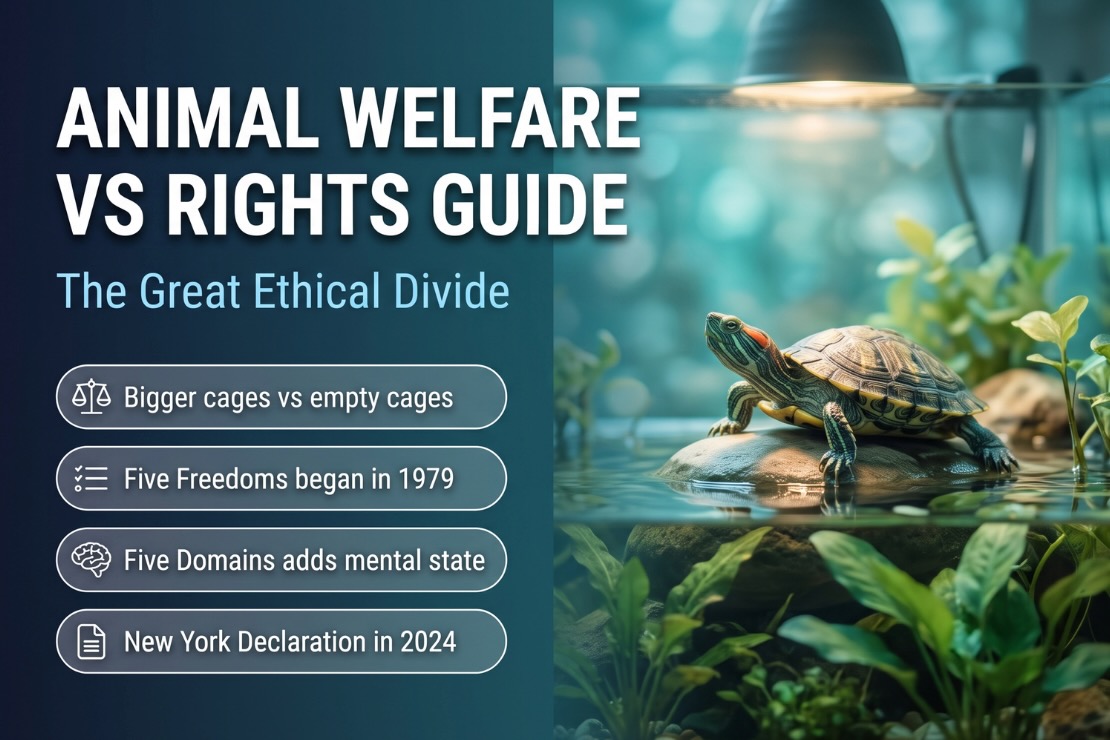
Animal welfare vs rights sounds like one debate wearing two name tags. In reality, the terms point toward opposite destinations. One view accepts that humans use animals and asks for kind treatment. The other argues that certain uses are simply wrong. Furthermore, modern science on animal minds has shifted the ground beneath both camps. This guide breaks down each idea and the evidence behind it. Better yet, it shows how to act on both from your living room.
Animal Welfare vs Rights: Where Does the Confusion Begin?
Why do people mix these two terms up so often?
Both movements care deeply about animals, so the labels blur in everyday talk. However, they answer very different questions. Welfare asks, “How should we treat the animals we use?” Rights asks, “Should we use animals at all?” That single distinction drives everything else. Consequently, a person can back strong welfare laws yet reject animal rights entirely. In fact, many farmers, vets, and pet keepers sit exactly there. Understanding the split saves you from arguing with someone who already agrees with you.
What Does Animal Welfare Really Mean?
What exactly does animal welfare set out to protect?
Animal welfare focuses on an animal’s quality of life under human care. The approach accepts farming, pet keeping, research, and zoos as legitimate. In exchange, it demands humane treatment, good health, and freedom from needless suffering. Welfare is therefore reformist rather than abolitionist. Specifically, it improves the system instead of dismantling it. In practice, that means better housing, veterinary care, and enrichment. Modern welfare science also measures welfare, rather than guessing at it. Researchers track cortisol levels, body condition, and natural behaviour as concrete indicators. As a result, “good welfare” now rests on evidence, not sentiment.
Which Five Freedoms Shaped Early Welfare Standards?
Where did formal welfare standards actually come from?
The story starts with Ruth Harrison’s 1964 book, Animal Machines. Her exposé of intensive farming shocked the British public. Consequently, the government commissioned the 1965 Brambell Report. That report insisted animals need room to turn, groom, stretch, stand, and lie down. The Farm Animal Welfare Council then codified these ideas as the Five Freedoms in 1979. Specifically, the freedoms cover hunger and thirst, discomfort, and pain, injury, or disease. They also include freedom to express normal behaviour and freedom from fear and distress. As a result, bodies like the World Organisation for Animal Health and the RSPCA adopted them worldwide. Indeed, the Five Freedoms still anchor welfare law and farm audits today. However, critics note one clear limit. The freedoms describe what animals should not suffer, not what they should enjoy.
How Did the Five Domains Model Advance Welfare?
Did welfare science stop at the Five Freedoms?
Not at all, because the Freedoms only describe the absence of bad states. Professor David Mellor and Dr Cam Reid proposed the Five Domains Model in 1994. They extended it in 2015 and updated it again in 2020. The framework maps four physical domains: nutrition, environment, health, and behavioural interactions. These four then feed into a fifth domain, the animal’s mental state. Crucially, the model rewards positive experiences, not just the removal of negative ones. In fact, a neutral life free of pain no longer counts as good welfare. Instead, animals should feel comfort, curiosity, and even play. The 2020 update added another layer. Specifically, it examines how human behaviour, including yours, shapes an animal’s daily experience. Therefore, the model now guides zoos, shelters, and home keepers alike.
What Do Animal Rights Actually Demand?
What does the animal rights position ask us to do differently?
Animal rights holds that animals possess inherent moral status. That status, the argument goes, cannot be overridden by human use. From this view, even humane slaughter or a comfortable cage still wrongs the animal. Rights theorists therefore reject using animals as mere resources. Above all, they seek the abolition of use, not the reform of use. Consequently, the movement targets farming, experimentation, and entertainment at the root. The core claim is philosophical, not scientific. However, sentience research increasingly informs how far that moral circle should stretch.
Who Built the Modern Animal Rights Argument?
Where did this philosophy gain its intellectual muscle?
Two thinkers dominate the conversation, and they disagree about method. Peter Singer’s 1975 book, Animal Liberation, took a utilitarian route. He argued that sentience, the capacity to suffer, earns equal consideration of interests. Singer also popularised “speciesism” to describe bias against other species. Notably, he is a utilitarian, not strictly a rights theorist. Tom Regan built the true rights-based case instead. His 1983 book, The Case for Animal Rights, introduced the “subject-of-a-life”. Any such subject, Regan argued, holds inherent value and therefore rights. His demand was blunt: empty cages, not bigger cages. As a result, these two frameworks still shape every serious debate today.
Animal Welfare vs Rights: What Truly Divides the Two?

So what is the single cleanest way to tell them apart?
The divide comes down to bigger cages versus empty cages. Welfare wants the cage improved. Rights wants the cage gone. Meanwhile, welfare treats suffering as the problem to minimise. Rights treats use itself as the problem to abolish. Therefore, a welfare advocate might campaign for cage-free eggs. A rights advocate would reject egg farming altogether. Both reduce harm, yet they aim at very different endpoints. Understanding this helps you match your actions to your values.
Animal Welfare vs Rights: What Does the Science Reveal?
Does evidence actually support treating animals as feeling beings?
Modern research increasingly says yes, and that finding strengthens both camps. Sentience means the capacity for subjective experience, such as pain, pleasure, and fear. Scientists call this phenomenal consciousness. Importantly, it does not require language or human-style reasoning. Instead, it rests on shared brain structures and observable behaviour. For example, fish show stress responses that painkillers reduce. Furthermore, the absence of a neocortex no longer rules consciousness out. The 2012 Cambridge Declaration on Consciousness made that point directly. Signed by leading neuroscientists, it affirmed conscious experience in mammals, birds, and even octopuses. The 2024 New York Declaration then pushed the boundary further still.
Animal Welfare vs Rights: Which Animals Are Conscious?
Which species does the current evidence actually cover?
The New York Declaration on Animal Consciousness launched on 19 April 2024. Jeff Sebo, Kristin Andrews, and Jonathan Birch led the effort. Forty scientists and philosophers signed it at the start. The statement reports strong scientific support for consciousness in mammals and birds. Furthermore, it finds a realistic possibility of consciousness across all vertebrates. That group includes reptiles, amphibians, and fish. The possibility extends to many invertebrates too, such as octopuses, crabs, and insects. Crucially, the declaration adds one practical rule. When conscious experience is a realistic possibility, ignoring it is irresponsible. In short, certainty is not required before we act with care.
Does the Law Recognize Animal Sentience?
Has any of this science reached actual legislation?
Increasingly, it has. New Zealand formally recognised animal sentience in law in 2015. Several South American nations acted around the same period. Specifically, Chile, Peru, and Colombia enshrined sentience through the 2000s and 2010s. Tanzania and every European Union country also recognise it. The United Kingdom followed with its Animal Welfare (Sentience) Act in 2022. As a result, sentience now sits inside real legal frameworks, not just philosophy papers. This matters because law converts moral claims into enforceable duties. However, recognition still varies widely between regions. In fact, enforcement often lags far behind the written wording.
Animal Welfare vs Rights: How Can You Help From Home?
Can an ordinary person contribute without a farm, a lab, or a law degree?
Absolutely, and the ladder of options starts remarkably low. Some actions support welfare by improving how used animals live. Others support rights by cutting demand for animal use. In practice, you can climb this ladder at whatever height fits your life. The effort ranges from a single tap to a lasting lifestyle change. Therefore, no one is too busy to make some difference.
Animal Welfare vs Rights: Can Sharing Really Help?
Does clicking a button truly move the needle for animals?
Modestly, yes, and it is the easiest rung on the ladder. Viewing, liking, commenting on, and sharing credible care content boosts its reach. Algorithms reward engagement, so each interaction spreads accurate information further. Writing about the topic goes one step further. For instance, a short caption, review, or blog post counters misinformation. In fact, misinformation causes real harm, from wrong diets to unsafe enclosures. Consequently, sharing good sources is a small act with outsized value. In short, attention is a resource, and you give it away anyway.
Which Everyday Choices Support Animals Most?

What higher-impact actions can you take once sharing feels too small?
Start with the animals already in your care. Apply the Five Domains model by adding enrichment, space, and natural behaviour. Next, adopt from shelters or rescues instead of impulse buying. Furthermore, thoughtful shopping reduces demand for cruelty. You might choose certified-humane products or cut back on animal products. You could also avoid unsustainable wild-caught species. Reporting cruelty, donating to reputable groups, and volunteering all raise your impact. Ultimately, supporting sentience-based legislation turns private values into public protection.
What Have My Animals Taught Me About Animal Welfare vs Rights?
For me, it lives inside every enclosure I maintain. My red-eared sliders, Mike and Frida, taught me the Five Domains in real time. Clean water and correct food cover only the functional basics. However, their behaviour changed sharply once I added basking space and depth. Frida, the larger of the pair, immediately claimed the best basking spot. Cosmo, my chameleon, showed me the same lesson from a reptile’s angle. A technically “adequate” enclosure is not the same as a thriving one. In fact, watching an animal choose to explore tells me more than any checklist. My honest position sits on the welfare side of the line. I keep animals, so I owe them the richest life I can build. Meanwhile, the sentience research keeps raising my personal standard for “enough”. That tension, I think, is exactly where responsible keeping belongs.
Your Questions Answered
This topic carries real ethical complexity, and readers often confuse the two positions. These answers clear up the most common myths, so you can form your own view.
Welfare accepts that humans use animals and demands humane treatment during that use. Rights argues that using animals is wrong, however kindly it happens. The simplest shorthand is bigger cages versus empty cages. Both reduce harm, yet they aim at opposite endpoints.
Yes, because both positions raise your standard of care. Welfare thinking pushes you toward enrichment, space, and positive experiences. Rights thinking asks you to question breeding and trade practices. Either way, your animals benefit from more thoughtful daily choices.
Not strictly, despite the common label. Singer is a utilitarian who judges actions by their effects. Tom Regan built the true rights-based case, grounded in inherent value. People often blur the two, yet their reasoning differs sharply.
Research strongly supports conscious experience in mammals and birds. The 2024 New York Declaration also found a realistic possibility elsewhere. That includes reptiles, amphibians, fish, and many invertebrates. Where sentience is realistically possible, ignoring it becomes irresponsible.
Yes, modestly and easily. Liking, commenting, and sharing accurate care content widens its reach. Writing your own posts spreads good practice and counters myths. It costs nothing, so it is the lowest-effort way to help.
New Zealand recognised sentience in law in 2015. Chile, Colombia, Peru, Tanzania, and every EU country followed over time. The United Kingdom passed its Sentience Act in 2022. Recognition still varies globally, and enforcement often trails the law.
Sources
- New York University
https://sites.google.com/nyu.edu/nydeclaration/declaration - New York University
https://sites.google.com/nyu.edu/nydeclaration/background - RSPCA Knowledgebase
https://kb.rspca.org.au/categories/about-animal-welfare/what-are-the-five-freedoms-of-animal-welfare - RSPCA Knowledgebase
https://kb.rspca.org.au/knowledge-base/what-are-the-five-domains-of-animal-welfare/ - Wikipedia
https://en.wikipedia.org/wiki/Five_Freedoms - Four Paws
https://www.four-paws.be/our-stories/eu-blog-news/the-five-domains-model-in-eu-animal-welfare-legislation - Frontiers in Animal Science
https://www.frontiersin.org/journals/animal-science/articles/10.3389/fanim.2023.1042733/full
Humanities LibreTexts
https://human.libretexts.org/Courses/Folsom_Lake_College/PHIL_310:_Introduction_to_Ethics_(Bauer)/02:_Compare_and_contrast_a_variety_of_ethical_theories_with_respect_to_specific_ethical_issues/2.05:_Animal_Rights_(Eduardo_Salazar)/2.5.05:_Modern_Animal_Rights-_Singer_and_Regan - Francis Crick Memorial Conference
https://fcmconference.org/img/CambridgeDeclarationOnConsciousness.pdf
Leave a Reply
You must be logged in to post a comment.